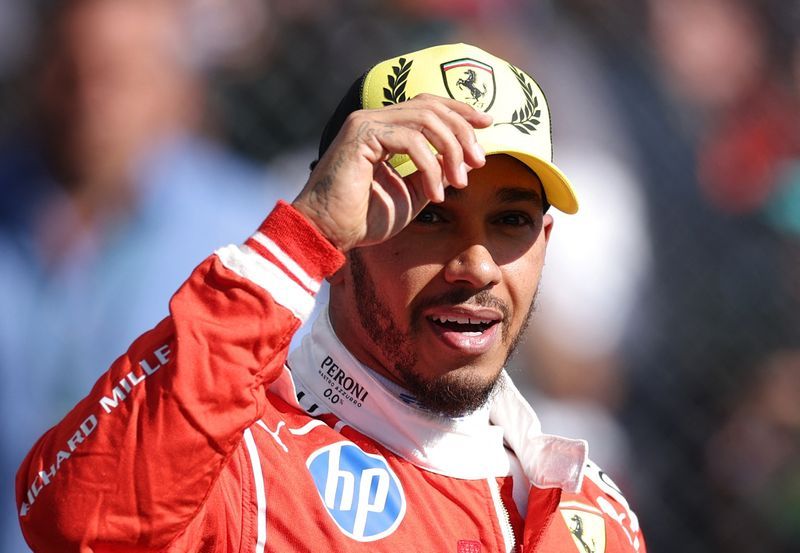
Lewis Hamilton arrives at the Hungaroring this weekend with the prospect of a morale-boosting victory before Formula One's August shutdown, while his Mercedes employers face an uncomfortable reckoning over their championship-leading driver George Russell's dramatic loss of form. The contrast between the two British drivers has become the paddock's dominant talking point, with Russell's car mysteriously shedding considerable time along the straights and now sitting 50 points behind championship leader Kimi Antonelli after his third non-scoring result of the season at Spa last Sunday, where he spun into the gravel.
The unravelling of Russell's campaign has been particularly stark given his billing as the season's early favourite and a driver associated with consistency. His descent has been so pronounced that Hamilton has climbed back into second place overall, though still 45 points adrift of Antonelli. The Hungarian circuit presents an intriguing tableau for Ferrari's newest driver, who boasts an extraordinary record at Budapest. Hamilton has claimed eight victories at the Hungaroring throughout his career—a singular achievement at the venue that no other driver approaches—and stands within touching distance of his all-time Silverstone tally of nine wins at any single circuit.
Hamilton's success in Hungary extends beyond mere race victories. He claimed pole position at the Hungaroring as recently as 2023, establishing credentials that could prove decisive on a track where engine power and straight-line acceleration carry considerably less weight than elsewhere on the calendar. This structural advantage should theoretically benefit Ferrari, whose power unit disadvantage has plagued them at high-speed venues. Yet Ferrari team principal Fred Vasseur counselled caution, resisting the temptation to declare the pendulum swinging decisively in his team's favour despite evident optimism elsewhere in the paddock. Vasseur's measured tone reflected the reality that Budapest demands a fundamentally different approach, emphasising chassis setup and tyre management over raw horsepower.
Charles Leclerc has emerged as Ferrari's strongest performer during the recent European swing, securing victory at Silverstone and a second-place finish at Spa, whereas Hamilton demonstrated inconsistency with wins in Barcelona offset by fourth-place finishes in Britain and Belgium. The Italian manufacturer's prospects rest substantially on Leclerc's ascending trajectory, though Hamilton's Hungarian pedigree cannot be discounted. Ferrari faces the delicate task of maintaining momentum without falling into the psychological trap of assuming Budapest's characteristics automatically disadvantage their rivals, particularly given the unpredictability that has defined this season.
The Hungarian Grand Prix threatens to expand beyond a two-team contest, with Kimi Antonelli suggesting that Max Verstappen's Red Bull and the championship-defending McLaren team possess realistic ambitions despite their recent struggles. Antonelli's assessment carries particular weight given McLaren's anticipated arrival with substantial mechanical upgrades, including a revised floor and fresh aerodynamic components, alongside continued evaluation of an experimental rear wing configuration. The 19-year-old described Budapest's demands in analogous terms to Monaco, a circuit rewarding precision and racecraft over mechanical advantage—an observation that fundamentally reshapes the competitive calculus entering the weekend.
McLaren's strategic preparation underscores their determination to capitalise on the season's tactical fluidity. The British team will field Leonardo Fornaroli, last year's Formula Two champion and currently their reserve driver, for Friday's opening practice session while Oscar Piastri sits out, enabling the squad to extract additional data during the crucial setup phase. This logistical flexibility reflects McLaren's institutional approach to maximising competitive intelligence across a weekend where conventional hierarchies may be obscured by Budapest's technical characteristics.
Aston Martin joins the queue of teams implementing mechanical evolution, though their long-awaited chassis upgrade represents merely the first stage of their resurrection plan. The squad must await the Dutch Grand Prix in late August before receiving their latest Honda power unit, a decision that effectively writes off Hungary as a venue for evaluating their total package. The Silverstone-based outfit's predicament highlights the complex timeline governing technical development and the strategic calculus required to sequence upgrades across the season.
Historically, four of the current championship's leading seven drivers have tasted victory at the Hungaroring, with only the Mercedes pairing and Leclerc absent from that exclusive club. Last year's race delivered a McLaren one-two with Lando Norris triumphing ahead of Oscar Piastri from Charles Leclerc's pole position, a result demonstrating the venue's capacity to produce surprising hierarchies. This precedent reinforces Antonelli's contention that competitive sorting remains wide open, particularly on circuits where energy management plays a secondary role to mechanical precision and driver extraction.
The August break arrives at a moment of pronounced turbulence across Formula One's established power structures. Mercedes must urgently diagnose and rectify whatever mechanical or aerodynamic affliction has visited Russell, whilst Ferrari capitalises on Hamilton's appointment and the Hungaroring's characteristics to rebuild momentum. The weekend's outcome will substantially influence the season's narrative heading into the sport's traditional midsummer hiatus and suggest whether recent form represents genuine competitive shifts or temporary anomalies born of circuit-specific factors and driver error.

