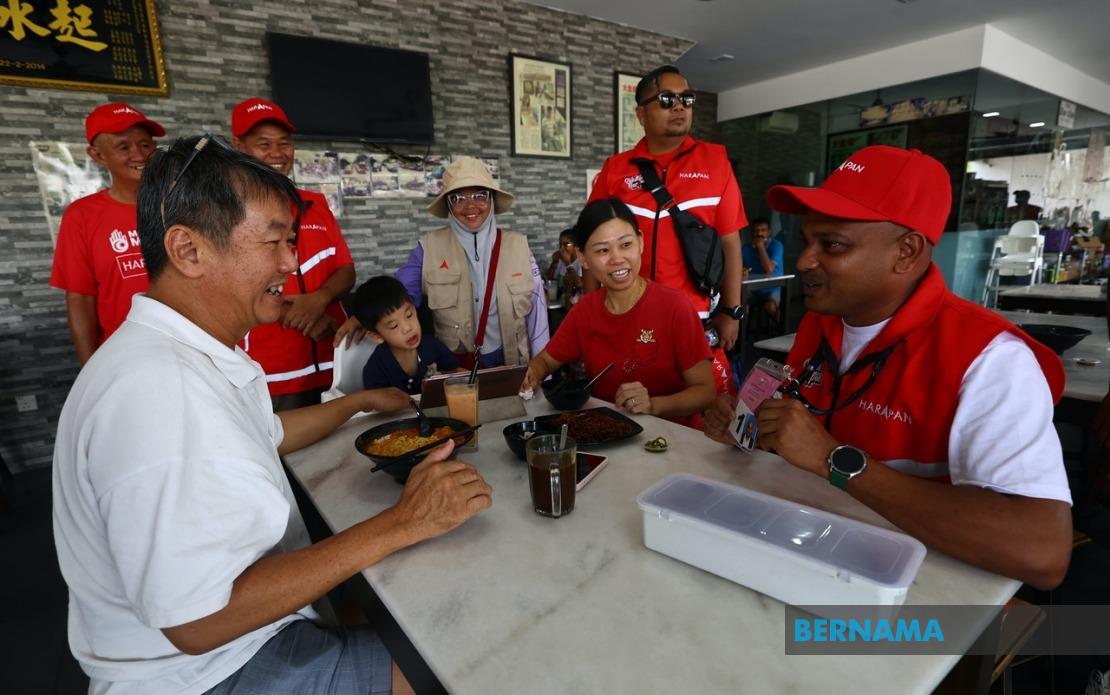
Pakatan Harapan candidate Guna Balakrishnan is entering the final week of campaigning in Layang-Layang with renewed urgency, determined to connect with the remaining fifth of the constituency's voters before the Johor state election on July 11. Speaking at the PH operations centre in Kluang, Balakrishnan acknowledged that his campaign machinery has already blanketed roughly four-fifths of the seat but recognises the critical importance of reaching every remaining household in these closing days. His commitment to maximum visibility reflects the competitive dynamics at play in this three-way contest, where every vote could prove decisive in a tightly contested race.
The candidate's resolve to elevate his campaign intensity underscores the competitive pressure facing Pakatan Harapan in Johor, a state that has been a traditional stronghold of Barisan Nasional. With the coalition seeking to consolidate gains and expand its footprint, Layang-Layang represents precisely the kind of competitive seat where ground operations and direct voter engagement determine outcomes. Balakrishnan's determination to boost his effort from what he characterises as current maximum capacity to an even higher level signals the stakes involved and the razor-thin margins often seen in Malaysian state elections.
The core of Balakrishnan's campaign pitch centres on demonstrating Pakatan Harapan's capacity to deliver tangible governance improvements. He has positioned the coalition's national track record as evidence of its ability to effect meaningful change, particularly in areas of economic management and policy delivery. For voters in Layang-Layang, many of whom grapple with local infrastructure challenges and service delivery gaps, this message attempts to bridge national political narratives with concrete constituency-level concerns.
The manifesto unveiled by Balakrishnan reflects a comprehensive approach to addressing local grievances that resonate with residents across Malaysia's smaller towns and suburban constituencies. Flood mitigation stands foremost, a recurring concern in constituencies across the peninsula where seasonal flooding disrupts livelihoods and threatens homes. Coupled with pledges to upgrade road networks and expand street lighting, these proposals target fundamental infrastructure deficits that voters directly experience. The emphasis on digital connectivity addresses a distinctly contemporary challenge, particularly acute in less urbanised areas where internet reliability remains inconsistent and limits economic opportunities for small businesses and remote workers.
Human capital development features prominently in Balakrishnan's platform, reflecting broader concerns about youth employment and economic participation across Southeast Asia. His commitment to expanding Technical and Vocational Education and Training opportunities directly addresses Malaysia's skills gap and the mismatch between educational pathways and employment market demands. The inclusion of women's entrepreneurship support signals recognition of gender-specific economic barriers and the potential for small enterprise development as a wealth creation mechanism at the grassroots level. These initiatives suggest a developmentally-oriented approach rather than purely redistributive politics.
The proposal to establish a senior citizen activity centre demonstrates an often-overlooked dimension of electoral politics in Malaysia: support for ageing populations and social inclusion across demographic groups. This pledge appeals to voters with elderly parents and reflects demographic realities in constituencies where extended families remain economically and socially intertwined. The initiative positions Balakrishnan as attentive to welfare concerns across the lifespan, not merely targeting working-age voters or families with young children.
Local feedback captured in the campaign narrative provides insight into which messaging resonates most effectively. Tan Ah Kiat's endorsement highlights the salience of infrastructure and flood management, issues that directly affect commercial viability for traders and smallholders. His particular appreciation for the internet connectivity commitment reflects economic anxieties in secondary towns, where digital divides create competitive disadvantages against more connected urban centres. Kalaiselvan's emphasis on inclusive long-term vision and cross-generational welfare suggests that voters respond positively when candidates articulate policies benefiting multiple constituencies simultaneously rather than pursuing narrow demographic targeting.
The Layang-Layang contest itself involves three distinct political camps, each representing different visions of governance and coalition politics. The incumbent, Abd Mutalip Abd Rahim, carries the weight of Perikatan Nasional's performance and brand, while Barisan Nasional's Chua Jian Boon represents Malaysia's longest-serving coalition. Balakrishnan's Pakatan Harapan candidacy thus represents a genuine choice between competing political orientations, not merely personalised competition. This triangular dynamic means that vote fragmentation becomes a critical consideration, with Balakrishnan needing to build a sufficiently broad coalition of support across different voter demographics and political traditions.
The constituency's electoral geography encompasses 25,181 registered voters distributed across what appears to be a mixed urban-rural profile. This composition suggests a voter base neither entirely traditional nor fully urbanised, likely including settled agricultural communities, small traders, semi-industrial workers, and service sector employees. Such constituencies often prove most volatile in Malaysian politics, responsive to local service delivery performance and community-oriented political messaging rather than ideological positioning alone. Balakrishnan's manifesto appears calibrated to this reality, prioritising tangible improvements and service expansion.
As Malaysia's federal political dynamics continue to evolve, state-level contests in Johor carry implications beyond local governance. The state's political trajectory influences national coalition stability and electoral momentum. Johor has traditionally served as a barometer of broader Malay-Muslim voter sentiment, making performance in seats like Layang-Layang potentially significant for understanding shifts in voter behaviour across the peninsula. Success here would validate Pakatan Harapan's approach to competitive state politics and demonstrate its capacity to win in traditionally challenging territory.
The campaign's final five days before the July 11 election represent the most intense phase of voter contact and persuasion. Early voting scheduled for July 7 will remove a portion of the electorate from the active campaign environment, making the remaining time even more precious. Balakrishnan's push to maximise constituency coverage reflects standard campaign mathematics: in close contests, the difference between winning and losing often amounts to small numbers of persuadable voters whose minds are made up in the campaign's closing phase.
For Malaysian observers tracking the evolution of state-level competition, the Layang-Layang contest exemplifies contemporary political dynamics where multiple coalitions genuinely compete in most seats, where local manifestos address specific constituency concerns, and where ground operations and voter engagement remain fundamentally important despite media saturation. The substantive focus on flood management, internet connectivity, skills development, and senior citizen welfare suggests that Malaysian voters increasingly expect candidates to articulate concrete policy positions rather than rely primarily on personality or party loyalty.

