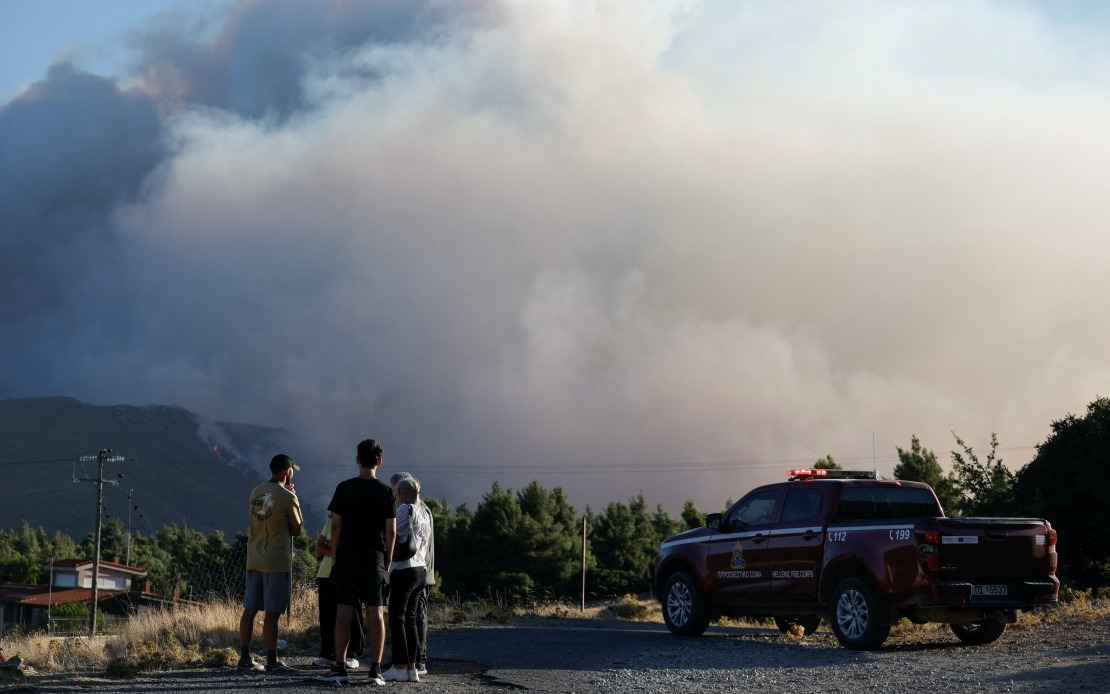
Greece is grappling with an escalating wildfire crisis as massive blazes continue to consume vast areas west of the capital, with emergency crews working around the clock to prevent flames from reaching inhabited areas. The primary fire burning through the Kithairon Mountains has mobilized an unprecedented response, drawing hundreds of firefighters from multiple nations and requiring constant reinforcement by military assets and civilian volunteers throughout the ongoing operation.
The scale of the response underscores the severity of the threat posed by the advancing flames. At least 500 firefighters have been deployed to combat the main fire, including specialized teams sent from Romania and France to assist Greek authorities. Throughout Sunday night, emergency responders maintained their defensive positions in the mountainous terrain, supported by heavy machinery and military vehicles positioned to protect critical infrastructure and residential zones. As dawn broke, the aerial component of the firefighting strategy resumed, with planes and helicopters resuming water-bombing operations over the affected terrain.
Wind conditions have dramatically accelerated the fire's progression, with gusts pushing flames eastward at unpredictable speeds and making containment efforts increasingly difficult. The communities of Veniza and Psatha have borne the brunt of the destruction so far, with residents in numerous settlements ordered to evacuate as a precautionary measure. The fire now stands only a few kilometres from Megara, a significant population centre situated approximately 50 kilometres west of Athens, raising concerns about potential civilian impact if current suppression efforts fail to halt the advancing flames.
The situation extends beyond the Athens region, with a second major fire currently burning on the island of Cephalonia in the Ionian Sea, though authorities have indicated that immediate danger to populated areas there remains limited. Meanwhile, wildfire activity on the island of Crete has largely subsided following intense overnight firefighting efforts, though not before inflicting substantial damage on local communities. Official reports indicate that multiple towns on Crete were evacuated during the height of the crisis, and media outlets have documented the destruction of approximately 200 residential structures, though government agencies have not yet formally confirmed this casualty figure.
The geographical extent of destruction is staggering, with meteorological experts estimating that roughly 10,000 hectares of vegetation and agricultural land have been consumed in the northwestern and western regions surrounding Athens. This represents a critical loss of ecological habitat and agricultural productivity in an already economically stressed region, with implications extending beyond immediate fire suppression to long-term environmental recovery and community rebuilding efforts.
Law enforcement agencies have begun investigating the origins of the fires, with authorities announcing that 13 individuals have been arrested nationwide on charges related to negligent arson. These arrests suggest that some of the fires may not be entirely natural in origin, pointing to human negligence or deliberate action as contributing factors to the current disaster. The investigation into fire causation will likely become increasingly important as authorities seek to prevent similar incidents and hold responsible parties accountable for the extensive damages caused.
For Malaysian and Southeast Asian observers, Greece's wildfire crisis offers sobering lessons regarding climate resilience and disaster preparedness at both national and regional levels. The rapid spread of fires despite the deployment of massive resources highlights vulnerabilities in existing emergency response infrastructure, even in developed European nations with significant technological and financial capacity. The involvement of international cooperation through firefighter deployments from Romania and France demonstrates the transnational nature of modern environmental crises, where neighboring countries must coordinate response efforts across borders to address large-scale natural disasters.
The situation also reflects broader patterns of climate change impacts across the Mediterranean region, where rising temperatures and altered precipitation patterns are creating conditions conducive to more frequent and intense wildfire seasons. For Southeast Asian nations already vulnerable to various environmental hazards, including transboundary haze from forest and peatland fires, the Greek experience underscores the importance of investing in early warning systems, international cooperation frameworks, and community-based disaster preparedness initiatives. The ability to mobilize substantial resources quickly and coordinate across multiple agencies and international partners represents a model, albeit an imperfect one, that developing nations should study and adapt to their own contexts.
The Greek government faces not only the immediate challenge of extinguishing the current fires but also the longer-term responsibilities of investigating root causes, supporting affected communities in reconstruction, and implementing prevention strategies to minimize future risk. For a nation where tourism and agriculture represent significant economic sectors, the cumulative impact of such environmental disasters carries implications extending well beyond environmental damage to broader economic and social stability. Regional policymakers across Southeast Asia should monitor Greece's recovery and response strategies as potential templates for strengthening their own disaster management capabilities in an era of increasingly volatile climate patterns.

