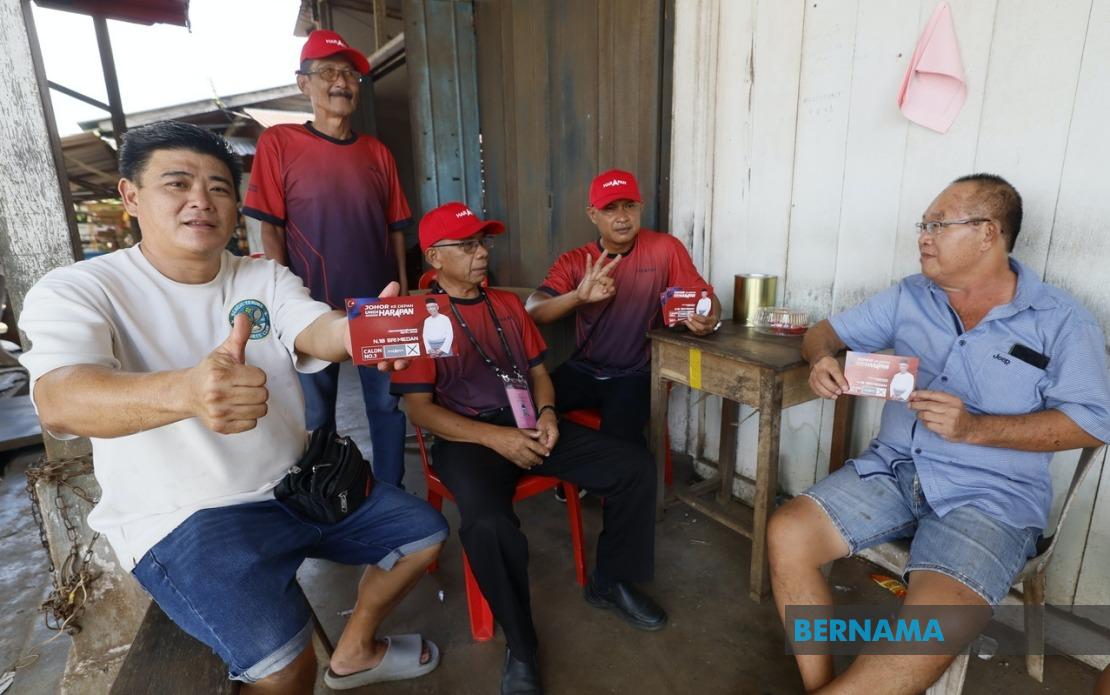
The Pakatan Harapan campaign machinery in the 16th Johor State Election has introduced a seasoned community organiser to contest what many political analysts regard as a stronghold of the ruling Barisan Nasional coalition. Hishamudin @ Misrin Ishak, the PH candidate for the Sri Medan seat, has embarked on ground-level engagement with voters in Batu Pahat, approaching constituents with a methodical focus on listening before pledging action. Known locally as "Cikgu Misrin" due to his background as a mathematics educator, his campaign strategy diverges markedly from conventional political messaging, instead grounding itself in the accumulated experience of village administration and community problem-solving.
The candidate's overarching philosophy reflects what he terms a "work first, talk later" ethos, a deliberate pivot away from expansive promises that characterise many electoral contests. Rather than offering headline-grabbing development schemes, Hishamudin has identified specific grievances that have festered within his constituency, most notably the recurring flooding episodes that have disrupted residents' livelihoods and safety. This issue, which has periodically dominated local discourse without resolution across multiple election cycles, figures prominently in his platform as both a practical and symbolic commitment to addressing long-neglected infrastructure gaps. The focus on such tangible problems reflects an understanding that suburban constituencies in Johor often feel overlooked by state-level policymaking when their concerns do not align with urban development priorities.
Hishamudin's background in education and village administration shapes his vision for balanced development that extends beyond the commercial corridors of urban Johor. He has committed to ensuring that infrastructure investment reaches semi-urban and rural pockets within Sri Medan, an approach that acknowledges the geographical diversity and often competing needs within single electoral districts in Malaysia's states. This inclusive framing carries particular resonance in constituencies where populations span prosperous town centres and more economically marginal surrounding areas, creating tension between fast-paced commercial development and the welfare of residents in less-trafficked zones.
The candidate has placed youth advancement at the centre of his economic vision, recognising the structural challenge of brain drain that affects many Johor constituencies. By proposing expanded access to Technical and Vocational Education and Training (TVET) programmes, Hishamudin addresses a critical gap in Malaysia's education ecosystem, where university-track pathways often overshadow skilled trades despite strong labour market demand. His commitment to digitalising educational exposure taps into the broader national imperative to upskill the workforce for an increasingly technology-dependent economy, a concern that resonates across Southeast Asia as automation reshapes employment landscapes.
Small and medium enterprises represent another strategic focus within his platform, with particular emphasis on breaking local businesses' dependence on domestic demand alone. This approach reflects awareness of how SMEs form the backbone of suburban economies yet frequently lack the institutional support and market access that larger corporations command. By positioning himself as an advocate for expanding these enterprises into broader markets, Hishamudin tacitly acknowledges the structural inequalities within Malaysia's business landscape and proposes targeted intervention to level the playing field. Such pledges carry weight in constituencies where petty traders, hawkers, and family-run shops form a significant voter base.
During his walkabout through Pekan Kangkar Senangar on the third day of campaigning, Hishamudin has maintained consistent messaging around welfare provision and quality service delivery, emphasising that his vision does not entail grandiose development projects but rather sustained improvements in the practical amenities that shape daily life. This calibrated approach—neither overpromising luxury nor suggesting stagnation—reflects realistic assessment of what a state assemblyman can realistically deliver within the constraints of state budgets and federal funding allocations. For constituents fatigued by electoral rhetoric disconnected from implementation capacity, such candour may carry persuasive force.
His prior experience as a village head positions him within a specific category of grassroots political operator whose legitimacy derives from accumulated community trust rather than party machinery or inherited political capital. This positioning carries strategic value within a Malaysian political context where decentralised administration and informal leadership networks retain considerable influence, particularly in constituencies where informal settlement governance predates formal municipal structures. The framing of village headship as "invaluable experience" signals recognition that state-level politics ultimately succeed or fail based on their ability to interface with deeply localised governance structures and community expectations.
The electoral landscape in Sri Medan encompasses a three-way contest that reflects contemporary Johor politics' fragmented competition. Hishamudin faces both the incumbent Barisan Nasional assemblyman Datuk Zulkurnain Kamisan and Perikatan Nasional candidate Ahmad Rosdi Bahari, a configuration that theoretically offers opposition voters two non-BN alternatives yet simultaneously splits anti-establishment votes. For Pakatan Harapan's strategic positioning, Sri Medan represents territory where the coalition contests traditional BN strongholds with a community-rooted candidate rather than a high-profile political personality, a calculated approach that acknowledges the uphill climb while emphasising authentic local representation.
The candidate's explicit acknowledgement that Sri Medan constitutes established Barisan Nasional territory demonstrates political realism alongside campaign optimism. Rather than glossing over structural disadvantage, Hishamudin presents himself as a fresh variable in a calcified electoral equation, banking on voter appetite for alternative representation and trusted local engagement over incumbent complacency. This messaging strategy particularly targets constituencies where BN's long tenure has bred perception of unresponsiveness or where development gains have accumulated unevenly across neighbourhoods.
With polling scheduled for July 11 and early voting on July 7, the campaign enters its final intensive phase. The receptive voter response that Hishamudin reports, coming despite the conventional wisdom surrounding BN dominance in Sri Medan, suggests that either genuine openness to opposition alternatives exists within the constituency or his grassroots approach generates sufficient personal support to overcome partisan headwinds. The outcome will likely hinge on whether such localised engagement momentum can translate into electoral performance sufficient to breach BN's structural advantages in voter registration, party machinery, and incumbency benefits.
Beyond the immediate contest, Hishamudin's campaign model offers broader implications for how Pakatan Harapan might compete in constituencies where it faces entrenched opposition. The emphasis on community service credentials, specific problem-solving capacity, and continuity with village-level governance represents a potential template for coalition campaigns in suburban and semi-urban Johor, areas where national political narratives often fail to penetrate but local administrative performance shapes voter calculation directly. The extent to which this approach generates electoral traction will inform opposition strategy across multiple upcoming contests in Malaysia's largest southern state.

