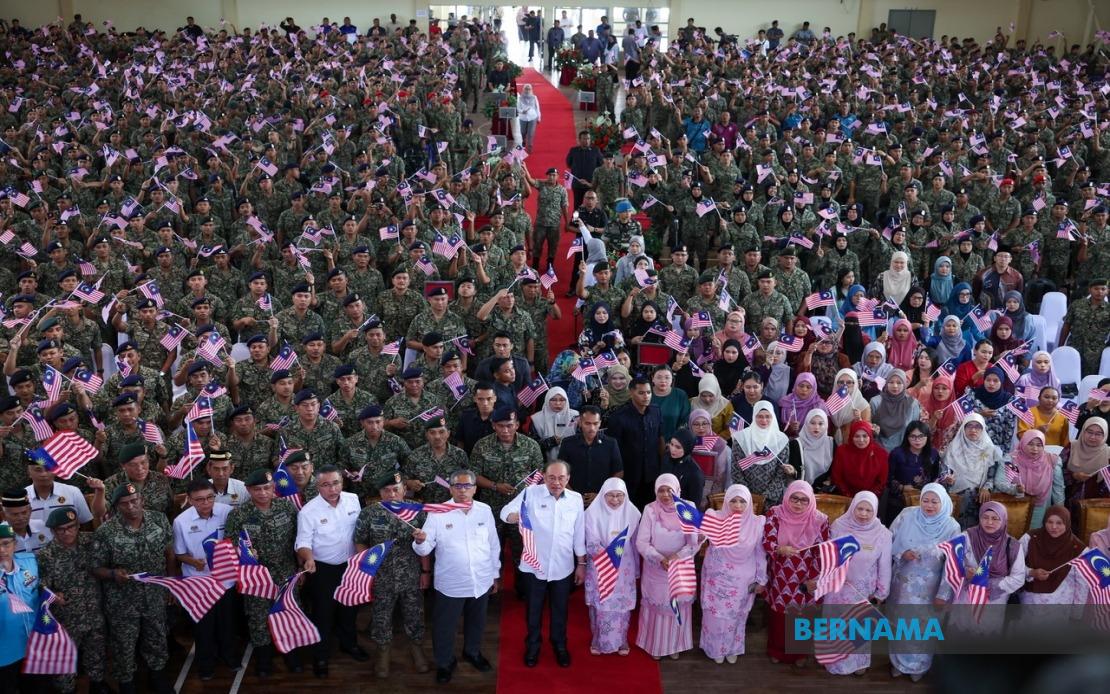
Prime Minister Datuk Seri Anwar Ibrahim has commissioned a comprehensive review of the promotion framework governing senior officers within the Malaysian Armed Forces, responding to observations that advancement through the ranks proceeds at a slower pace than comparable progression in other government sectors. Speaking in Tampin on July 27, Anwar emphasised that the government recognises the need to accelerate career pathways for military leadership to prevent talented personnel from experiencing unnecessary delays in their professional development and advancement opportunities.
The initiative addresses a structural concern within Malaysia's defence establishment: while the broader civil service, including security personnel, has already transitioned to the reformed Public Service Remuneration System (SSPA), the specific mechanisms governing promotion timelines for senior military ranks have not received equivalent modernisation. Anwar acknowledged this discrepancy directly, noting that the extended duration required for senior officer promotions within the armed forces contrasts markedly with advancement schedules across other government agencies, suggesting systemic inefficiencies that warrant immediate attention and remedial action.
The Prime Minister framed the review not merely as a technical administrative exercise but as a fundamental matter of institutional morale and equity. By explicitly stating that the armed forces must never feel abandoned or sidelined by government policy, Anwar signalled that accelerating military advancement carries symbolic weight beyond mere bureaucratic reorganisation. This framing reflects broader government messaging about prioritising defence sector personnel and ensuring that defence professionals receive treatment commensurate with their vital national security responsibilities.
Though the number of senior officers directly affected by prolonged promotion timelines remains relatively modest, Anwar emphasised that financial implications require careful evaluation before any systemic changes proceed. This cautious approach reflects the tension between addressing legitimate grievances within the defence establishment and maintaining fiscal responsibility across government spending. The government must balance competitive compensation and advancement incentives against budgetary constraints affecting other critical sectors and social programmes.
The review process has already progressed beyond preliminary discussion stages. Key stakeholders have been consulted, including Chief Secretary to the Government Tan Sri Shamsul Azri Abu Bakar, Deputy Defence Minister Adly Zahari, Chief of Defence Forces General Tan Sri Malek Razak Sulaiman, and Army Chief General Tan Sri Azhan Md Othman. Their presence at the announcement underscores both the seriousness with which the administration treats the matter and the multi-departmental coordination required to implement potential reforms effectively.
Anwar has committed to chairing a subsequent meeting to finalise recommendations emerging from the ongoing review process. This hands-on involvement by the Prime Minister suggests the government intends to resolve outstanding issues expeditiously rather than allowing the matter to languish within bureaucratic channels. The timeline for reaching concrete decisions appears compressed, with implementation potentially occurring within the near term, though no specific completion date has been publicly announced.
For Malaysia's defence sector, these developments carry significant implications. Senior military officers represent the institutional knowledge and leadership core of the armed forces. When career progression appears sluggish or inequitable relative to civilian counterparts, retention becomes problematic and recruitment of high-calibre personnel becomes more challenging. An accelerated, transparent promotion system could enhance morale across the officer corps and reinforce the government's rhetorical commitment to strengthening national defence capabilities.
The broader context within which this review occurs is significant for regional observers. As Southeast Asian nations grapple with evolving security challenges and the strategic importance of maintaining robust defence establishments, personnel retention and institutional morale assume heightened importance. Malaysia's willingness to systematically examine and reform military advancement mechanisms demonstrates governmental awareness that defence excellence depends fundamentally on attracting and retaining exceptional leadership talent.
The initiative also reflects contemporary civil service modernisation trends more broadly. The earlier adoption of the SSPA salary reforms created expectations throughout government that compensation and advancement terms would reflect modern personnel management principles. The armed forces review represents extension of that modernisation ethos into previously unreformed institutional corners, suggesting a comprehensive government approach to civil and military service reform.

