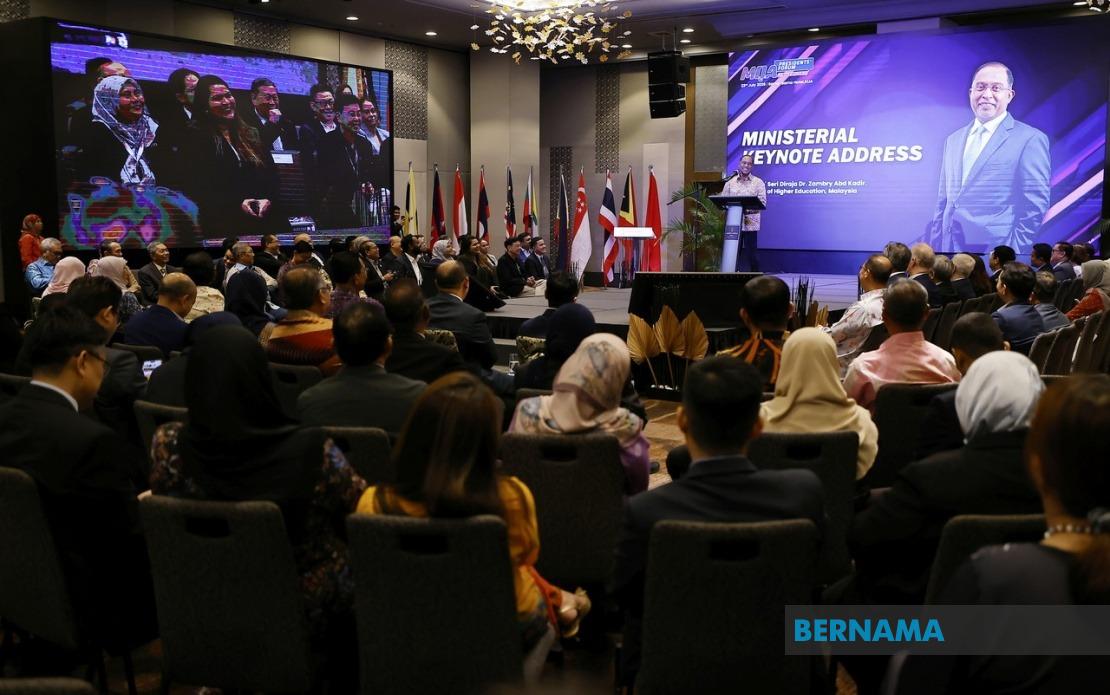
Higher Education Minister Datuk Seri Dr Zambry Abd Kadir has reiterated the government's unwavering commitment to protecting academic freedom and nurturing environments where intellectual inquiry flourishes across Malaysia's higher education sector. Speaking at a public lecture titled Muslim Identity in a Globalised World delivered by Columbia University's Prof Dr Joseph A. Massad at Putrajaya on July 23, Zambry underscored the crucial role universities play as platforms for the exchange of contrasting viewpoints conducted with rigour, courtesy and substantive reasoning.
The minister's remarks come at a time when Malaysian tertiary institutions increasingly engage with global scholars and grapple with complex societal questions. Universities, Zambry stressed, must function as sanctuaries where heterogeneous ideas receive fair hearing and scrutiny, enabling knowledge advancement through collaborative examination across geographical boundaries, academic disciplines and intellectual traditions. This framing positions universities not merely as repositories of established knowledge but as dynamic spaces where understanding evolves through principled contestation.
Zambry anchored his position in the recognition that academic freedom demands corresponding intellectual responsibility from those who exercise it. Rather than characterising freedom and accountability as opposing forces, he presented them as complementary imperatives. Scholars and students engaging in debate, he suggested, bear an obligation to marshal evidence, acknowledge legitimate counterarguments and maintain civility even when fundamental disagreements exist. This calibrated approach acknowledges both the necessity of unfettered inquiry and the risks of discourse conducted without epistemic rigour or ethical restraint.
Malaysia's distinctive demographic and cultural composition, Zambry argued, renders the cultivation of informed dialogue and reciprocal comprehension particularly vital. The nation's plural character—encompassing multiple religious traditions, ethnic communities and worldviews—means that universities operate within a context where competing narratives and frameworks remain perpetually present. Rather than suppressing such plurality, the minister proposed that scholarly engagement offers pathways toward deeper mutual understanding and the identification of common ground despite substantive philosophical divergences.
The minister acknowledged that disagreement represents an inescapable feature of contemporary intellectual life, a reality amplified by digital technologies and algorithmic information distribution. Social media platforms and artificial intelligence systems have fundamentally altered how ideas circulate, often accelerating polarisation and diminishing space for nuanced discussion. Against this backdrop, Zambry invoked Malaysia's historical tradition of accepting divergent perspectives whilst maintaining social cohesion—what he characterised through the maxim of agreeing to disagree. This cultural reference suggests that national stability need not depend on enforced consensus but can accommodate fundamental differences of opinion.
Zambry's framing carries particular resonance for Malaysian universities navigating scrutiny regarding the boundaries of permissible discourse. By positioning academic freedom as a core institutional value linked to national educational strategy, the ministry seeks to signal that intellectual openness aligns with rather than contradicts governmental objectives. The emphasis on responsibility and civility addresses concerns about unconstrained speech whilst maintaining that legitimate debate encompasses politically sensitive or religiously contested topics when approached through scholarly methods.
The Higher Education Ministry, Zambry announced, will persist in extending invitations to accomplished international scholars, viewing such engagement as essential infrastructure for advancing Malaysia's higher education ecosystem. This commitment reflects recognition that knowledge production occurs increasingly within transnational networks and that Malaysian institutions must participate actively in global academic conversations to maintain intellectual vitality and attract top talent. International scholarly exchange simultaneously exposes local academics and students to alternative perspectives and methodologies whilst positioning Malaysian universities within broader research and intellectual communities.
The public lecture itself illustrates this principle in practice, bringing a scholar from a leading American institution to address Malaysian audiences on matters intersecting religion, identity and globalisation—themes laden with sensitive implications across Southeast Asia. The decision to facilitate such engagement signals official confidence that universities can engage controversial subject matter responsibly. It also reflects the ministry's view that shielding students from challenging ideas ultimately impoverishes their intellectual development and leaves them poorly equipped to navigate an interconnected world where they will encounter diverse worldviews.
Zambry's remarks resonate within ongoing debates across Southeast Asia regarding the appropriate relationship between state authority and academic autonomy. Countries throughout the region face tension between desires to foster world-class universities requiring scholarly independence and governmental concerns about political stability or ideological influence. By emphasising that academic freedom operates within parameters of responsibility and civility, Zambry attempts to construct a middle position recognising legitimate state interests in social stability whilst preserving intellectual space necessary for universities to fulfil their distinctive missions.
The minister's invocation of Malaysia's multicultural character as justification for robust intellectual discourse also carries implications for how the nation understands its own identity and values. Rather than treating diversity as a challenge requiring careful management or control, this framing presents pluralism as generating distinctive educational advantages. Universities become spaces where citizens of a diverse nation learn to engage across difference—a capacity arguably essential for democratic participation and social peace in any heterogeneous society.
Moving forward, the commitment articulated by the Higher Education Ministry will face practical tests as specific controversies arise regarding boundaries of acceptable discourse or concerns about particular speakers or research directions. The principles Zambry enunciated provide a framework for navigating such tensions, but their implementation will require sustained effort from university administrators, academics and students committed to maintaining both academic integrity and institutional autonomy. The success of this balancing act will likely influence whether Malaysian universities can establish themselves as regionally significant centres of intellectual production and innovation.

