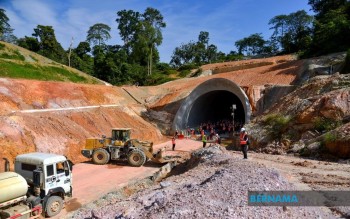
The Malaysian government has committed RM207.2 million to transform Pasir Puteh in Kelantan through 46 carefully selected projects scheduled for 2026, marking a significant boost for one of the country's less-developed parliamentary constituencies. The investment package carries strategic importance beyond immediate local benefits, as it seeks to position the Kelantan district as a vital logistics and industrial node within the broader East Coast Rail Link (ECRL) economic corridor that spans from Port Klang to Kota Bharu.
Deputy Economy Minister Datuk Mohd Shahar Abdullah detailed the government's integrated approach during parliamentary question time, emphasising that the approved initiatives extend beyond simple infrastructure spending to reflect a deliberate spatial economic strategy. The portfolio encompasses land preparation and infrastructure development specifically earmarked for the Pasir Puteh downstream industrial area, working in tandem with the ECRL cargo station to create what planners envision as a comprehensive logistics hub. This coordinated development philosophy represents a shift from project-by-project implementation toward ecosystem-building that leverages existing transport infrastructure as an anchor for broader economic activity.
The geographical positioning of Pasir Puteh offers natural advantages that government planners intend to exploit systematically. The constituency's proximity to the Tok Bali Supply Base—a strategic maritime asset on Kelantan's coast—creates what officials describe as a rare opportunity to integrate rail cargo handling with port logistics operations. Such integration has proven successful in established regional hubs across Southeast Asia, where rail-port synergies have catalysed substantial job creation and private investment. For Pasir Puteh, the combination could theoretically replicate those outcomes by positioning the locality as an attractive destination for warehousing, container handling, and value-added manufacturing operations that require efficient transport connections.
The government's development framework for the area operates under the ECRL Integrated Land Use Master Plan (PGTA-ECRL), a comprehensive blueprint designed to ensure that railway infrastructure investments generate multiplier effects throughout surrounding communities. Rather than treating the ECRL as merely a transport corridor, this planning approach identifies railway stations as potential economic engines capable of attracting private sector investment when supported by adequate industrial land, utilities, and connectivity. The Pasir Puteh station has been specifically designated as a dual-purpose facility serving both passenger movements and freight operations, a dual functionality that maximises asset utilisation and creates diverse employment opportunities across different skill levels.
Deputy Minister Mohd Shahar stressed that the government views this investment not simply as expenditure but as strategic resource allocation designed to narrow development disparities between prosperous urban centres and peripheral regions. Under the 13th Malaysia Plan (13MP) framework, which runs through 2030, this philosophy prioritises place-based development that respects local economic strengths rather than imposing generic solutions. The Pasir Puteh package exemplifies this approach: recognising that the locality's comparative advantage lies in logistics infrastructure and supply chain positioning, the investment concentrates on building that capacity rather than pursuing incompatible development paths that might suit elsewhere but not Kelantan.
The 46 approved projects collectively represent a multi-year commitment extending from commencement this year through 2030, providing the continuity necessary for complex infrastructure initiatives to reach operational status. Industrial area development rarely yields results within single fiscal cycles; successful transformation typically requires sustained investment across multiple phases—from preliminary site preparation through utility installation, building construction, and finally operational launch. The government's decade-long implementation window for 13MP projects accordingly reflects realistic timelines for meaningful economic restructuring in peripheral regions where supporting infrastructure remains incomplete.
Project monitoring and accountability mechanisms have been built into the implementation framework through the MyRMK system, a digital platform enabling real-time progress tracking and periodic parliamentary reporting. This transparency infrastructure serves multiple purposes: it allows elected representatives to monitor spending efficiency, provides government agencies with performance data for mid-course corrections, and offers the public visibility into how development funds are being deployed. For constituencies like Pasir Puteh, where development outcomes directly influence electoral dynamics and constituent satisfaction, systematic monitoring helps ensure that approved allocations translate into tangible benefits rather than disappearing into bureaucratic inefficiency.
The implications of Pasir Puteh's development trajectory extend beyond Kelantan's borders into Malaysia's broader regional competitiveness within Southeast Asia. As countries throughout the region compete for logistics investment and supply chain positioning, Malaysia's ability to quickly develop functional cargo-handling infrastructure around rail networks directly influences multinational investors' decisions about warehouse locations and regional distribution hub placement. Successful ECRL-adjacent development in Pasir Puteh would create demonstration effects encouraging similar investment models elsewhere, potentially accelerating regional integration while distributing economic gains beyond Kuala Lumpur's established dominance.
The government's stated intention to emphasise economic activities aligned with local strengths—whether logistics, tourism, or other sectors—represents a corrective to previous development approaches that sometimes imposed mismatched economic structures on communities lacking the historical or geographic foundations to sustain them. By anchoring Pasir Puteh's transformation to the existing ECRL infrastructure and the nearby maritime supply base, policymakers have constructed an economic development narrative grounded in realistic comparative advantages rather than aspirational thinking. This pragmatic approach increases the probability that the RM207.2 million investment will generate sustainable economic activity and genuine employment growth rather than creating underutilised infrastructure that becomes a fiscal burden on future governments.

