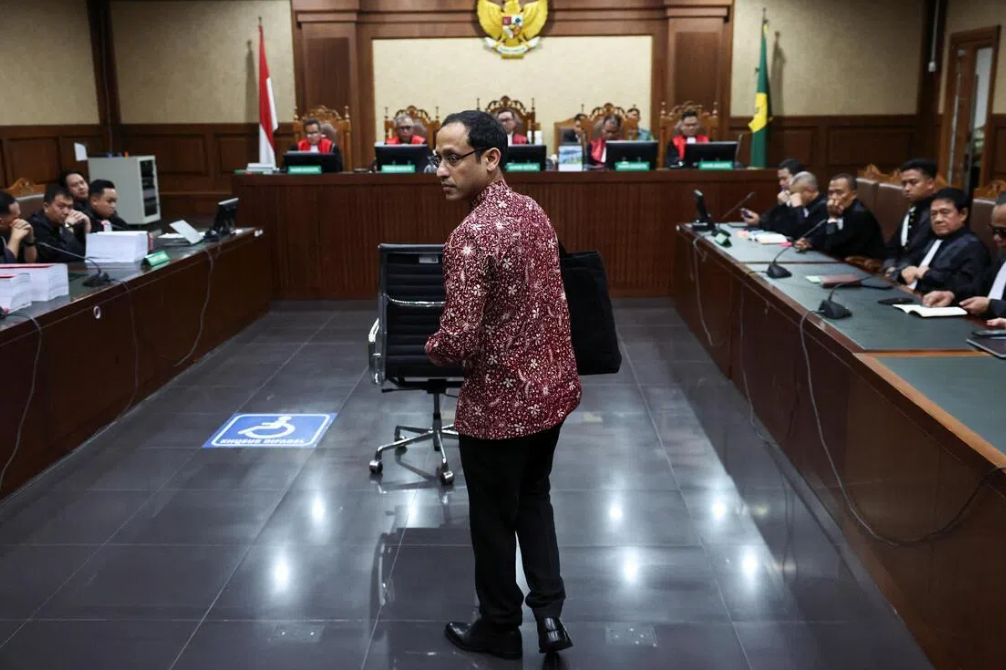
Nadiem Makarim, the Harvard-educated entrepreneur who built Indonesia's first unicorn technology company before joining government, has been handed a 10-year prison sentence on charges stemming from a Chromebook procurement scandal during the Covid-19 pandemic. The Jakarta Corruption Court delivered its verdict on June 30, marking a dramatic fall from grace for the 41-year-old who was once championed as a symbol of Indonesia's new generation of reform-minded leaders. The conviction delivers a sobering message to the Southeast Asian technology elite about the perils of mixing private business interests with public office.
Beyond imprisonment, the court imposed a fine of 1 billion rupiah and ordered Makarim to pay 809.6 billion rupiah in restitution—equivalent to approximately US$45 million. Judges added an additional five-year sentence contingent on his failure to settle the restitution amount, a provision that effectively extends the financial and legal jeopardy he faces. Chief Judge Purwanto articulated the court's reasoning by finding that Makarim had deliberately wielded his ministerial authority to "unlawfully benefit certain parties," explicitly citing an abuse of power that violated his oath of office.
The case centred on a programme to acquire approximately 1.1 million Chromebook laptops between 2020 and 2022, a period when Indonesian schools urgently pivoted to remote instruction following pandemic-related closures. Prosecutors contended that the procurement scheme generated roughly 2.18 trillion rupiah in state losses, with Makarim personally enriching himself by around 809 billion rupiah through transactions routed via PT Aplikasi Karya Anak Bangsa, the parent company of his Gojek enterprise. The panel of five judges determined that Makarim had "consciously and intentionally" steered the Chromebook policy to strengthen what they characterised as a "strategic business relationship" between Google and his corporation—a finding that struck at the heart of conflict-of-interest concerns.
Makarim's trajectory illuminates the complex dynamics facing technology entrepreneurs who transition into public service across the region. Before his 2019 appointment as education minister under former president Joko Widodo, he had transformed Gojek from a motorcycle-taxi operation into a sprawling super app delivering food, ride services, and digital payments through GoPay. By 2019, the company had achieved unicorn status with a valuation exceeding US$10 billion, positioning Makarim as a symbol of Indonesia's digital economy ambitions. His appointment was hailed as a modernisation initiative, yet the very digitalisation agenda that defined his ministerial tenure ultimately became the subject of criminal prosecution.
Prosecutors had sought more severe sanctions, requesting 18 years imprisonment along with fines and restitution totalling 5.6 trillion rupiah. They presented evidence suggesting that Google's strategic investments in Gojek had influenced the Chromebook procurement decision, though Google itself has not faced any charges. The prosecution also highlighted pre-appointment discussions documented in an August 2019 group chat that allegedly outlined a Chromebook-focused digitalisation strategy, implying that the initiative was conceived with commercial, rather than purely educational, objectives. These exchanges formed a critical component of the narrative prosecutors constructed around Makarim's motivations.
The defence mounted a vigorous counterargument grounded in pandemic exigency and good-faith governance. Makarim's legal team contended that the procurement occurred during an unprecedented disruption to Indonesia's educational system, and they emphasised that approximately 97 percent of the 1.1 million Chromebooks had reached 77,000 schools by 2023. They asserted that Makarim received no personal monetary benefit and argued that ministry studies conducted in 2018, prior to his appointment, had in fact cautioned against over-reliance on Chromebooks in areas lacking reliable internet infrastructure. The defence sought a complete acquittal and framed the case as fundamentally unfounded.
The trial captured extraordinary public attention in ways that transcended conventional high-profile corruption proceedings. Gojek drivers attended hearings en masse to demonstrate solidarity, while court sessions were livestreamed to accommodate public viewership and social media viewing parties. The case attracted amicus curiae briefs supporting Makarim, a comparatively rare occurrence in Indonesian corruption cases. These manifestations of public support reflected the affection many Indonesians harboured for Makarim as a homegrown entrepreneurial success story and his elevation of the nation's technological profile.
Makarim's family background adds another dimension to his prominence within Indonesian society. His father, Nono Anwar Makarim, is a distinguished lawyer, whilst his maternal grandfather participated in Indonesia's independence movement. This lineage positioned him within Indonesia's established elite circles, lending him credibility as a public servant and perhaps amplifying the perceived breach of trust that the conviction represents. The verdict thus carries ramifications extending beyond Makarim himself, signalling to members of Indonesia's professional and business classes how courts assess their conduct when transitioning from private enterprise to government service.
In his final defence plea delivered June 23, before the verdict was announced, Makarim reframed the trial as a referendum on whether Indonesia remains welcoming to skilled professionals willing to enter public service. Addressing the bench directly, he posed a provocative question to the judiciary: "Is this country still safe for us to serve?" This rhetorical gesture sought to position the proceedings as determinative of whether Indonesian society could attract and retain talented technologists in government roles, transforming what prosecutors presented as a straightforward corruption case into a broader statement about institutional trust and national competitiveness. The appeal to the judges suggested that the verdict would reverberate throughout Southeast Asian technology circles contemplating public sector engagement.
The conviction's implications for governance and talent recruitment across Indonesia and the wider region warrant careful consideration. Makarim's case demonstrates that even prominent, internationally educated entrepreneurs face substantial legal exposure when public procurement decisions intersect with their private business interests, regardless of pandemic circumstances or genuine educational intent. The conviction will likely chill the enthusiasm of technology sector leaders to accept ministerial positions, potentially depriving governments of precisely the expertise they claim to value during digital transformation initiatives. For Malaysian policymakers and business leaders observing from across the Strait, the case offers a cautionary lesson about the institutional and legal frameworks required to reconcile private sector experience with public office without creating corruption liability.
Makarim expressed continued confidence in Indonesia's judicial system even as he faced imprisonment, thanking supporters through a LinkedIn post managed by his legal team and affirming belief in the verdict's justice despite five months of proceedings. His statement reflected a measured acceptance of the court's authority, though the severity of the sentence—10 years constitutes a substantial punishment in Indonesian corruption jurisprudence—underscores the gravity with which judges assessed his conduct. The case now moves into appeals processes that may occupy years of additional litigation, leaving unresolved questions about whether Indonesia's courts can effectively balance the need to prosecute genuine corruption with the imperative to encourage talented professionals to contribute their expertise to government modernisation efforts.

