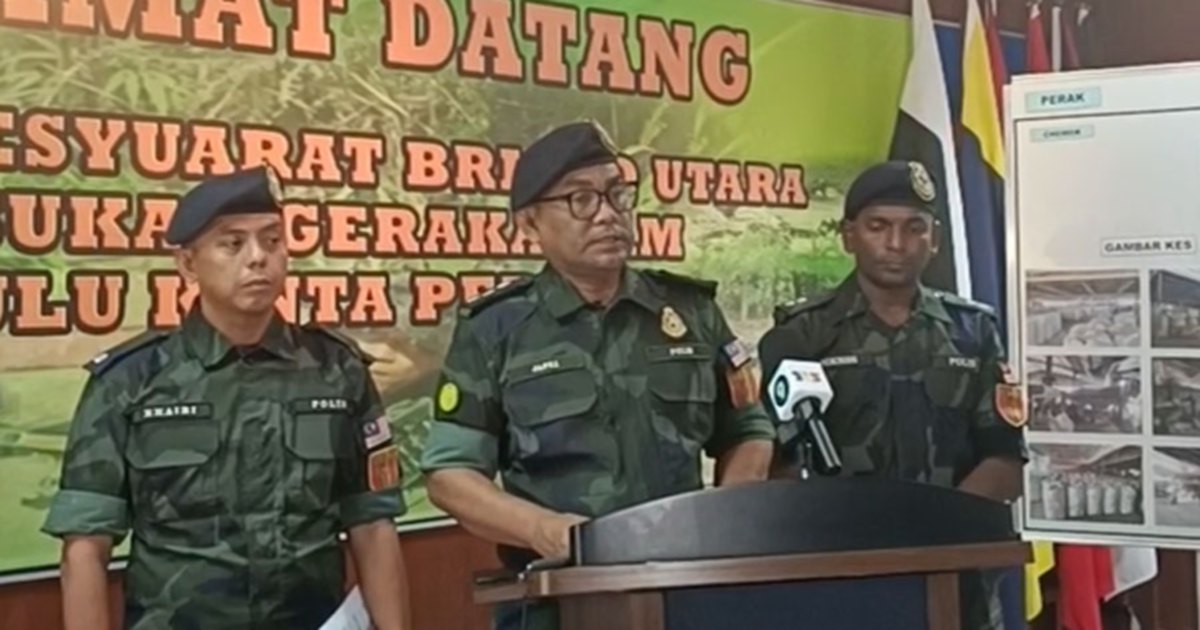
Malaysia's General Operations Force has brought down a significant illegal mining network spanning two northern states, culminating in the arrest of 30 suspects and the confiscation of minerals and equipment with an estimated value of RM31.7 million. The GOF Northern Brigade's enforcement action in Perak and Kedah represents a substantial blow against the underground extraction industry that has long plagued Malaysia's resource-rich regions, undermining legitimate mining operations and wreaking environmental damage across affected communities.
The scale of this seizure underscores how organized and profitable illegal mining has become across the northern corridor. The accumulation of machinery and extracted minerals worth over RM31 million signals an operation of considerable sophistication, likely involving multiple production facilities, distribution networks, and financial arrangements spread across both states. Such operations typically attract investors seeking quick returns, operatives willing to work in hazardous conditions without regulation, and middlemen facilitating the sale of materials into both domestic and potentially international markets.
Illegal mining has emerged as a persistent challenge for Malaysian authorities, particularly in states like Perak and Kedah where geological conditions favour the extraction of valuable minerals. These operations frequently operate from remote locations or abandoned quarries, exploiting gaps in enforcement and the difficulty of monitoring vast stretches of rural terrain. The practice generates significant environmental costs, including soil degradation, water contamination, and habitat destruction that can persist for years after operations cease. For surrounding communities, illegal mining brings noise pollution, traffic from heavy vehicles, and the risk of accidents involving unregulated machinery and untrained workers.
The financial incentive driving these networks remains considerable. High global prices for minerals have made even small-scale extraction economically viable for criminal syndicates. The illegal operators typically undercut legitimate producers by avoiding licensing fees, environmental compliance costs, and worker safety standards, creating unfair competition that pressures lawful mining companies operating under strict regulatory frameworks. This dynamic perpetuates an incentive structure favouring continued illegal activity.
Government enforcement agencies face considerable operational challenges in disrupting these networks. The mobile nature of some operations, combined with the cooperation of multiple stakeholders in facilitating illegal mining, means that dismantling even a well-established ring requires sustained intelligence gathering and coordinated raids. The GOF's multi-state operation in Perak and Kedah demonstrates the resource commitment necessary to achieve meaningful results, involving surveillance, intelligence analysis, and coordinated deployments across jurisdictional boundaries.
The arrest of 30 individuals suggests the operation extended across multiple layers. These typically include equipment operators, site managers, financial handlers, and potentially higher-level coordinators directing activities across different locations. The diversity of roles reflects how illegal mining has professionalized over time, moving beyond opportunistic small-scale extraction to organized criminal enterprise with defined organizational structures.
For Malaysia's legitimate mining sector, such enforcement actions are essential for maintaining competitive integrity. Companies holding proper licenses and meeting environmental standards operate at significant cost disadvantage when competing against unregulated rivals. By reducing the prevalence of illegal operators, enforcement helps preserve market conditions that justify continued investment in compliant mining businesses and the tax revenues they generate. Perak's mining industry, historically central to Malaysia's economic development, has legitimate stakeholders who benefit from reduced illegal competition.
The environmental remediation implications of these seizures extend beyond the immediate operation. Abandoned illegal mining sites frequently require expensive rehabilitation, costs that typically fall to government agencies or communities rather than the operators who profited from the activity. The confiscation of machinery may prevent further damage at these locations, though many sites likely already bear significant scars from unregulated extraction. Long-term environmental monitoring and restoration efforts will be necessary to restore affected areas.
The GOF operation reflects broader trends in Malaysian law enforcement, where specialized units increasingly target organized crime at the intersection of resource extraction and environmental protection. The Northern Brigade's capacity to conduct simultaneous operations across multiple locations in two states demonstrates improved coordination and intelligence capabilities. Such enforcement success, however, typically triggers adaptation by criminal networks, which may shift operations to other regions or employ more sophisticated concealment methods.
From a regional perspective, illegal mining activities in Malaysia connect to broader Southeast Asian challenges involving transnational resource extraction networks and the smuggling of minerals across borders. Materials extracted illegally in Malaysia may enter supply chains serving regional and international markets, creating compliance problems for legitimate downstream purchasers. This operational success therefore contributes to regional efforts to improve supply chain transparency in the mining sector.
The detained individuals now face criminal processing through the judiciary, outcomes that will be closely monitored by both industry observers and environmental advocates. Conviction rates and sentencing severity for illegal mining cases significantly influence the cost-benefit calculations of potential future operators. Stronger penalties create more credible deterrence, though enforcement must remain consistent to maintain effectiveness.
Looking forward, this operation demonstrates that enforcement against illegal mining remains viable despite the networks' organizational sophistication. However, sustained success requires continued resource allocation, inter-agency cooperation, and potentially strengthened legal frameworks addressing both the operational and financial aspects of these criminal enterprises. For Malaysian policymakers balancing resource development with environmental protection, the GOF's action represents one component of a necessary comprehensive approach to regulating the mining sector.
The RM31.7 million in seized assets now enters government custody, with eventual disposition decisions resting with relevant authorities. Such confiscations, when properly accounted for, provide tangible evidence of enforcement effectiveness and can fund future operations against similar criminal activity.

