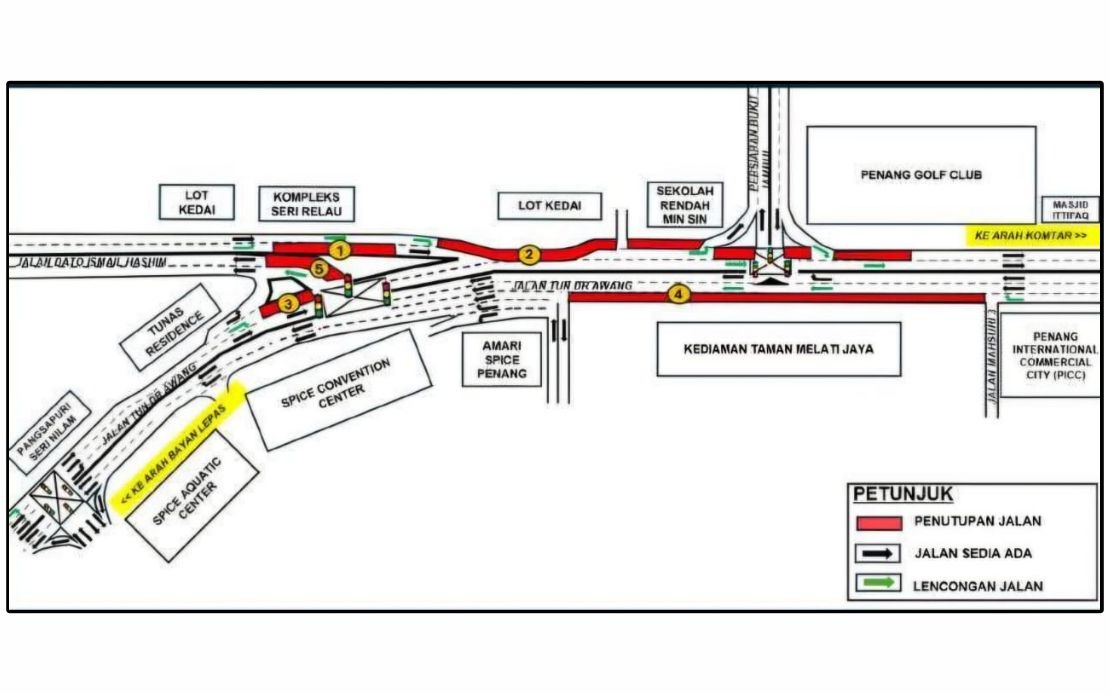
Residents and commuters in George Town face a 72-day period of periodic traffic disruptions beginning August 20 as Malaysia Rapid Transit Corporation Sdn Bhd (MRT Corp) undertakes preliminary construction activities for the Mutiara Line Light Rail Transit initiative. The closures, scheduled to run until October 31, will affect sections of Jalan Tun Dr Awang and Jalan Dato Ismail Hashim spanning from the Sri Relau Complex eastward to the Penang Golf Club, creating a series of localized bottlenecks during peak construction hours.
The temporary lane restrictions will operate between 8:30 am and 4:30 pm each day, allowing authorities to complete critical groundwork essential to the broader Mutiara Line expansion. These preliminary phases focus specifically on drainage infrastructure improvements and road widening necessary under Package CMC1 of the overall project blueprint. Rather than implementing complete road closures that would halt traffic entirely, MRT Corp has structured the work to maintain partial access, though drivers navigating the corridor should anticipate delays and exercise heightened caution.
The closure footprint extends across multiple directions and entry points, reflecting the complexity of urban infrastructure work in an established commercial and residential area. The right lane of Jalan Dato Ismail Hashim adjacent to Sri Relau Complex will be unavailable for traffic heading toward Komtar, while simultaneously the left lane along the same street from the shophouses near SJK (C) Min Sin through to the Penang Golf Club also closes in the same direction. This staggered approach, though creating pockets of congestion, enables construction crews to progress systematically through the area without rendering the roads completely impassable.
Additional restrictions apply at the intersection of Jalan Dato Ismail Hashim and Jalan Tun Dr Awang, where the left turn lane directing vehicles toward Komtar will be cordoned off. The leftmost lane on Jalan Tun Dr Awang near the residential enclave of Taman Melati Jaya heading toward Bayan Lepas will similarly face closure. Notably, MRT Corp emphasizes that alternative lanes in each location will remain operational, offering drivers the possibility of navigating through affected zones via parallel routes, albeit with reduced capacity and potential slowdowns during congested periods.
The Mutiara Line represents a significant expansion of Penang's rapid transit infrastructure and connects to broader regional transport ambitions. For Malaysian transportation planners, the project underscores the ongoing investment in light rail networks across major urban centers, following successful implementations in the Klang Valley and elsewhere. Penang's geographic constraints and traffic challenges make such transit-oriented development particularly strategic, offering potential relief from the congestion that characterizes many routes through the state capital.
MRT Corp has mobilized standard traffic management protocols to minimize disruption and protect all road users throughout the closure period. Signboards, traffic cones, and on-site flagmen will populate the work zones, providing real-time guidance and ensuring that both vehicle operators and pedestrians remain aware of lane shifts and temporary configuration changes. This visible presence of traffic controllers represents an attempt to maintain orderly flow despite the constrained environment and heightened complexity of navigating around active construction zones.
For the broader George Town business community, the temporary inconvenience must be weighed against longer-term connectivity improvements that rapid transit promises. The Sri Relau Complex and surrounding commercial establishments will experience reduced customer accessibility during the work period, though the construction window—roughly two months—represents a relatively contained timeframe compared to infrastructure projects typically requiring year-long disruptions. Retailers and service providers in the affected corridor have advance notice enabling some operational adaptation.
The public has been instructed to monitor directional signage carefully and adjust travel patterns accordingly. Journey times through the affected sections may increase substantially, particularly during morning and evening peaks when normal traffic volumes already strain road capacity. Commuters relying on these arterial routes should consider alternative paths or adjusted departure times to maintain schedule adherence, especially those with time-sensitive appointments or regular work commutes through the area.
MRT Corp has established dedicated communication channels for public inquiries, maintaining accessibility through its Careline telephone service at 1-800-88-6782 and email contact at [email protected]. This ongoing dialogue mechanism allows residents and affected businesses to report specific concerns, seek clarification on closure schedules, or propose solutions that might ease local impacts. The corporation's responsiveness to feedback during construction phases often determines community acceptance of infrastructure projects and shapes perceptions of transit authority competence and accountability.
The Mutiara Line initiative positions Penang to address traffic congestion through modal shift strategies, encouraging residents toward public transportation alternatives. As Malaysia pursues urbanization goals and seeks to manage environmental impacts of vehicle emissions, expanding rapid transit networks becomes central policy priority. Penang's geographic position as an economic hub with established manufacturing sectors and tourism appeal makes effective transport infrastructure essential to competitiveness and livability for both residents and visiting professionals.
Completing preliminary construction works during the designated August-October window allows MRT Corp to maintain the overall project timeline while minimizing extension of disruptions into subsequent quarters when traffic patterns typically intensify. The coordinated approach reflects lessons learned from other Malaysian transit projects, where extended work periods breed public frustration and political pressure. By containing the most intrusive phases to a specific, announced interval, authorities facilitate better adjustment and reduce the perception of perpetual inconvenience that sometimes characterizes infrastructure development in established urban areas.

