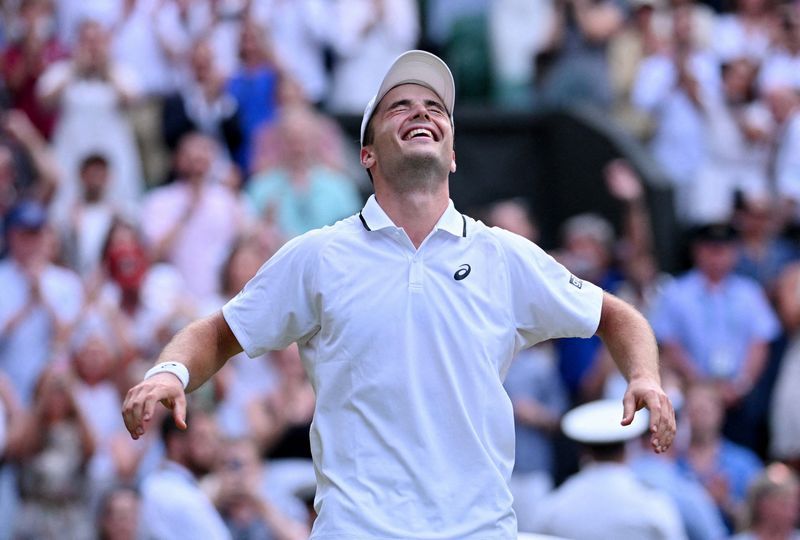
Arthur Fery's journey to the Wimbledon semi-finals reads like a screenwriter's fantasy rather than factual sporting narrative. At 23 years old, this wildcard entry ranked 114th globally has advanced further than almost anyone predicted, armed with just two previous Grand Slam match victories and a background that seemed destined for anonymity rather than glory. Should he defeat French Open champion and second seed Alexander Zverev on Friday, he would contest the final on his 24th birthday—an outcome so improbable that it rivals the most celebrated Wimbledon narratives in living memory.
The magnitude of Fery's accomplishment becomes clearer when contextualised against recent British tennis struggles. Following a disastrous opening round that saw 15 of Britain's 19 singles competitors eliminated, the nation's tennis establishment found itself seeking a lifeline. That saviour emerged unexpectedly from within spitting distance of Centre Court itself—a homegrown player who transformed his obscurity into a catalyst for national hope. His path to the semi-finals included a commanding performance against ninth seed Flavio Cobolli, where Fery dispatched the Italian 6-4 7-6(4) 6-0 on a sweltering Centre Court on Wednesday, becoming only the fifth British male in the professional era to reach this stage.
Fery's ascent represents a singular narrative in contemporary tennis, yet the player himself demonstrates a philosophical composure that belies his youth and sudden prominence. When Queen Camilla attended his quarter-final victory, offering personalised congratulations at match's conclusion, Fery responded with characteristic restraint rather than overwhelming emotion. "The queen, she was waiting for me at the end of the match. She congratulated me. I told her how much of an honour it was for me to play in front of her. She just said, 'Congratulations, keep going'," he recounted to assembled journalists. This measured demeanour extends throughout his tournament conduct—Princess Kate cheered his earlier victory against Otto Virtanen, whilst Roger Federer, the eight-time Wimbledon champion, observed Fery's five-set thriller against Grigor Dimitrov in the last 16 with evident approval.
The contrast between Fery's modest physical stature and his commanding court presence struck observers during the Cobolli encounter. Standing merely 5ft 9in tall, he retrieved balls with seemingly superhuman extension, simultaneously constructing offensive positions that rendered him nearly impenetrable. His tactical maturity and ability to harness the Centre Court crowd's energy created a performance that transcended his ranking and experience level, suggesting depths of talent previously unexploited. The casualness with which he dismantled a top-ten opponent hints at technical sophistication developed away from the professional spotlight.
Fery's pathway diverged significantly from conventional tennis development trajectories. Rather than pursuing full-time professional status immediately, he elected to attend Stanford University, where he majored in science, technology and society whilst simultaneously becoming the nation's top-ranked college player. This unconventional route—combining intellectual development with elite athletic training—proved prescient when considering his current composure under extraordinary pressure. His measured responses to reporters hungry for sensational quotations mirror the psychological equilibrium he demonstrates on court, suggesting that his collegiate diversion strengthened rather than hindered his competitive psychology.
Despite his remarkable showing, Zverev presents a formidable obstacle representing a substantial elevation in competitive calibre. The German's French Open championship credentials and second seeding reflect a player of pedigreed consistency and Grand Slam experience that Fery has yet to demonstrate across an extended campaign. Nevertheless, the trajectory of this fortnight suggests that Fery possesses the adaptability and resilience to compete effectively against elite opposition, provided his nerve withstands the mounting pressure of a potential final appearance.
Fery's identity as a British player carries particular resonance given his Franco-British heritage. Born in the Parisian suburb of Sèvres near Roland Garros, he represents a curious irony for French tennis authorities, who witnessed a junior international representative choose British allegiance without hesitation. His father, Loïc Fery, a multi-millionaire hedge fund manager and proprietor of Ligue 1 club Lorient, reinforced his son's authenticity as a British contender. "He's a true Wimbledon boy," Loïc told French sports daily L'Équipe. "It's like someone who grew up in Boulogne playing at Roland Garros. He went to school five minutes from here. He's always lived here." This characterisation encapsulates how Fery, despite his parentage and birthplace, represents the quintessential British tennis product through his education at King's College in Wimbledon and navigation of the domestic tennis infrastructure.
The psychological mechanics undergirding Fery's continued advancement warrant analysis, particularly his apparent immunity to the distractions accompanying sudden elevation. When questioned about the temporal proximity of his forthcoming semi-final, he responded with straightforward pragmatism: "It's good that I don't have two weeks before my next match. They keep coming fast. So that's good. Just staying in my bubble and just carrying on." This perspective suggests that Fery benefits psychologically from continuous competition rather than suffering paralysis from extended contemplation, an atypical response that distinguishes mentally resilient competitors from those overwhelmed by circumstantial pressure.
The broader implications of Fery's run extend beyond individual accomplishment to encompassing British tennis renewal at a moment when the sport faced genuine institutional anxiety. His emergence as an unexpected standard-bearer during the nation's worst Grand Slam performance in recent memory demonstrates the unpredictable nature of tournament tennis, where preparation, form, and psychological readiness converge unexpectedly. For Malaysian and Southeast Asian observers, Fery's narrative carries particular relevance as it illustrates how unconventional developmental pathways—specifically his collegiate interlude—can strengthen rather than compromise competitive readiness at the highest professional echelon.
The spectre of Goran Ivanisevic's 2001 wildcard Wimbledon triumph looms throughout Fery's narrative. Should he continue his improbable ascent beyond Zverev, he would pursue an achievement unmatched for more than two decades, cementing his status among tennis's most improbable champions. Yet Fery's consistency of performance and evident technical mastery suggest that his run, whilst surprising in magnitude, reflects genuine competitive substance rather than merely fortuitous circumstance. His journey encapsulates why Wimbledon retains its talismanic position within global sports culture—as a stage where established hierarchies yield unpredictably to preparation, talent, and an intangible psychological advantage that emerges from playing proximate to home.

