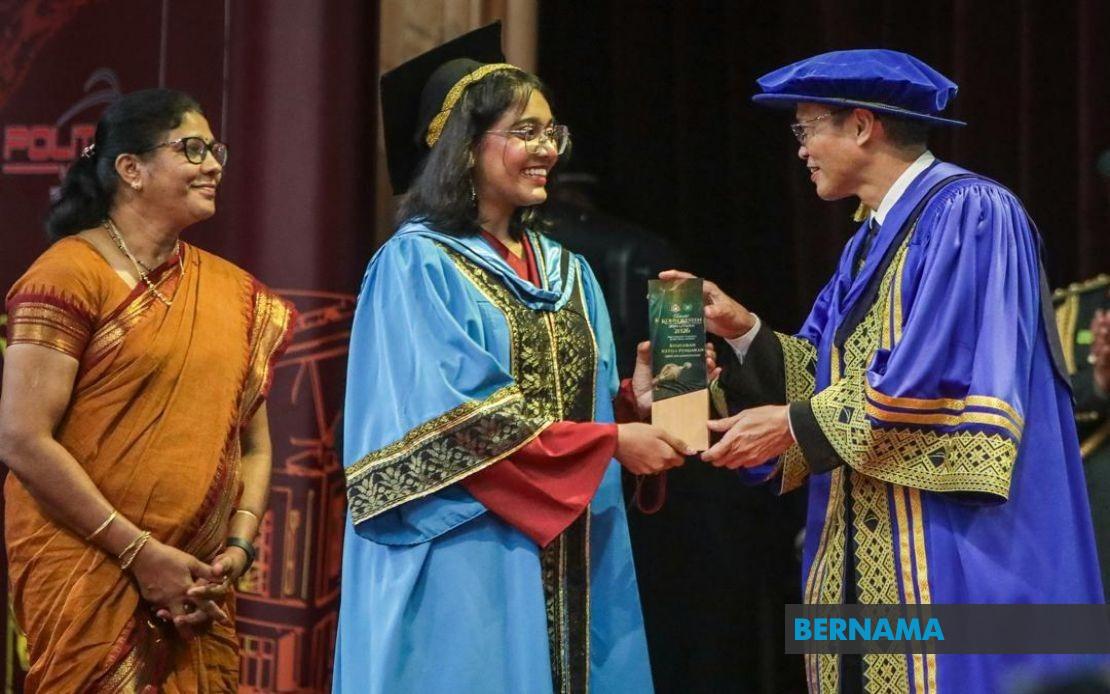
Teerti Ganapathi Rao's journey through higher education reveals the resilience required to overcome personal hardship while maintaining academic focus. The 22-year-old Diploma in Digital Technology student from Politeknik Tuanku Syed Sirajuddin (PTSS) in Arau has been recognised for her exceptional accomplishments at the institution's recent convocation ceremony, securing both the Director-General's Award and the Academic and Co-Curricular Excellence Award during the first session of the 2026 Northern Zone Polytechnic and Community College Convocation.
What makes Teerti's achievement particularly noteworthy is the timing of personal tragedy in her academic timeline. While undertaking her Semester Two examinations in 2023, her father passed away—a loss that could have derailed many students' educational pursuits. Instead, she channelled her grief into motivation, ultimately graduating with a cumulative grade point average of 3.61, a distinction that places her among the institution's most accomplished learners. Upon receiving notification of her awards, Teerti expressed genuine surprise, having doubted whether such recognition would come her way given the circumstances she had navigated.
The youngest of four siblings, Teerti credits her late father's persistent encouragement as the cornerstone of her determination to complete her studies. During what she described as a particularly difficult period when she contemplated abandoning her diploma to pursue a foundation programme instead, her father's counsel proved decisive. His advice to persevere became the emotional anchor she relied upon throughout the remainder of her three-year enrolment at PTSS, demonstrating how parental support, even when delivered from memory, can sustain a student through considerable adversity.
Beyond her headline achievements, Teerti's record at PTSS demonstrates consistent academic engagement across multiple dimensions. She received the Head of Department's Award in Semesters One, Three, and Four, indicating that her excellence was neither a single accomplishment nor temporary peak performance but rather sustained achievement throughout her studies. Her involvement extended beyond classroom performance; she served actively within the Student Representative Council (MPP), an experience that developed her leadership, communication, and collaborative capabilities—competencies increasingly valued in technology-driven workplaces throughout Malaysia and the region.
Teerti's extracurricular contributions also included representing PTSS in collaborative programming and seminar presentations at Universiti Putra Indonesia, expanding her exposure to academic environments beyond Malaysia's borders. For her final-year project, she developed the Koop Printing System, a technological solution designed to enhance the operational efficiency of cooperative printing service management. This practical application demonstrates her ability to identify real-world problems and deploy technical expertise to address them—a capacity that distinguishes her from purely theoretically-oriented graduates.
Language proficiency represents another dimension of Teerti's intellectual breadth. Beyond her fluency in Bahasa Melayu and English, she demonstrates competence in Mandarin, Tamil, and Telugu, with foundational knowledge of French, Japanese, and Korean. This linguistic range underscores her potential for cross-cultural professional engagement and reflects the cosmopolitan character increasingly necessary for technology professionals operating in Southeast Asia's multilingual marketplace. The combination of technical expertise and communicative versatility positions her advantageously for roles spanning international operations or regional technology companies with diverse workforce demographics.
Teerti's trajectory through information technology education began earlier than many peers, stemming from a chance introduction to computers and coding through gaming communities at age 16. Rather than dismissing this recreational gateway to technical knowledge, she recognised the potential within it and transformed casual interest into focused academic pursuit. Her perspective on the field's inherent challenges is instructive: she emphasises that while information technology presents substantial difficulty, systematic learning and conceptual mastery render complex material manageable—a philosophy that likely sustained her through examinations during her father's terminal illness.
Looking ahead, Teerti is awaiting outcomes from her application to pursue a Bachelor's degree in Information Technology, with Universiti Malaya designated as her first-choice institution. Her ambitions extend considerably beyond undergraduate qualification; she explicitly articulates a doctoral trajectory, expressing her intention to eventually pursue a Doctor of Philosophy qualification. Such aspirations, backed by her demonstrated discipline and achievement record, suggest potential contributions to Malaysia's technology research ecosystem and innovation landscape.
Her success carries particular significance within the Malaysian polytechnic sector, which serves as a critical educational pathway for middle-income students pursuing vocational and technical qualifications. Teerti's accomplishment demonstrates that polytechnic education, often positioned hierarchically below university-track alternatives, can produce graduates of exceptional calibre capable of advancing to postgraduate studies and research-oriented careers. For Malaysian policymakers and educators, her narrative validates investment in polytechnic infrastructure and support systems designed to nurture talented learners from diverse socioeconomic backgrounds.
The convocation ceremony itself, graced by the Raja of Perlis, Tuanku Syed Sirajuddin Jamalullail, recognised 6,104 graduates from polytechnics and community colleges across Perlis, Kedah, and Penang—representing the accumulated human capital development occurring within Malaysia's technical education system. Within this cohort of thousands, Teerti's specific journey illuminates broader themes: the transformative potential of structured technical education, the resilience fostered through institutional support systems, and the capacity of individual determination to transcend even profound personal setbacks.
For other Malaysian students facing similar personal losses or challenging circumstances, Teerti's example offers both inspiration and practical instruction. Her success was not achieved through denial of grief or suppression of emotional difficulty, but rather through channelling adversity into purposeful academic engagement. Her story validates the institutional role played by educational institutions in providing the structured environment, mentorship, and recognition systems that enable students to navigate concurrent personal and academic demands. As Malaysia continues developing its technical workforce to support digital economy ambitions, graduates like Teerti—resilient, multilingual, practically skilled, and intellectually ambitious—represent the human foundation upon which national competitiveness ultimately rests.

