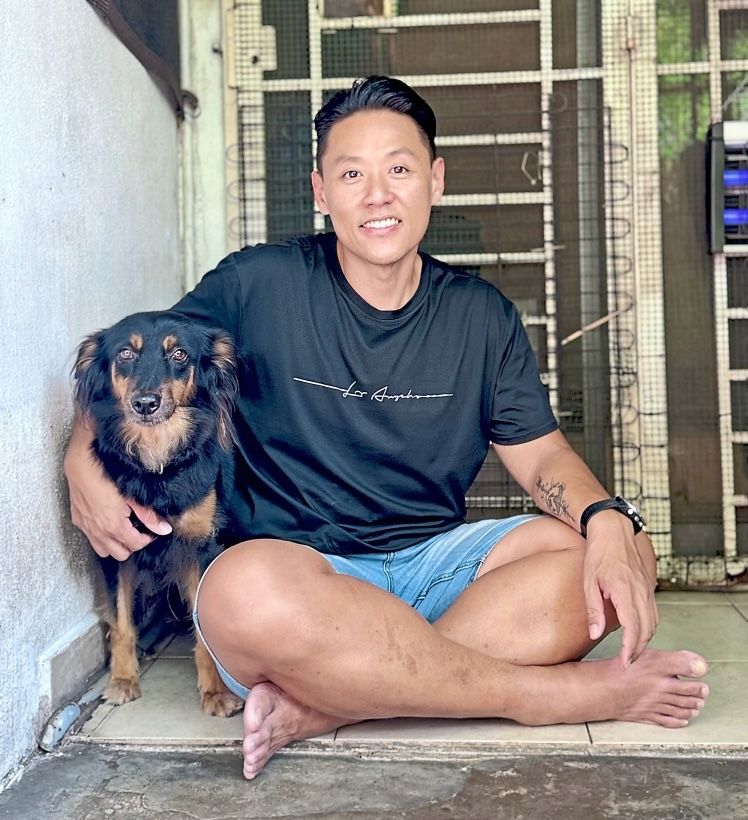
Three years ago, Benjamin Tan, a real estate negotiator based in Puchong, Selangor, attended a pet fair at Mid Valley Megamall with his family seeking a companion for Blacky, their 12-year-old poodle. Rather than selecting a dog themselves, they enlisted the expertise of Brenda Chia, a volunteer coordinator with Malaysian Dogs Deserve Better, to identify a suitable match from the hundreds of animals awaiting adoption. Chia's recommendation fell upon Zudy, a small dog who captivated the family immediately. Yet what began as a heartwarming adoption story would reveal the deeper trauma that many rescue animals carry with them into their new lives.
When Zudy first arrived at the Tan household, the family confronted a sobering reality about her past. The dog exhibited severe anxiety symptoms, trembling uncontrollably and shivering at the slightest stimulation. Benjamin Tan reflected on these early days with evident concern, noting that her fear was so profound she initially refused to eat. The physical manifestations of her distress were unmistakable signs of prior mistreatment or neglect. Rather than becoming discouraged, the Tans committed themselves to a patient rehabilitation process, understanding that trust cannot be rushed and that healing requires consistent, compassionate intervention over extended periods.
The family's dedication yielded gradual improvements. After approximately nine months of gentle handling and a stable, secure environment, Zudy's constant trembling subsided. She began to relax within the familiar confines of her home, recognising the safety her new family provided. However, the Tans noticed an unusual characteristic that distinguished Zudy from typical dogs: she remained almost entirely silent. While canines ordinarily communicate through a diverse vocabulary of sounds—huffing, whining, yipping, yelping, barking, and howling—Zudy produced virtually no vocalisations whatsoever. Benjamin Tan initially wondered whether the dog was mute, a condition that would not have diminished her value as a cherished family member but represented another layer of her mysterious past.
As Zudy's confidence grew incrementally, Tan began taking her to a dog-friendly park near their Puchong residence, creating opportunities for controlled socialisation. In these early outings, Zudy remained withdrawn, hugging close to her owner's side and requiring time to acclimatise to the presence of strangers. The gradual exposure to different environments and people, coupled with positive reinforcement and Tan's patient demeanour, slowly eroded her nervousness. Yet despite these environmental changes and her visible relaxation, Zudy's silence persisted throughout her first year in the home. Tan observed her attempting to mimic the barking of Blacky and other dogs, her body language clearly indicating the intention to vocalise, but no sound emerged from her throat.
The breakthrough moment arrived unexpectedly around the one-year anniversary of Zudy's adoption. Benjamin Tan heard Blacky barking at the front gate, a familiar occurrence in any household with a canine guardian. Moments later, a second bark joined Blacky's, but this one was markedly louder and more forceful than anything Tan anticipated. Astonished, he realised that the unexpected vocalization belonged to little Zudy, who had finally discovered her voice. This moment transcended mere novelty; it represented a profound psychological breakthrough for an animal who had spent months soundlessly attempting to participate in her family's daily interactions. The emergence of her bark signified that Zudy had moved beyond mere physical comfort to achieve genuine emotional security and confidence.
Since rediscovering her voice, Zudy has become considerably more vocal, transforming into an active participant in household life. She now joins Blacky—now 15 years old—in alerting the family to various stimuli, from the security guard making evening patrols to the delivery personnel approaching their home. This role, which she performs with notable enthusiasm, appears to invigorate her sense of purpose and belonging. Beyond household security duties, she has developed distinct interests including hunting lizards and responding enthusiastically to the calls of birds in the rear garden. Benjamin Tan acknowledges that Zudy's newly found voice has become so pronounced that he occasionally requests she moderate her volume, a situation that would have been unimaginable during her first silent year.
Zudy's transformation extends considerably beyond the discovery of vocalization. Within the park environment where she once cowered at her owner's feet, she now demonstrates remarkable courage and independence. When approached by other visitors, she sits composedly, awaiting the interaction rather than fleeing. When released to play, she exhibits the uninhibited joy characteristic of psychologically healthy animals, running freely without the paralyzing fear that once defined her behavior. This progression from traumatised silence to confident independence illustrates the profound impact of safety, consistency, and unconditional acceptance on animal psychology.
Perhaps most tellingly, Zudy has evolved to the point where she now actively sets expectations within her household. The family maintains a dinner schedule, feeding Zudy at 8 o'clock each evening. While minor deviations from this routine pass without complaint, significant delays—extending beyond thirty minutes—trigger her intervention. She approaches her family members and barks with unmistakable purpose, communicating her needs with the authority of someone who has learned her voice will be heard and her requirements will be met. Her family complies promptly, acknowledging her communication with good humour. This dynamic demonstrates not merely that Zudy has gained confidence, but that she has learned to assert herself within a family structure that values and respects her presence.
Zudy's journey from the pet fair to her current life in Puchong encapsulates the transformative power of rescue adoption and family commitment. Her initial silence reflected not an inability to communicate, but rather the suppression that accompanies trauma and fear. The patient, loving environment provided by the Tan family—neither forcing nor rushing her emotional recovery—created the conditions necessary for her to gradually reclaim her voice, her courage, and ultimately, her identity. In Malaysia, where animal rescue operations like Malaysian Dogs Deserve Better work tirelessly to place abandoned and traumatised animals, Zudy's story serves as a powerful reminder that rescue dogs often arrive bearing invisible wounds requiring as much care as their physical needs. Her barks today are not merely sounds; they represent years of healing and the profound difference that compassionate human intervention can make in an animal's life.

