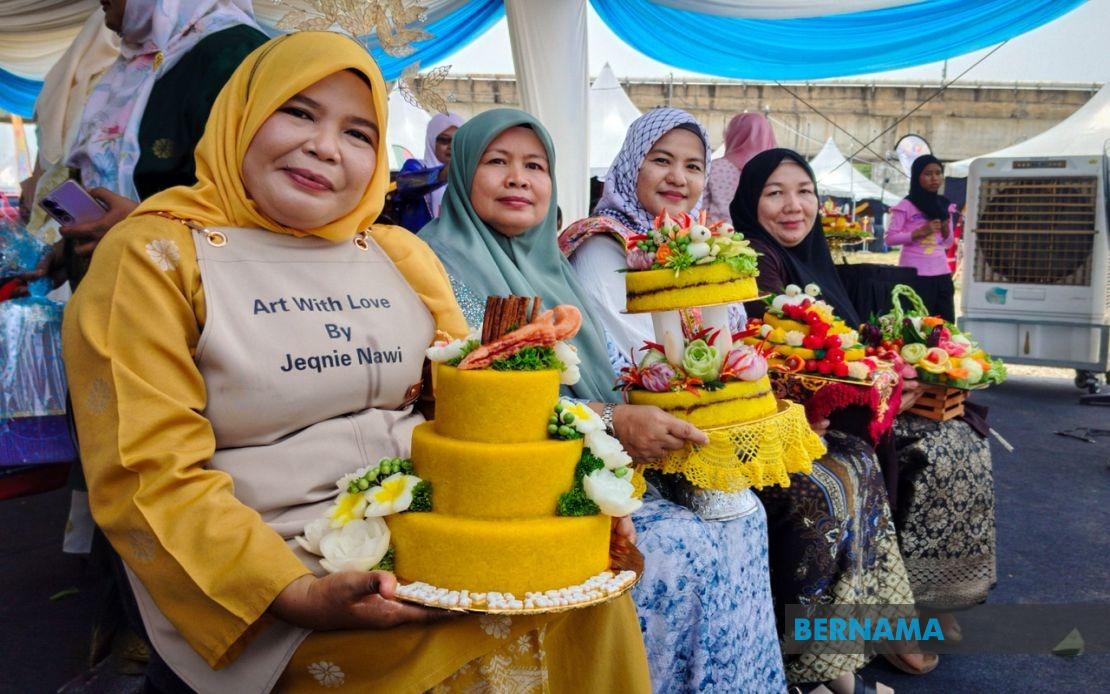
Nortiny Nawi's journey from salaried resort marketing officer to independent pulut kuning entrepreneur offers a compelling narrative about career reinvention and the economic potential of traditional Malaysian culinary arts. Operating from her modest home in Kampung Gong Cokoh in Pasir Puteh, the 46-year-old has transformed a long-held passion into a robust income stream over the past four years, demonstrating how rural artisans can thrive by specializing in culturally rooted crafts that remain in steady demand.
The demand for her elaborately crafted turmeric rice arrangements tells a larger story about contemporary Malaysian dining customs and celebration culture. These decorative presentations, which command prices ranging from RM100 to RM280 depending on complexity and weight, have become essential elements for thanksgiving feasts, birthday celebrations, and formal bridal dinners known locally as makan beradab. The price sensitivity reflects genuine market segmentation—customers willing to pay premium rates for intricate floral carvings fashioned from white radish or other vegetable decorations, while others opt for simpler presentations at the lower end of the spectrum.
What distinguishes Nortiny's business model from other food-based enterprises is the fundamental constraint that pulut kuning arrangements cannot be mass-produced or pre-prepared. Unlike conventional cakes that benefit from refrigeration and advance preparation, these creations demand fresh steaming and meticulous hand-shaping on the morning of delivery. This temporal limitation actually strengthens her market position by creating a natural ceiling on supply and justifying her premium pricing. Her willingness to wake before 3 am to steam and knead glutinous rice, before shaping and cooling it into decorative configurations, requires dedication that casual competitors cannot easily replicate.
Nortiny's customer base has expanded beyond individual households to encompass schools and government departments throughout Kelantan, indicating that institutional buyers recognize the cultural and practical value of these arrangements. Her capacity to accept up to six orders daily, contingent on design complexity, suggests a finely calibrated operation that balances quality control with revenue maximization. This scaling strategy reflects sound business judgment—rather than attempting to industrialize production and sacrifice quality, she has instead expanded her addressable market while maintaining the artisanal standards that justify her pricing.
Her recent recognition at the Kelantan Folk Arts Festival, where she won top prize for an eight-kilogramme pulut kuning arrangement embellished with elaborate radish carvings, validates both her technical skill and her artistic vision. Such institutional validation carries significance beyond the competition itself, functioning as marketing credentialization in a market where consumers increasingly seek authentic, award-recognized products. Festival appearances and prizes generate social proof and media visibility that would otherwise require substantial advertising expenditure.
The path to her current success reveals how workplace observation can catalyze entrepreneurial development. During her resort employment, Nortiny spent discretionary moments watching kitchen professionals, absorbing techniques and building the foundational knowledge that would later underpin her independent venture. This experience underscores a broader principle: economic opportunity often emerges at the intersection of personal passion and observable market need, requiring only the courage to transition from employment security to self-directed enterprise.
For Malaysian policymakers and economic development specialists, Nortiny's trajectory illustrates the overlooked potential within heritage food crafts to generate sustainable rural livelihoods. As urbanization and industrialization reshape Malaysia's economy, artisanal producers of traditional food items occupy a distinctive economic niche—one that is simultaneously resistant to automation, rooted in cultural identity, and capable of commanding premium pricing. Her success suggests that rural entrepreneurship development initiatives might fruitfully emphasize support for traditional crafts and foods rather than exclusively pursuing high-tech manufacturing or service-sector ventures.
The business model also demonstrates resilience through product specialization. By narrowing her focus entirely to pulut kuning arrangements rather than diversifying into multiple catering offerings, Nortiny has cultivated expertise that competitors would struggle to match quickly. This concentration strategy reduces operational complexity while allowing her to develop deeper relationships with repeat customers and institutional clients who value consistency and excellence. The daily customer compliments she receives function as both emotional reinforcement and functional quality feedback, perpetually incentivizing improvement.
Looking forward, Nortiny's expressed ambition to expand operations to larger premises reflects confidence in sustained market demand. The Kelantan region, with its rich culinary traditions and status as a cultural heartland, provides a natural market foundation. However, her growth trajectory also hints at a broader opportunity: Southeast Asian food tourism and heritage preservation initiatives increasingly create markets for authentic, locally-produced traditional dishes. Enterprising producers like Nortiny are well-positioned to supply restaurants, hotels, and cultural festivals seeking genuine regional specialties rather than mass-produced facsimiles.
Her narrative challenges conventional assumptions about career satisfaction and income stability. Rather than remaining in formal employment with its salary ceiling and prescribed advancement path, she pursued a calculated transition that prioritized passion and autonomy. The almost-daily bookings she now receives arguably provide greater income security than her previous salaried position, while offering superior control over her work schedule and methods. For other Malaysians contemplating similar transitions from employment to entrepreneurship, Nortiny's experience provides both inspiration and practical demonstration of how cultural competence and persistent dedication can generate viable economic returns.
The broader implications extend to Kelantan's economic development strategy. States seeking to differentiate themselves regionally often emphasize tourism and cultural heritage; Nortiny exemplifies how grassroots entrepreneurs can embodify and commercialize these cultural assets. Supporting networks of artisanal food producers could generate employment clusters, enhance cultural tourism appeal, and create authentic experiences that distinguish Malaysian tourism offerings from competitors throughout Southeast Asia. Her success suggests that deliberate cultivation of heritage food crafts could constitute meaningful economic development policy for culturally rich but economically challenged regions.

