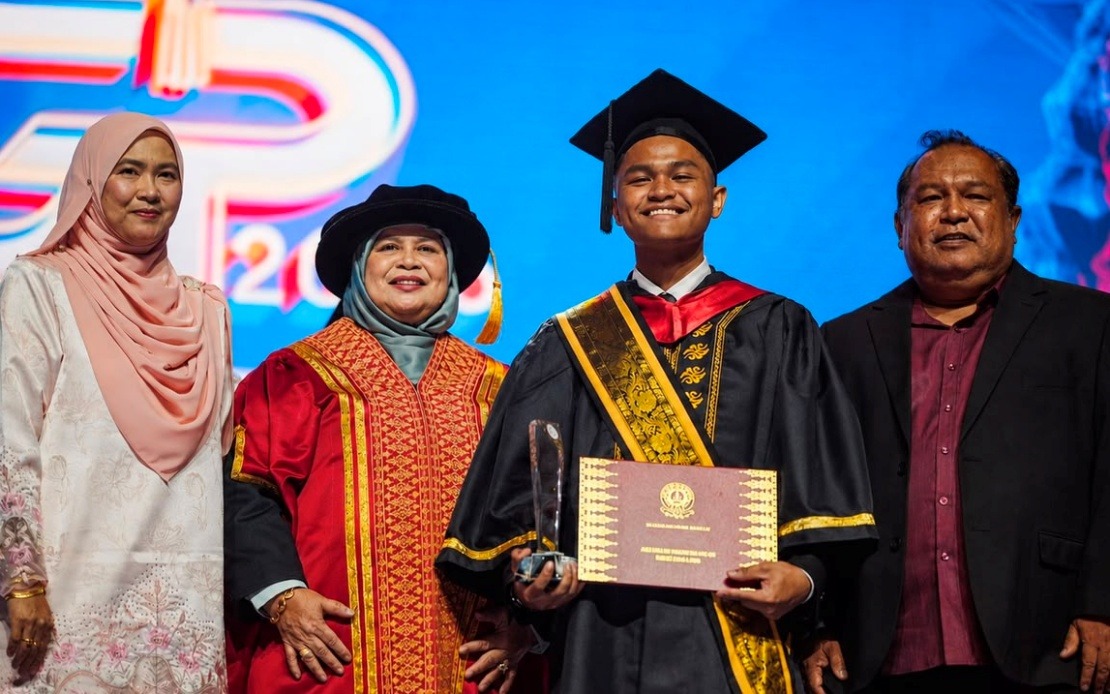
Muhammad Aaqif Dino Faezal's path to one of the world's leading scientific institutions began not in a prestigious international school, but at MARA Science Junior College (MRSM) Tun Ghafar Baba in Melaka, where he developed the academic foundation that would eventually open doors at Imperial College London. Recognised as the 2026 MARA College Graduate Icon on August 20, the 19-year-old exemplifies how Malaysia's Majlis Amanah Rakyat (MARA) scholarship programmes can transform educational prospects for talented Malaysian students who might otherwise lack access to world-class learning environments. His appointment to pursue a geology degree at Imperial College London this September marks another success story for Malaysia's national talent development framework.
The route to this achievement was deliberate and structured. After excelling at MRSM, Muhammad Aaqif secured sponsorship through MARA's Young Talent Development Programme (YTP) to undertake the International Baccalaureate Diploma Programme (IBDP) at Kolej MARA Banting (KMB) between 2024 and May 2026. This pathway illustrates how MARA strategically positions its affiliated institutions to prepare high-performing students for global academic competition, using internationally recognised qualifications as a bridge to leading universities abroad. The financial aspect proved crucial to his trajectory. Speaking to Bernama, Muhammad Aaqif reflected candidly on the barriers he faced: without MARA's comprehensive support covering both tuition and living expenses, the prospect of studying internationally would have remained aspirational rather than achievable for his family.
The magnitude of his academic achievement cannot be overstated. Completing the IBDP examination in May 2026 with a score of 44 out of 45 points places Muhammad Aaqif in an elite cohort of high-achieving students globally. The IB programme is deliberately pitched at rigorous international standards, demanding mastery across sciences, humanities, and supplementary disciplines whilst maintaining extensive engagement with theory of knowledge and extended essays. His near-perfect score reflects not merely examination technique but genuine intellectual depth across multiple subject domains, qualities that Imperial College London's admissions process specifically seeks in prospective geology students.
Beyond academic metrics, Muhammad Aaqif's recognition as Graduate Icon reflects MARA's holistic approach to developing Malaysian human capital. During his time at KMB, he served as president of the Students' Representative Council (MPP), demonstrating the leadership capabilities that institutions increasingly value in graduates destined for professional roles. His responsibilities encompassed mediating between student body and institutional management, requiring diplomatic skills, emotional intelligence, and an ability to represent diverse constituencies. These competencies, developed through structured co-curricular engagement, complement the technical knowledge acquired in formal classrooms. The KMB director Arfaseela Amir emphasised this dimension, noting that Muhammad Aaqif's success reflected KMB's institutional philosophy: cultivating graduates who combine intellectual capability with strong character and collaborative orientation.
The strategic significance of Muhammad Aaqif's trajectory extends beyond individual achievement. Malaysia's education policy increasingly emphasises the development of internationally competitive human capital, particularly in sectors aligned with national economic diversification priorities. Geology and earth sciences represent strategically important fields given Malaysia's continued reliance on petroleum and natural gas revenues, alongside emerging opportunities in renewable energy and environmental sustainability. By equipping scholars like Muhammad Aaqif with advanced geological expertise from leading international institutions, MARA effectively invests in future technical leadership for these sectors. His explicit intention to apply his Imperial College training to Malaysia's oil, gas, and energy sectors suggests a commitment to knowledge transfer and domestic skill development.
The MARA scholarship ecosystem itself warrants examination. The Young Talent Development Programme represents a targeted intervention in Malaysia's educational stratification, specifically designed to identify and nurture merit-based excellence among students who might otherwise face socioeconomic barriers to international education. By anchoring this programme within KMB, which combines Malaysian educational oversight with internationally recognised qualifications, MARA creates a controlled transition environment. Students experience rigorous international-standard pedagogy whilst remaining embedded in Malaysian institutional structures, reducing psychological displacement often accompanying direct international secondary schooling. This approach recognises that excellence operates multidimensionally: academic achievement alone proves insufficient without accompanying development of leadership, cultural awareness, and national commitment.
Muhammad Aaqif's recognition as the 2026 MARA College Graduate Icon illuminates the selection criteria underlying MARA's human capital development strategy. Candidates for this honour are evaluated across four dimensions: academic excellence, demonstrated leadership qualities, contributions to society, and assessed potential for sustained high achievement. This multifaceted assessment reflects evolving international understanding of what constitutes valuable educational outcomes. While traditional metrics emphasised examination results, contemporary scholarship development recognises that future professionals require judgment, interpersonal effectiveness, and genuine commitment to broader social benefit. Muhammad Aaqif's achievements across all four dimensions suggest he represents exactly the profile MARA aims to cultivate.
The institutional recognition also carries symbolic importance within Malaysia's competitive scholarship environment. MARA, as a constitutionally-established body serving Bumiputera interests, occupies particular significance within Malaysia's education policy framework. Its scholarships carry national prestige and often imply a quasi-implicit expectation of subsequent contribution to Malaysian development. For Muhammad Aaqif, receiving the Graduate Icon award effectively signifies institutional endorsement of his potential as a future contributor to Malaysian professional and intellectual life. This recognition likely enhances his standing when seeking future employment or research partnerships, particularly within Malaysia's energy sector where MARA-supported professionals often gravitate.
The broader context involves Malaysia's ongoing positioning within global knowledge hierarchies. Imperial College London consistently ranks among the world's top ten universities for science and engineering disciplines, particularly in earth sciences and geology. Access to its programmes remains highly selective, with admission typically requiring demonstrated excellence at the highest international standards. Muhammad Aaqif's admission represents validation that Malaysian secondary education, when structured through rigorous international frameworks and supported by institutional commitment, produces graduates capable of competing successfully at the highest global level. This reality contradicts persistent narratives suggesting Malaysian education necessarily occupies a lower tier within international academic rankings.
Looking forward, Muhammad Aaqif's journey raises important considerations for Malaysian educational policy. His success depended on coordinated intervention at multiple levels: MRSM provided initial momentum; MARA provided financial and institutional support; KMB offered internationally benchmarked pedagogy; and Imperial College London now offers advanced training. This multi-stage pipeline, whilst producing excellent outcomes, requires substantial institutional coordination and investment. As Malaysia seeks to expand its pool of internationally-competitive professionals, questions arise about scaling such programmes beyond the currently limited cohort accessing MARA support. The model demonstrates viability; questions about universalisability and resource sustainability remain.
Muhammad Aaqif himself emphasised the emotional and psychological dimensions of his achievement. When receiving the Graduate Icon award, he experienced reflection on accumulated challenges, family sacrifices, and institutional support that collectively enabled his progress. This emotional acknowledgement proves important precisely because educational trajectories often appear, in retrospective accounts, as inevitable sequences of achievements. The reality involves contingency, vulnerability, and dependence on supportive others. His candid reflection honours the contributions of family members, teachers at MRSM and KMB, peer networks, and institutional personnel who collectively created conditions enabling his advancement. This recognition of interdependence contrasts with individualistic narratives sometimes dominating achievement discourse.
As Muhammad Aaqif prepares for Imperial College London in September, his story encapsulates both accomplishment and aspiration. He exemplifies what becomes possible when talent, institutional support, and individual commitment intersect productively. For Malaysia, his advancement to elite international institution represents human capital development functioning as intended. For other Malaysian students confronting educational barriers, his journey demonstrates that pathway exists, though accessing it requires demonstrating excellence, pursuing structured opportunities, and maintaining long-term commitment. The challenge for Malaysian education policy involves ensuring such pathways expand beyond the currently privileged few who access MARA support, making international excellence an aspiration increasingly available to Malaysia's broader student population.

