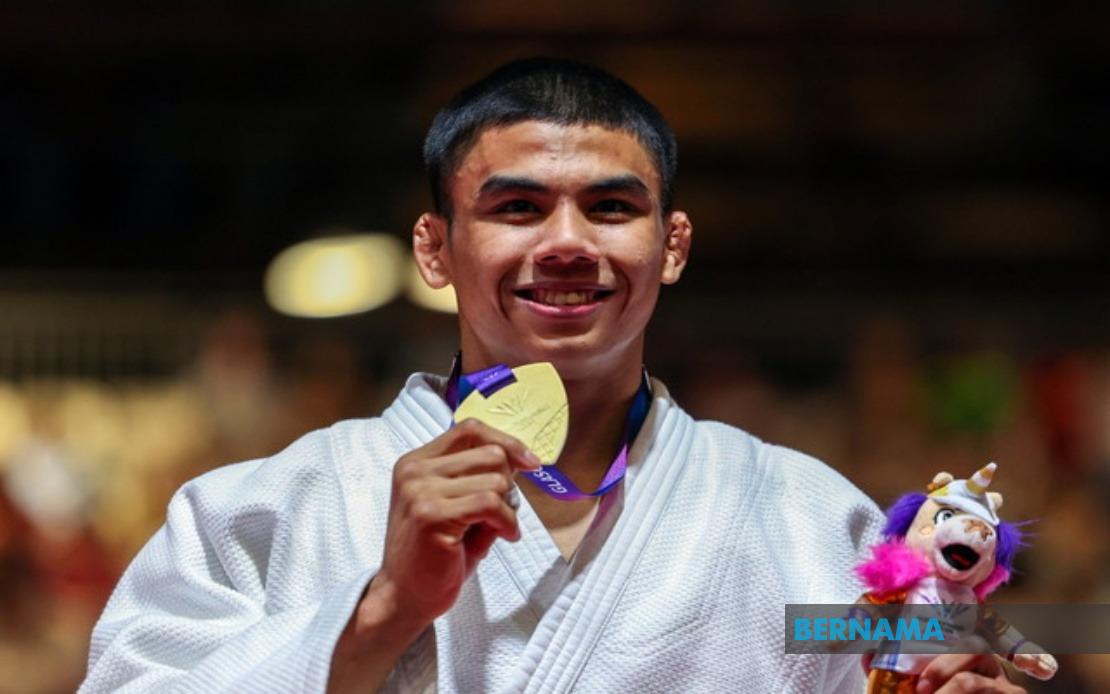
At just 21 years old, Amir Daniel Abdul Majeed has already achieved what many judokas spend their entire careers pursuing: a Commonwealth Games gold medal. Yet the transition from standing on the mat as a competitor to standing at its edge as a coach has proven unexpectedly more demanding than he anticipated. Speaking at Shah Alam during SUKMA Selangor 2026, the young Commonwealth champion revealed that the psychological toll of mentoring differs fundamentally from the pressures of individual competition, presenting what he describes as an entirely unfamiliar landscape of responsibility and emotional investment.
Currently serving as assistant coach of the Penang judo squad, Amir has discovered that the nervous energy he once channelled into personal performance now extends across an entire team under his guidance. Where competitive bouts required him to manage only his own technique, tactics and mental fortitude, coaching demands he simultaneously monitor and develop 13 athletes at varying stages of technical proficiency and competitive readiness. This multiplication of responsibility has proven far more taxing than anticipated, forcing him to grapple with concerns that previously resided solely within his own sphere of control.
Amir's reflection on this coaching transition carries particular weight given his intimate familiarity with these athletes. Many of the judokas he now coaches were teammates during his own competitive years, and he watched numerous squad members develop from inexperienced young competitors into more accomplished athletes. This personal history creates an unusual dynamic: he shares the same competitive heritage as those he now directs, yet must now occupy a position of authority that requires maintaining professional distance while drawing on hard-won experience. The emotional complexity of this role—where fondness for past competitors mingles with coaching obligations—adds psychological layers that pure athletic competition never demanded.
Despite these challenges, Amir's coaching tenure has already yielded tangible results. Penang's judo contingent completed their three-day campaign at SUKMA Selangor 2026 with an impressive medal haul of three gold medals, one silver, and five bronze medals overall. This performance proved sufficiently competitive to secure Penang joint-top placement alongside Johor in the overall medal standings for judo, demonstrating that Amir's transition to coaching has not diminished his ability to influence competitive outcomes at the highest domestic level.
Beyond his immediate coaching responsibilities at SUKMA, however, Amir's focus increasingly turns toward the international stage. He currently awaits official confirmation regarding his selection for the Aichi-Nagoya 2026 Asian Games in Japan, with the crucial selection meeting scheduled to occur imminently. For a young athlete balancing concurrent roles as both competitor and coach, this dual responsibility structure creates competing demands that require careful management and focus.
The prospect of competing at the Asian Games carries strategic significance within Amir's longer-term athletic planning. Japan hosts some of the world's most technically accomplished judokas, and the Aichi-Nagoya Games will draw elite competitors from across the Asian continent. Rather than viewing this formidable competition as intimidating, Amir frames it as an invaluable opportunity to test himself against opponents who represent his peers and superiors in the sport. The intensity of such high-level exposure proves essential for athletes harbouring Olympic ambitions, as international competition at premier events builds competitive experience and technical refinement that domestic tournaments, however well-organised, cannot replicate.
Amir's articulation of his Asian Games aspirations reveals strategic thinking about competitive progression. He explicitly identifies the Asian Games as a stepping stone toward realising his Olympic dream, suggesting a carefully mapped competitive pathway rather than ad-hoc participation in available tournaments. Competition in Japan offers the precise quality of opposition and tournament structure necessary for athletes seeking to compete at the Olympic Games, where margin for error shrinks considerably and technical mastery becomes paramount.
Simultaneously, Amir identifies the SEA Games Malaysia 2027 as another crucial milestone within his competitive timeline. This regional competition, held on home soil in Malaysia, carries both personal and national significance. For Amir, competing at the SEA Games as a medallist would represent validation of his competitive trajectory and potential contribution to Malaysia's regional standing in judo. The combination of Asian Games experience in 2026 followed by SEA Games competition in 2027 creates a logical competitive sequence that allows athletes to build momentum and refine preparation strategies across successive major tournaments.
The intersection of Amir's coaching role and his own competitive aspirations creates an interesting tension. Younger athletes frequently benefit from mentors who remain actively competitive, as coaching becomes infused with current technical knowledge and contemporary competitive insights rather than relying solely on historical experience. Amir's continued participation at elite levels thus enhances his credibility and effectiveness as a coach, allowing him to speak authoritatively about current technical trends, mental preparation strategies, and the psychological demands of competition at the highest levels. His Penang squad benefits from a coach who understands through active participation rather than memory.
Looking ahead, the intersection of Amir's dual roles—as both developing international competitor and emerging coaching talent—positions him at an intriguing juncture within Malaysian judo. His generation of athletes possesses the technical calibre to represent Malaysia credibly at Olympic level, yet the sport simultaneously requires experienced, capable coaches to develop the next generation of competitors. Should Amir continue on his current trajectory, combining competitive excellence with coaching responsibility, he could become a central figure in Malaysian judo's future, simultaneously advancing his personal Olympic ambitions while contributing to the sport's institutional development within the country.

