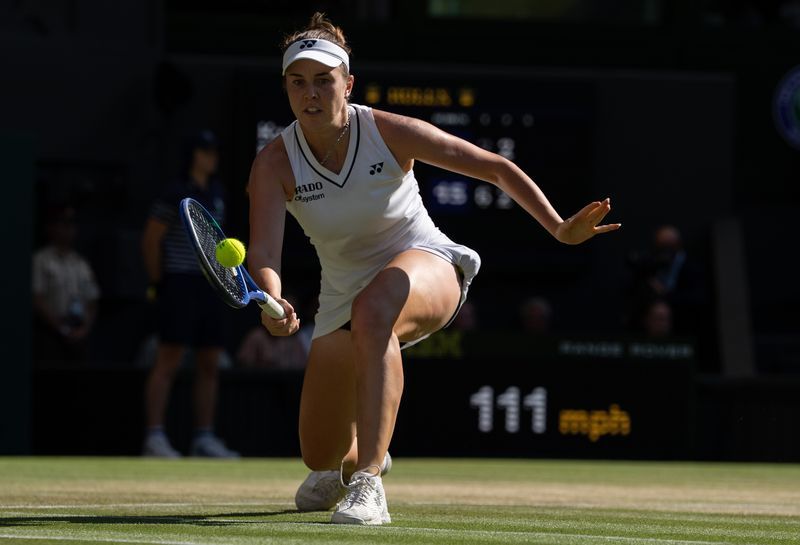
Linda Noskova's coronation as Wimbledon champion on Saturday did not follow the script that seemed destined just an hour earlier. The 21-year-old Czech ninth seed, on the cusp of collecting one of tennis's most prestigious trophies after appearing to control the showpiece against compatriot Karolina Muchova, instead endured an agonising collapse that would have broken the spirit of most players at her career stage. Yet she emerged victorious with a 6-2 5-7 6-3 scoreline that barely hints at the psychological rollercoaster she navigated on Centre Court.
The trajectory of the match seemed settled when Noskova powered through the opening set comfortably and then assumed total dominance in the second, establishing a commanding 5-2 lead with Muchova serving to stay in the set. At that juncture, the Venus Rosewater Dish appeared destined for the Czech challenger's hands, and she could already envision her place alongside the legendary pantheon of Central European women who have claimed the Wimbledon crown. Multiple opportunities emerged to seal the victory: three match points arrived when Muchova served at 2-5, another materialised at 5-3, and a fifth slipped away in the ninth game, yet each time the moment evaporated like mist on the grass courts.
What unfolded next proved remarkable for its reversal of fortune. Muchova, far from capitulating as countless players before her had done in similar straits, summoned reserves of determination and executed five consecutive games that would ultimately extend the contest to a third set. The momentum shift was so pronounced and so thoroughly demoralising to Noskova that she retreated to her chair visibly shaken, covering her ears against the roar of the crowd—a gesture eloquent in its expression of emotional turmoil. As she walked towards the toilet for a comfort break, the nine-time Czech champion appeared to many observers to be a player whose chance had slipped away forever, consumed by the cruel mathematics of sport where margins of millimetres and moments determine destiny.
Yet the interval proved transformative, not through elaborate sports psychology or coaching intervention, but through an almost accidental psychological reset. As Noskova made her way back to court, her gaze fell upon the two trophies displayed on the route—one significantly larger than the other. In that moment of seeing the Venus Rosewater Dish, the larger and grander prize, she experienced what she would later describe as a moment of crystalline clarity and determination. She resolved in that instant that she would not settle for the smaller runner-up prize; she would claim the champion's trophy or leave everything on the lawn courts of SW19. The psychological manoeuvre, though simple, proved decisive—it reframed her mental narrative from one of loss and regret to one of resolute ambition.
Upon returning to court, Noskova faced the critical test of holding serve in the opening game of the third set, a moment she would later identify as pivotal to the psychological momentum of the final set. She succeeded, and with that accomplished, something fundamental shifted in her performance. The timing returned to her groundstrokes, her footwork regained its precision, and the youthful exuberance that had characterised her first-set dominance resurfaced. When match points arrived again at 5-3, more than sixty minutes after her first opportunity had come and gone, she would not be denied. This time, there was no hesitation, no nervous double fault, no mental lapse—only execution and closure.
Noskova's victory elevated her to a particularly exclusive status within the global tennis hierarchy. At 21, she became the youngest women's champion at Wimbledon since her fellow Czech Petra Kvitova claimed the first of her two titles in 2011, a distinction underscoring the particular excellence that Czech women have demonstrated on grass courts in the past decade. She is also the third Czech woman to capture the singles title at the All England Club within a four-year span, a remarkable concentration of success from a nation whose population is only ten million, demonstrating that Czech women possess something distinctive in their approach to the sport's highest echelon.
The composure and perspective Noskova displayed in handling such extreme adversity hints at psychological resources that extend well beyond the tennis court. She wears a nose ring, an affectation that immediately signals her individuality and unconventional approach to life within the traditionally conservative world of professional tennis. More significantly, her worldview encompasses concerns and commitments that dwarf the sphere of competitive sport. She has spoken movingly of her mother, Ivana, whose death from cancer two years prior has fundamentally shaped her approach to achievement and what constitutes genuine success in life.
This broader philosophical orientation emerged clearly in her discussion of how she spent her off-season. Rather than pursuing the conventional circuit of training camps, sponsorship commitments, and commercial opportunities, Noskova instead devoted significant time to Zanzibar, where she volunteered at a school for a charity organisation. That experience of direct engagement with communities far less privileged than her own recalibrated her sense of gratitude and perspective. She acknowledged returning with a deepened appreciation for everything in her life, a sentiment that would prove invaluable when facing the psychological precipice of her Wimbledon final.
Her commitment to causes beyond tennis further reflects her maturity and dimension as a human being. Noskova grew up in a village nestled within a Czech forest, an upbringing that cultivated within her a profound connection to nature and environmental concerns. She has articulated clear intentions to pursue volunteering work focused on environmental conservation in the coming years and months, positioning her post-tennis career with specificity and purpose that most young athletes lack entirely. This is not a player who views tennis as her entire identity or ultimate measure of worth; rather, she understands sport as one chapter in a larger narrative of a life devoted to meaning-making and contribution.
Such perspective and emotional maturity likely proved instrumental in how Noskova navigated the specific psychological crisis of blowing five match points in a Grand Slam final. For most athletes barely past their teenage years, squandering such opportunities would trigger a spiral of self-doubt, recrimination, and catastrophic loss of confidence. Yet Noskova's larger sense of purpose and her cultivation of equanimity through engagement with causes beyond sport provided psychological anchors that prevented complete mental collapse. She could temporarily lose the match but not lose herself, a distinction that proved crucial to ultimate victory.
In her post-match reflections, Noskova acknowledged the critical importance of holding serve in the opening game of the third set. She recognised that had she lost that game after already surrendering five consecutive games in the second set, the psychological consequence might have proven insurmountable. The margin between triumph and defeat in elite sport frequently depends upon such micro-moments—single games, individual points, moments of mental clarity or lapse. Noskova's acknowledgment of this reality demonstrated tactical acumen and psychological insight beyond her years.
As she processes the magnitude of her achievement, Noskova has permitted herself the luxury of reflecting that her sacrifice and perseverance throughout these two weeks of competition have been thoroughly vindicated. She will never forget the emotional turbulence of this Wimbledon fortnight, the exquisite pain of approaching and then losing multiple opportunities for glory, followed by the extraordinary satisfaction of ultimately claiming the prize. For Malaysian and Southeast Asian readers accustomed to following tennis's global theatre, Noskova's triumph represents a powerful reminder that mental resilience, perspective beyond sport, and commitment to causes larger than oneself can provide the psychological foundation necessary to achieve excellence even in sport's most pressurised moments.

