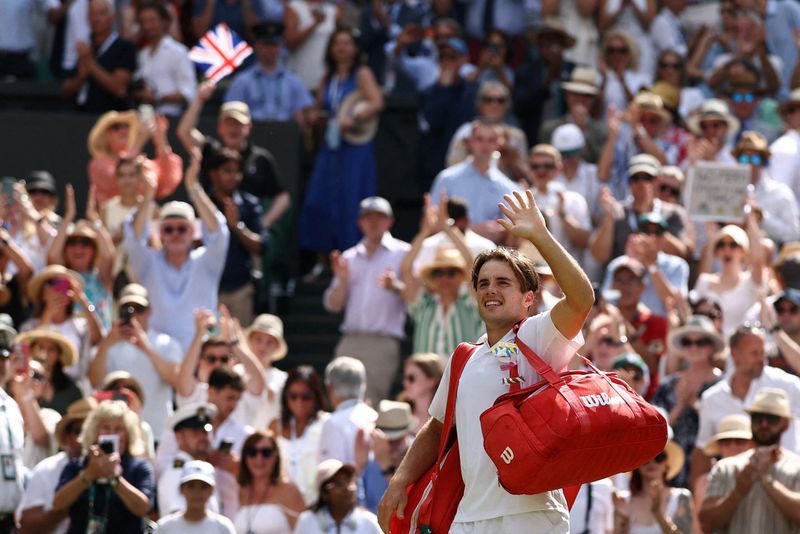
Arthur Fery's unexpected journey through the Wimbledon draw has rewritten the script for the 23-year-old British player. The France-born competitor, who entered the tournament as a wildcard with a ranking of 114, had resigned himself to spending this week on a Greek beach with friends rather than competing on Centre Court. That casual assumption evaporated as he methodically progressed through the tournament, capturing the imagination of the home nation and defying expectations that seemed to restrict him to a supporting role in what was meant to be someone else's fortnight.
What unfolded instead was a story of remarkable perseverance. Fery defeated five opponents to reach the semi-finals, becoming the first wildcard to achieve this feat at Wimbledon in a quarter-century. The accomplishment carries particular weight given his limited pedigree in major championships; before this month, he had won just two matches across all Grand Slam tournaments combined. His unexpected success transformed him from a journeyman competitor into a household name in British tennis circles and beyond, with supporters rallying around his candidacy throughout each successive round.
The support from home proved instrumental in sustaining Fery's run through the grasscourt championship. Britain's national football team recorded a video message of encouragement, while senior members of the royal family—including Queen Camilla and Princess Kate—attended matches to observe the hometown hero in action. Even Fery's own social circle became invested, with one friend who had travelled to Greece ahead of the tournament's conclusion returning after just two days to support him from the stands. The personal narrative of an underdog overcoming improbable odds resonated deeply with observers during the intense 11-day campaign.
Yet the dream run encountered its inevitable conclusion on Friday when Alexander Zverev proved too formidable, dismissing Fery in straight sets during the semi-final encounter. While the loss marked the end of his championship hopes, it arrived at a point where the damage—or perhaps more accurately, the transformation—had already been accomplished. The tournament had fundamentally altered the trajectory of Fery's professional career in ways that transcended the immediate disappointment of elimination.
Fery himself acknowledged the surreal nature of his experience, maintaining perspective even as his name now features prominently in Wimbledon's recent history. Reflecting on his friend's early departure to Greece, Fery noted with characteristic levity that the companion had evidently underestimated his chances. The anecdote illustrates how thoroughly unexpected his deep run proved to everyone, including those closest to him who had factored in an early exit when making their holiday calculations.
The financial reward accompanying his semi-final appearance provides a tangible benefit alongside the intangible gains of elevated confidence and public recognition. Fery secured £900,000—equivalent to approximately $1.21 million—for reaching the championship's final four, a sum that substantially exceeds what he might have earned through a typical season of lower-ranking tournaments. This prize money represents far more than holiday spending money; it constitutes a meaningful financial foundation for his continued development on the professional circuit.
More significantly, Fery's ranking is now projected to climb dramatically into the mid-30s, a transformation that unlocks access to the tennis calendar's most prestigious events. Access to tour-level competitions represents a qualitative shift in his career prospects. Rather than competing primarily in qualifying rounds and lower-tier tournaments, he will now automatically receive invitations to major tour events for at least the next twelve months, potentially longer depending on his continued results. This elevation represents the concrete, structural change that can genuinely accelerate a player's development.
The psychological dimension of his Wimbledon performance may ultimately prove equally valuable. Having competed successfully against and defeated higher-ranked opponents in the championship's main draw, Fery has acquired empirical evidence of his capability to contest at elevated levels. He enters the remainder of the season with demonstrated confidence rather than mere aspirational hope, a distinction that shapes how athletes approach future challenges and recover from setbacks.
Fery acknowledged the daunting adjustments ahead as his circumstances shift dramatically. The transition from obscurity to prominence brings competing pressures—managing elevated public expectations while maintaining focus on technical improvement, adjusting to increased media scrutiny while preserving the mentality that sustained him through a two-week sprint through Wimbledon's draw. He expressed awareness that these challenges demand careful navigation, yet his tone suggested readiness rather than apprehension about the journey ahead.
Looking forward, Fery has identified the American hardcourt swing as his immediate priority, culminating in his debut appearance at the United States Open at Flushing Meadows. This sequence of events represents a significant milestone, as a player elevated to the main draws of major championships typically requires some establishment before accessing the year's final Grand Slam tournament. The concrete timeline for his rejuvenated career underscores how thoroughly Wimbledon has altered his prospects.
Before commencing that ambitious autumn campaign, Fery recognises the necessity of genuine recovery time. Two weeks of intense competition in summer heat, combined with the emotional turbulence of mounting success and ultimate defeat, demand physiological and psychological restoration. His measured commentary about needing space to process recent events demonstrates maturity in understanding that sustaining higher performance levels requires intentional recovery cycles, not merely continuous competition.
For Malaysian and Southeast Asian tennis observers, Fery's trajectory offers instructive perspective on how tournament draws can pivot a career, and how extended runs at major championships generate momentum that extends far beyond the specific fortnight. As regional players aspire to breakthrough moments at the sport's highest levels, Fery's example illustrates that such transformations remain possible even from marginal starting positions when opportunity and execution align. The Greek holiday abandoned for Wimbledon glory will remain forever a symbol of the unpredictable nature of professional sport.

