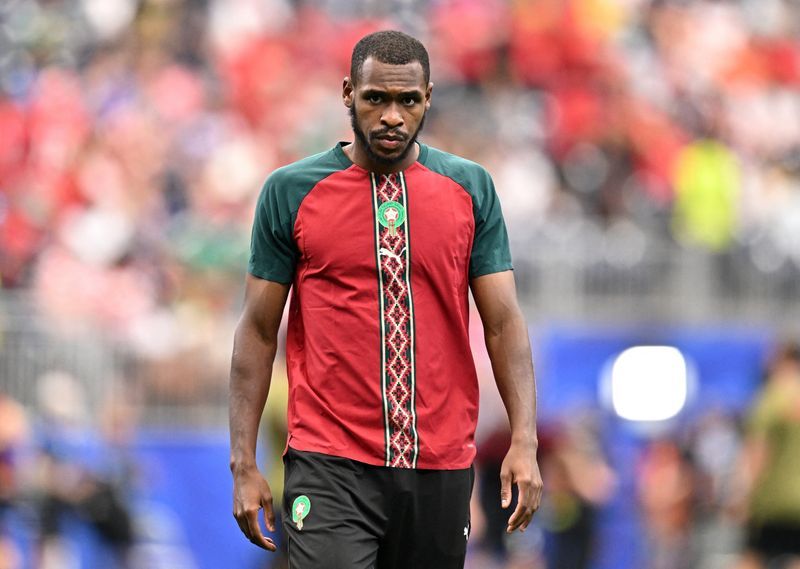
The narrative threading through Morocco's World Cup campaign took a peculiar twist as the North African side prepared for Thursday's quarter-final encounter against France in Boston. At the centre of this curious storyline stands Issa Diop, the 29-year-old West Ham United and Fulham veteran whose previous protestations of unwavering French allegiance have given way to the complex reality of international football. Now tasked with containing one of the tournament's most lethal attackers in Kylian Mbappe, Diop embodies the kind of sporting irony that transforms matches into narratives about identity, belonging, and the strange paths that lead athletes to their ultimate destinations.
Diop's journey to this moment was marked by consistent and vocal rejection of Morocco's overtures. Born in Toulouse to a Senegalese father and Moroccan mother, he possessed the eligibility that made him an attractive prospect for both African nations eager to strengthen their squads. Yet his public pronouncements on the subject were unambiguous. Speaking to French television Canal Plus during his time with France's Under-21 programme seven years earlier, he articulated a vision of football loyalty rooted in geography and gratitude rather than ethnic heritage or family connection. "I am French. I was born in France. France has given me everything," he declared, dismissing the notion of switching allegiance as inherently hypocritical. Such a move, he suggested, would constitute capitulation rather than aspiration—the refuge of a player unable to break through in his nation's setup.
Those words would later prove prescient in their own way, though not in the manner Diop himself had anticipated. When he finally committed to Morocco in March, reversing his long-held position, social media erupted with recriminations and accusations of inconsistency. The reversal appeared to vindicate the very charge he had once deflected: that such switches represent compromise rather than conviction. Yet the full context of his decision reveals the pragmatic calculus that often underpins international football moves. Morocco's defensive depth had been severely compromised by the departure of captain Romain Saiss, who left the international fold following the Africa Cup of Nations in January, combined with the unfortunate injury sustained by Nayef Aguerd in March. Into this void stepped Diop, recruited by coach Mohamed Ouahbi as vital reinforcement ahead of the World Cup campaign.
Ouahbi's assessment of his new signing extended beyond mere defensive capability. The coach observed in Diop someone whose commitment transcended the ceremonial aspects of international representation. "I sensed someone who is committed, who lives a somewhat Moroccan lifestyle and visits the country frequently," Ouahbi reflected, offering a portrait of a player whose ties to Morocco ran deeper than eligibility papers might suggest. The coaching staff welcomed Diop with open arms, deliberately choosing not to dwell excessively on the contradictions surrounding his conversion. Instead, they focused attention on immediate contribution and future potential. His debut arrived in a March friendly against Ecuador, and he subsequently established himself as a first-choice central defender, forming a partnership with Crystal Palace's Chadi Riad.
Diop's performance in Morocco's opening knockout encounter vindicated the controversial selection. Facing the Netherlands in the round of 32, he delivered a moment of individual heroism that transcended the particulars of his biographical complications. With the match drawing toward its conclusion in regular time, Diop ventured forward—an unusual deployment for a centre-back at such a crucial juncture—and connected powerfully with a cross from Chemsdine Talbi. The header found the net in the first minute of stoppage time, an intervention that proved decisive in forcing extra time and ultimately delivering Morocco to a penalty shootout victory. "I went forward, I don't know what I was doing there, it was the end of the match," Diop reflected with characteristic modesty about his unexpected contributions in the final stages. "I tried to find some space and scored."
This goal assumed significance that extended beyond the tactical and into the emotional and narrative dimensions of international football. For Moroccan supporters and the national football community, Diop's intervention represented validation of the decision to pursue him—proof that his commitment, however recently forged, translated into tangible contributions when stakes reached their highest. His eight years in English football, spanning two Premier League clubs, had honed his defensive instincts against some of Europe's most demanding attackers, experience that now became directly relevant to Morocco's aspirations.
The quarter-final appointment against France brought these various threads into configuration. Diop would face not merely his former country, but specifically the player whom many consider the most explosive force in world football. Mbappe's combination of speed, technical refinement, and finishing ability has defined tournament moments, and containing him would demand every ounce of Diop's concentration and defensive acumen. The encounter transforms from a straightforward competitive fixture into something layered with biographical resonance. Diop must set aside whatever nostalgic attachments or lingering identification with France might persist, focusing entirely on the imperative to neutralize a player he presumably watched many times while representing the nation he has now joined.
For Moroccan football observers and the broader Southeast Asian sporting audience tracking the tournament, Diop's story offers a compelling meditation on the complex allegiances that characterize modern international sport. His trajectory from vocal French loyalist to committed Moroccan representative challenges assumptions about national identity in professional athletics. The pragmatism of his switch—arriving when Morocco faced specific defensive shortages—reflects the fluid market dynamics of international football, where needs and availabilities interact with individual ambition and capability. Yet his subsequent performance suggests that such moves, however motivated by practical considerations, can generate genuine engagement and commitment from players and supporters alike.
The quarter-final will test whether Diop's integration into the Moroccan project has progressed sufficiently to withstand the examination that Mbappe and France will present. Morocco seeks to reach the semi-finals for a second consecutive World Cup, a remarkable achievement for a nation that had never previously progressed beyond the first knockout round until this tournament cycle. Diop's defensive partnership with Riad will face its most severe challenge, and the individual confrontation between the centre-back and world football's most dynamic young attacker carries implications extending well beyond the immediate sporting contest. Should Morocco advance, Diop's role in that progression will cement his place in the national narrative, transforming his controversial decision into a story of calculated redemption. Should France prevail, questions will inevitably resurface regarding whether Diop's years of insistence on French loyalty might have altered a different trajectory entirely.

