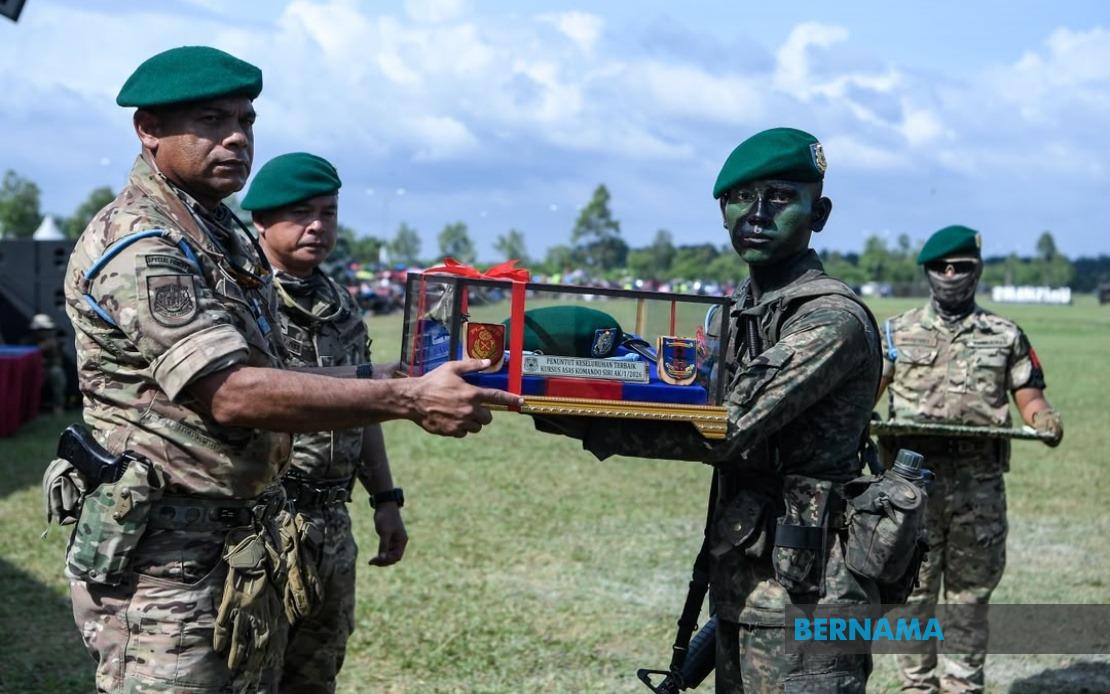
Second Lieutenant Muhammad Fadli Jamalluddin's path to becoming Malaysia's top commando trainee was far from straightforward. The 24-year-old from Ampang, Kuala Lumpur, initially stumbled when he failed to complete the Basic Commando Course Series 3/2024, yet rather than accept defeat, he channelled that disappointment into renewed determination. His eventual triumph in completing the Basic Commando Course Series AK/1/26 and securing the Best Overall Trainee award represents more than personal achievement—it underscores the resilience culture embedded within Malaysia's Special Forces training framework.
Muhammad Fadli's military trajectory began during his secondary school years, when he first harboured ambitions to serve in uniform. His commitment crystallised through formal military education at the National Defence University of Malaysia (UPNM), from which he graduated with a Bachelor's degree in Global Policing and Intelligence with Honours. Upon commissioning in 2024, he joined the Royal Malay Regiment, positioning himself within the broader ecosystem of Malaysia's defence establishment. Yet a conventional officer's posting held limited appeal; instead, he sought the legendary green beret by applying to the 21st Special Service Group (21 GGK), the nation's premier commando formation.
The decision to pursue commando training reflected more than professional ambition. Muhammad Fadli articulated that challenging himself represented both a personal milestone and a means of honouring his father, the third of five siblings driving his desire to pursue the military's most exacting specialisation. His motivations intertwined family pride with institutional aspiration, capturing a dimension of military service that transcends technical competency. This personal dimension gained poignancy when he later explained that his father, who suffered a stroke more than a year prior to the course's completion, could not attend the closing ceremony. His achievement, he hoped, would provide his father with strength and pride despite the elder's physical limitations.
The path to success proved considerably more arduous than anticipated. During the eighth week of the three-month training programme, Muhammad Fadli encountered another crisis when he failed one of the critical training exercises. This setback threatened to force him to repeat the entire course from the beginning, adding exponential difficulty to an already gruelling regime. The emotional toll proved immediate; he wept upon realising the implications of the failure. At that juncture, having already endured over 100 kilometres of endurance marching and countless other physical ordeals, many observers and counsellors suggested he abandon the pursuit and accept that commando training simply exceeded his capabilities.
His refusal to surrender at that critical moment defined his eventual success. Rather than internalising the failure as evidence of fundamental inadequacy, Muhammad Fadli reframed it as a learning opportunity and motivational catalyst. He explicitly rejected the counsel of those who warned him away from repeating the course, instead adopting a philosophical stance that positioned failure not as terminal but as a springboard for returning with enhanced preparation and mental fortitude. This cognitive reframing proved essential, as the Basic Commando Course demands not merely physical prowess but exceptional psychological resilience—precisely the mental framework that distinguished successful candidates from those who recognised their limitations.
The three-month course structure demanded integrated excellence across multiple domains. Muhammad Fadli elaborated that the training regime encompassed demanding land operations and amphibious maritime components, each testing different facets of military competency. The course required candidates to synthesise raw physical endurance with cognitive sharpness, recognising that special operations rarely succeed through brute strength alone. The most complex missions demand meticulous planning, sophisticated decision-making under extreme stress, and the capacity to adapt when conditions deviate from theoretical models. Officers faced particular scrutiny; the challenges confronting commando officers exceed those confronting enlisted personnel, as command authority demands not only personal operational excellence but the capacity to evaluate complex tactical scenarios and lead subordinates through existential danger.
Muhammad Fadli's qualifications positioned him well for officer-level commando operations. His academic background in global policing and intelligence provided analytical frameworks beyond those taught in purely military contexts. Understanding international security architectures, intelligence gathering methodologies, and strategic threat assessment equips officers to contextualise their operational roles within broader security architectures. This intellectual dimension, combined with his demonstrated physical and psychological resilience, created a comprehensive skill set that justifiably earned him the Best Overall Trainee distinction.
The course produced 38 successful graduates—five officers and 33 other ranks—completing the Basic Commando Course Series AK/1/26 at Universiti Sultan Abdul Halim Mu'adzam Shah (UniSHAMS) in Kuala Ketil. The venue itself holds symbolic significance within Malaysia's defence establishment, representing the institutional commitment to professional military education beyond traditional barracks environments. The awards ceremony, presided over by Colonel Nordin Abu, Commandant of the Special Warfare Training Centre (PULPAK), formalised Muhammad Fadli's achievements within the ceremonial structures that mark military progression.
For Malaysian defence observers, Muhammad Fadli's trajectory illuminates important patterns within the Special Forces recruitment ecosystem. The services deliberately seek officers willing to test themselves against elite standards, recognising that commando formations require leaders who have personally experienced and overcome the extreme demands imposed on their personnel. His resilience when confronting initial failure demonstrates that the modern Malaysian military values not innate talent alone but the capacity to persist through adversity. This emphasis on psychological toughness and adaptive learning reflects international best practice among elite special operations communities globally.
The recognition accorded to Muhammad Fadli extends beyond individual honour. His achievement validates the training methodologies employed by PULPAK and reinforces the institutional prestige associated with commando specialisation within Malaysia's defence culture. For prospective officers contemplating whether to pursue special forces careers, his example demonstrates that initial setbacks need not foreclose ultimate success, provided candidates possess the mental fortitude and determination to return stronger. The green beret he has earned represents not merely a credential but evidence of having met standards that few civilians and even fewer military personnel achieve throughout their careers.

