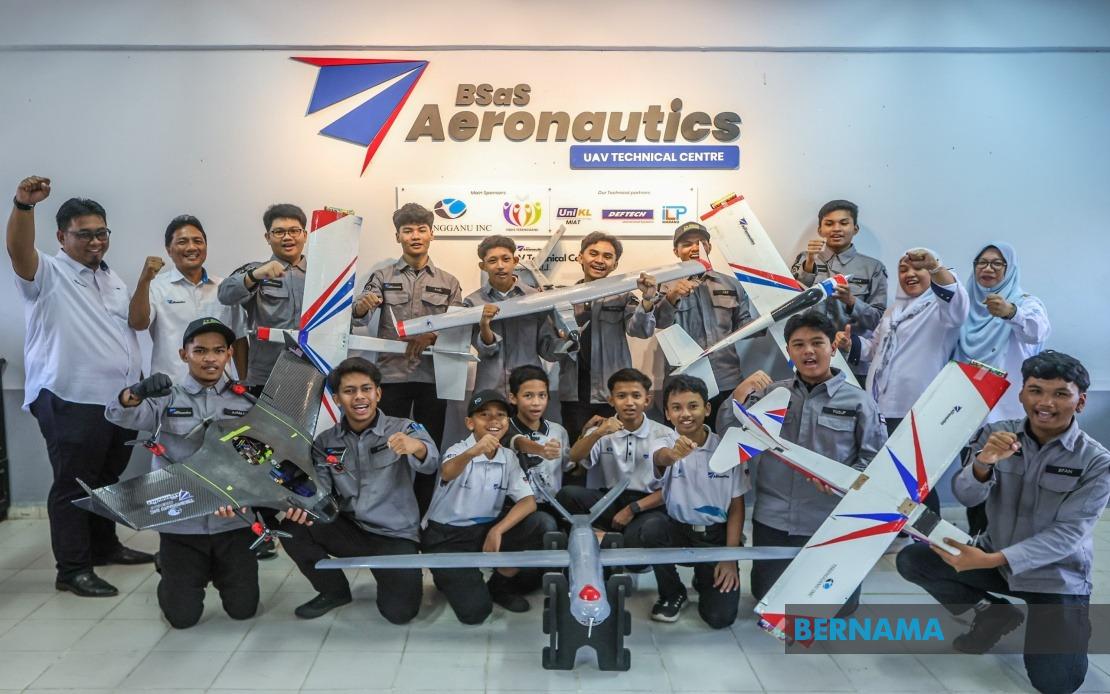
A secondary school in Marang, Terengganu, is charting an unconventional educational path by transforming aerospace engineering from abstract theory into tangible, flying machines. SMK Bukit Sawa has become home to an innovative hands-on learning initiative where 35 students have successfully constructed their own unmanned aerial vehicles, moving beyond textbook instruction to develop practical competencies in a high-technology field increasingly vital to Malaysia's economic future.
The driving force behind this initiative is Badrul Hisyam Zakaria, an English teacher whose passion for remote-controlled aircraft has evolved into a comprehensive educational programme known as the TI-BSAS UAV In School scheme. Since its inception in 2023, this venture has seen students and their instructors—a team of three teachers—engineer over five fully-functional UAVs, with each unit representing an investment of between RM6,000 and RM10,000. What distinguishes this school-based effort from hobbyist projects is its rigorous adherence to professional aviation standards, employing industrial-grade techniques and materials adapted to an educational setting.
The technical sophistication embedded in these student-built systems reflects genuine aerospace innovation. Each UAV incorporates Global Positioning System technology enabling precision target tracking, mirroring the capabilities found in commercial and military applications. The students are not simply assembling kits; they are learning the fundamental principles of aircraft design, avionics integration, and autonomous systems operation. The programme has already evolved beyond its initial specifications, with newer iterations incorporating artificial intelligence capabilities for visual target detection, representing a qualitative leap from the GPS-dependent systems that characterised earlier iterations.
Recognition for this educational endeavour came swiftly and decisively. In June of this year, SMK Bukit Sawa claimed the championship title in the UAV Avionics Integration Challenge at the MyAERO Challenge 2026 competition held at MAEPS in Serdang, Selangor. This victory was not merely a symbolic achievement but validation that students working within resource constraints could compete effectively against their peers nationwide. The competition result underscores that quality aerospace education need not be confined to prestigious urban institutions, and that dedicated educators and institutional commitment can unlock potential in regional Malaysia.
The programme's influence extends beyond immediate competition success into long-term career trajectories. Two former SMK Bukit Sawa students who participated in the UAV initiative have already progressed to undergraduate aircraft engineering studies at Universiti Kuala Lumpur, while three others have gained admission to matriculation science programmes. This progression—from secondary school hands-on projects to advanced tertiary study—demonstrates how experiential learning can inspire and prepare students for career paths in demanding technical fields. The ripple effect is beginning to manifest in measurable educational outcomes.
Badrul Hisyam has articulated an ambitious multi-year vision extending well beyond the current school cohort. The TI-BSAS programme deliberately targets students across Forms One through Four, establishing a comprehensive pipeline rather than one-off interventions. Through sustained monitoring of student development and career progression, the institution aims to track how secondary school participants translate their aerospace experience into professional trajectories. Within three to four years, the programme leadership anticipates producing Malaysia's first graduates—homegrown aerospace engineers who developed their foundational competencies within their secondary school walls.
The broader strategic rationale underlying this initiative reflects genuine national development priorities. Beyond cultivating individual talents, the programme explicitly targets building domestic capacity in UAV technology development and manufacturing. Currently, Malaysia's aerospace sector retains considerable technological dependence on foreign suppliers and expertise. By nurturing indigenous design, engineering, and production capabilities beginning at secondary level, the TI-BSAS programme contributes incrementally to eventual self-sufficiency in advanced aerospace applications. This philosophical orientation aligns with Malaysia's broader push toward becoming a technology-enabled economy less reliant on imported solutions.
Substantial financial backing has proven essential to realising this vision. Terengganu Incorporated Sdn Bhd, a state-linked commercial entity, has channelled RM75,000 toward programme support since its 2023 launch. The funding structure reveals strategic thinking: RM45,000 was deployed initially to establish foundational infrastructure and conduct pilot activities, while an additional RM30,000 allocation in 2026 ensures continuity and enables the aforementioned evolution toward AI-integrated systems. Datuk Burhanuddin Hilmi Mohamed, the company's president and group chief executive, articulated corporate social responsibility motivations centred on equipping Terengganu youth—particularly those from lower-income B40 households—with competitive skills in high-demand technological sectors.
This targeted focus on socioeconomic inclusion within Terengganu reveals important dimensions often overlooked in discussions of STEM education expansion. Rural and secondary-tier schools frequently face chronic resource constraints limiting student exposure to cutting-edge technology fields. By deliberately investing in a Terengganu institution and prioritising accessibility for disadvantaged socioeconomic backgrounds, Terengganu Incorporated is addressing both geographic and class-based disparities in aerospace opportunity. Students who might otherwise have no exposure to aviation careers are gaining hands-on familiarity with industry-standard equipment and methodologies.
The aviation sector globally faces persistent talent shortages, and Malaysia's aerospace industry is no exception to this international pattern. Creating authentic career pathways beginning at secondary level, rather than assuming talent will materialise organically at tertiary stage, represents a deliberate strategy to address anticipated workforce deficits. When students transition from classroom engagement with functional UAV systems to formal aviation studies, they arrive with considerably advanced baseline knowledge and demonstrated practical capability—a competitive advantage that will benefit both individual career prospects and employer recruitment pipelines.
Sustainability of the TI-BSAS programme over multiple academic cycles requires institutional commitment extending beyond initial novelty and corporate sponsorship enthusiasm. The evident success to date, reflected in national competition triumph and documented student progression into aviation careers, suggests the initiative has moved beyond experimental status into more durable operational mode. As the programme matures and produces demonstrable alumni outcomes, the case for sustained investment—whether through corporate CSR channels, government educational funding, or hybrid arrangements—becomes progressively more compelling.
The SMK Bukit Sawa experience offers a replicable model for other Malaysian secondary institutions seeking to engage students in technologically demanding fields while addressing regional educational equity. The combination of dedicated educator leadership, corporate partnership, state government coordination, and clearly articulated long-term objectives has generated measurable results. As Malaysia navigates transitions toward higher-value manufacturing and advanced technology sectors, cultivating aerospace talent through institution-embedded, experiential learning programmes represents a pragmatic investment in both individual student futures and national economic competitiveness.

