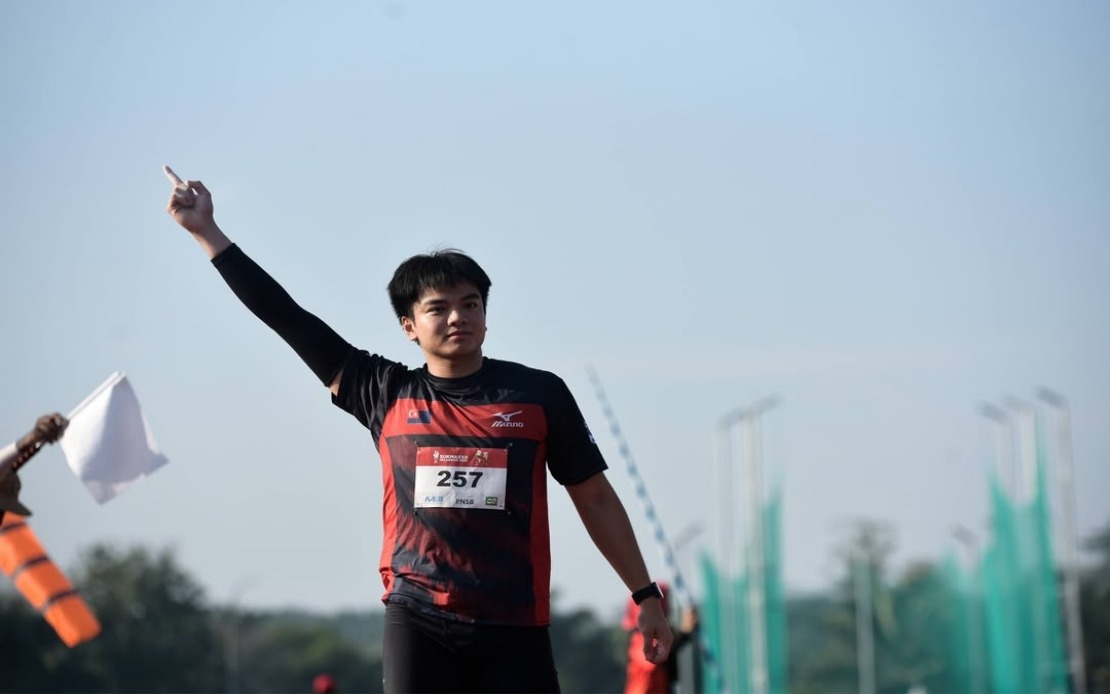
Eighteen-year-old Chai Kai Le's ascent to becoming Malaysia's record-breaking javelin thrower at the 2026 Selangor Malaysia Games began not on a track or field, but on a badminton court. The Johor athlete's journey from shuttlecock to spear demonstrates how sporting talent often emerges through unexpected pathways, shaped by keen observation and timely intervention from mentors who recognise potential beyond conventional channels. Today at the Universiti Putra Malaysia Sports Centre, Kai Le hurled the javelin 64.44 metres on his second attempt, obliterating the previous Games record of 62.33 metres established by Sarawak's Kho Mei Kuan at the 2000 Penang edition—a mark that had stood unchallenged for a quarter-century.
The catalyst for this transformation occurred during Kai Le's years in primary school when a perceptive teacher noticed something distinctive about his badminton technique. Rather than focusing purely on court performance, the educator recognised that the explosiveness and precision required in releasing the shuttlecock suggested latent potential in a throwing sport. This observation would prove pivotal. By Standard Six, Kai Le had made the transition to javelin, trading his racket for a spear and beginning the disciplined progression that would eventually position him among Malaysia's elite field athletes. The shift, though significant, was not presented as a career-ending decision but rather as an opportunity to explore where his natural abilities might lead him further.
What distinguishes Kai Le's story is not merely his raw athletic talent but the ecosystem of support enabling his development. His father, Chai Yin Huan, has functioned as an steadfast foundation throughout this journey, demonstrating the commitment required to nurture an aspiring elite athlete in a sport where specialised coaching, medical care, and equipment demand substantial investment. The financial dimension of youth athletics in Malaysia remains largely invisible in public discourse, yet it fundamentally determines which talented youngsters can pursue their potential and which must abandon their dreams due to resource constraints. Every injury treatment, every replacement pair of shoes, every competition entry fee has been shouldered by his father without expectation of immediate return or guaranteed success.
The past year has tested both Kai Le's resilience and his father's commitment in particular ways. While competing at the pre-university level at Bukit Jalil Sports School, the young thrower has grappled with recurring back problems and injuries to his right shoulder and elbow. These are not minor discomforts but potentially career-threatening complications that plague throwing athletes throughout their careers. Many athletes at this developmental stage would have retreated from competition to prioritise healing. Kai Le instead persisted, continuing his training regimen and competing despite incomplete recovery. This determination crystallised at the Indonesia Open earlier this year, where he established both a personal best and the national under-20 record of 65.65 metres, demonstrating that his breakthrough at SUKMA represents not a sudden eruption of talent but rather the culmination of sustained competitive progression.
The significance of his SUKMA record extends beyond personal achievement into the broader context of Malaysian athletics' performance trajectory. Field events have historically received less prominence and investment than track events within Malaysian sports development, yet they remain crucial components of comprehensive athletic excellence. Kai Le's record suggests that investment in systematic talent identification and coaching infrastructure can yield results even in traditionally under-resourced disciplines. His breakthrough at eighteen, with years of competitive development ahead, positions him as a potential standard-bearer for Malaysian athletics at regional and international competitions.
Looking forward, Kai Le has articulated ambitious targets that reflect both confidence and strategic ambition. His immediate objective centres on achieving a 70-metre throw within the next year, a threshold he believes necessary for securing a position in Malaysia's 2027 SEA Games delegation. To pursue this goal, he has planned a month-long training stint in Japan early next year, recognising that exposure to elite international coaching and training environments can accelerate development beyond what domestic programmes alone might provide. This outward-looking approach—seeking expertise and infrastructure beyond Malaysia's borders—reflects the pragmatism required of athletes striving for continental prominence.
The narrative surrounding Kai Le also illuminates the human dimensions often obscured in headlines celebrating national records. His acknowledgement of ongoing injuries that have not fully healed underscores the physical toll demanded by throwing disciplines. The javelin event requires generating explosive force through a complex kinetic chain involving legs, core, shoulder, and arm in precise coordination. Any weakness or imbalance in this sequence invites injury, and recovery often involves prolonged rehabilitation rather than quick fixes. That Kai Le achieved his record while managing these physical challenges suggests either exceptional pain tolerance or perhaps an underestimation of injury severity—both concerning from a long-term health perspective.
The role of Bukit Jalil Sports School in facilitating Kai Le's development deserves recognition as institutional infrastructure. Malaysia's network of sports schools represents a deliberate policy choice to identify and nurture talented young athletes, providing specialised coaching, training facilities, and academic support simultaneously. For students like Kai Le, these institutions create an environment where athletic development is not pursued parallel to education but rather integrated within it. The sustainability of such programmes depends on consistent funding, quality coaching recruitment, and alignment between school management and national sporting objectives.
Kai Le's comment that he commenced javelin training by observing senior athletes and envisioning himself matching their performances captures an essential element of athletic development often underestimated in policy discussions. Access to role models competing at high levels provides tangible evidence that ambitious goals are achievable rather than fantastical. For younger athletes in Malaysian sport, the availability of domestically-based competitors performing at elite levels serves motivational functions that statistics alone cannot replicate. Kai Le's presence at SUKMA as a record-setter will similarly inspire the next generation of field athletes contemplating whether pursuing javelin represents a viable pathway.
The economic implications of elite athletic development merit consideration for Malaysian sports administrators and policymakers. Kai Le's father's sustained financial investment in his son's athletics career represents private capital supporting national athletic achievement. Yet the sustainability of this model depends on families possessing adequate resources and cultural disposition toward such investment. Conversely, governmental programmes and national sports bodies must consider whether current support structures sufficiently subsidise promising athletes from less privileged backgrounds, ensuring that national records and medal achievements reflect talent distributed across society rather than concentrated among economically advantaged households.

