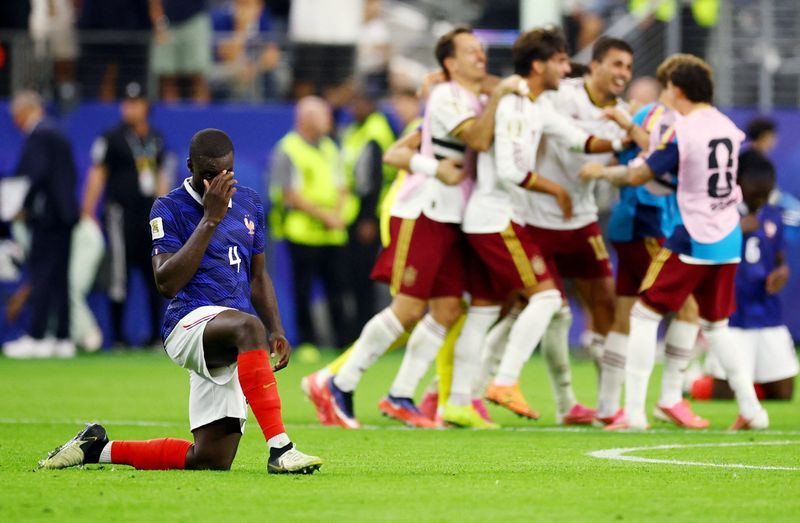
France's hopes of winning a second consecutive World Cup title evaporated in devastating fashion on Tuesday evening in Arlington, Texas, when Spain delivered a comprehensive 2-0 semi-final victory that exposed critical weaknesses in the French set-up. The defeat marked a stunning reversal of fortunes for a team that had entered the tournament as one of the favourites, only to crumble under serious pressure for the first time. Unlike their dramatic 2022 World Cup final appearance against Argentina, where they mounted a fierce comeback despite poor early-match displays, France found no redemption on this occasion. They were simply outplayed in every department by a Spanish outfit that dictated terms throughout and administered a tactical lesson the French side proved unable to answer.
Coach Didier Deschamps was forced to confront an uncomfortable truth in his post-match assessment, acknowledging that his players had fundamentally misunderstood the challenge ahead. The coaching staff and their highly paid roster of international stars had evidently underestimated Spain's capacity to control the game's rhythm and impose their style of play. Deschamps admitted that France's technical execution fell short when it mattered most, a damning indictment of a squad assembled with the expectation of defending their world championship status. The narrative that had surrounded the French preparation—built on assertions of cohesion and team unity—rang hollow once the whistle sounded for kick-off. What unfolded instead was a methodical Spanish dismantling of a side that appeared unprepared for the intensity of opposition they would encounter.
Spain's confidence heading into the match proved entirely justified, particularly in the swagger demonstrated by teenager Lamine Yamal, who had boldly declared that France should fear his team rather than the reverse. The Spanish teenager's swagger reflected a deeper understanding within the Spanish camp of their tactical superiority. Spain understood precisely how to neutralise France's strengths by controlling possession tempo and denying the French attackers the space they craved. This mastery of pacing and positioning proved the crucial difference, as Spain managed the encounter with the assurance of a team playing at the peak of their collective powers. The midfield orchestration by Rodri proved particularly influential, with the Spanish midfielder gliding through the centre with a ruthlessness that left his French counterparts chasing shadows and frequently out of position.
The struggles of Michael Olise symbolised France's broader attacking impotence throughout the evening. Olise had arrived at the tournament bearing considerable weight of expectation, with some observers suggesting his performances warranted inclusion in Ballon d'Or discussions. Yet on the Dallas Stadium pitch, the playmaker appeared entirely bereft of the space and creative freedom his game requires. Rodri's dominance in midfield meant Olise received possession in crowded areas where he could neither progress the ball effectively nor construct attacking opportunities for teammates. The statistical evidence painted a particularly bleak picture: Olise surrendered possession on twenty separate occasions and failed to complete a single successful dribble throughout the match. For a player France had specifically relied upon to unlock Spain's defensive structure, this represented a comprehensive failure when the stakes could not have been higher.
Olise's anonymity extended across the entire French attacking contingent, with other key forwards equally unable to impose themselves on proceedings. Ousmane Dembele contributed almost nothing to France's attacking thrust, while Bradley Barcola and his second-half replacement Desire Doue proved equally ineffective in generating scoring opportunities. Even Kylian Mbappe, widely regarded as one of football's most devastating attacking talents, found that his moment of decisive intervention never materialised. The afternoon's loudest roar from the crowd resulted not from French attacking prowess but rather from the appearance of David and Victoria Beckham on the stadium's giant screen—a striking indicator of where excitement and attention had shifted during the match. This convergence of underperformance from France's attacking array rendered the team's forward line a collective disappointment when measured against the considerable reputation its component parts carried into the tournament.
France's vulnerability in midfield proved the foundation upon which Spain constructed their dominant performance. The double pivot system Deschamps had deployed, intended to provide defensive stability and midfield control, was quickly overwhelmed by Spain's superior positioning and movement. Adrien Rabiot's early yellow card forced him to moderate his aggressive approach just when France needed his driving force most, effectively neutralising one of their key midfield engines. Aurelien Tchouameni, who had missed the previous two matches due to a hamstring injury, appeared short of both rhythm and the physical conditioning necessary to maintain pace with Spain's energetic midfield. His struggle to keep up with Spanish movements highlighted the risks inherent in selecting players returning from injury in such a critical fixture. The exposed defence that resulted from midfield failures meant France's back line faced relentless Spanish pressure, ultimately conceding twice through preventable errors.
Spain opened the scoring in the twenty-second minute when Mikel Oyarzabal converted a penalty following France's defensive lapse, an early blow that set the psychological tone for the remainder of the encounter. The second goal arrived just before the hour mark through Pedro Porro, extending Spain's advantage and effectively ending any realistic possibility of a French comeback. These were not fortunate strikes resulting from defensive aberrations alone, but rather the natural consequence of Spain's sustained dominance and France's inability to establish defensive coherence. Deschamps' tactical framework had been dismantled so thoroughly that by the time the second goal arrived, the outcome was virtually predetermined. France never threatened a meaningful comeback, and their attacking impotence meant Spain could regulate the game's intensity at will.
The physical and emotional response from French players at the final whistle starkly illustrated the magnitude of the disappointment. Kylian Mbappe stood isolated on the pitch, a solitary figure contemplating the magnitude of the team's collapse. Some teammates dropped to their knees in devastation, while others buried their faces in their hands, unable to process the scale of the defeat. These raw emotional displays reflected not merely the pain of elimination but the sense that France had failed to compete adequately when the tournament reached its defining moment. The stark contrast between their pre-match rhetoric of unity and cohesion and the fractured, dispirited players visible at the full-time whistle underscored how comprehensively Spain had exposed their vulnerabilities.
For Malaysian and Southeast Asian observers, France's elimination carries broader implications for international football dynamics. The result demonstrates that technical pedigree and star-studded squad composition provide insufficient guarantee of success against opponents who execute superior tactical preparation and collective understanding. Spain's methodical approach—slowing tempo, controlling possession, and neutralising individual threats through intelligent positioning—offers a blueprint for teams seeking to overcome ostensibly more talented opposition. The defeat also highlights the dangers of underestimating emerging talent, as Lamine Yamal and Spain's young generation proved capable of outmaneuvering a defending world champion. For regional football development, the match underscores the continuing importance of systematic tactical preparation and team cohesion over individual brilliance alone. French football's painful exit from the tournament serves as a cautionary tale about the fragility of perceived supremacy and the necessity of tactical discipline at the highest competitive levels.

