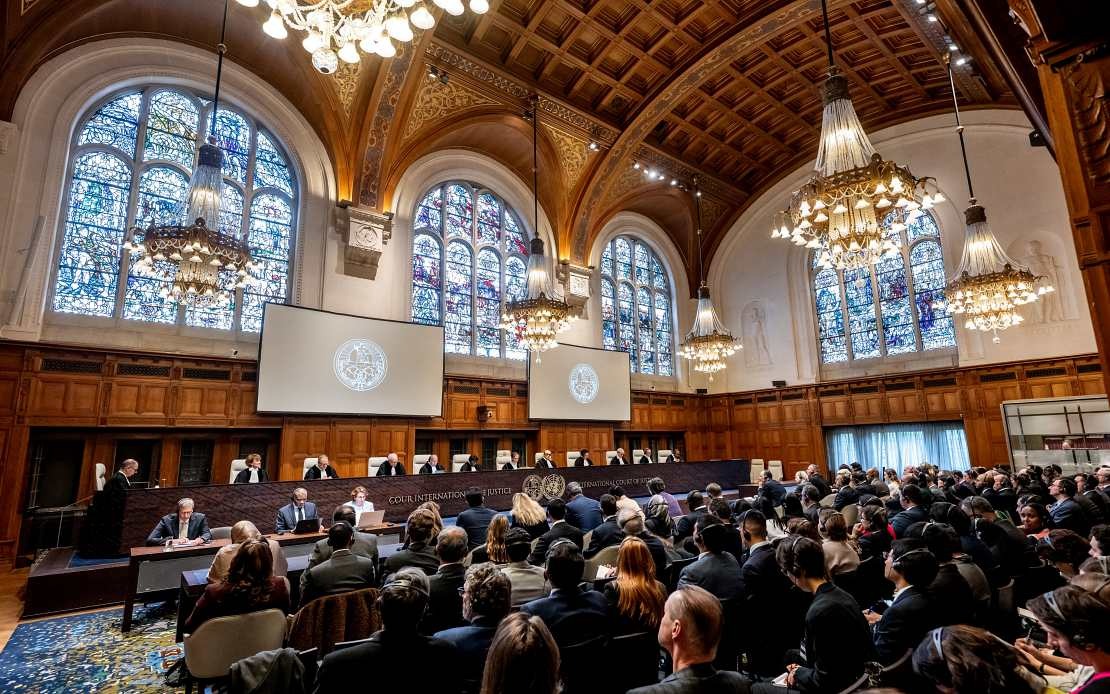
France has doubled down on its commitment to the International Criminal Court, rejecting the characterisation by the United States that the institution represents a threat to state sovereignty or independent governance. The stance from Paris underscores a widening diplomatic fissure between Washington and major European allies over the role and legitimacy of international justice mechanisms, an issue that carries particular weight for Southeast Asian nations navigating complex geopolitical relationships with both Western powers and the Global South.
Foreign Ministry spokesman Pascal Confavreux articulated France's position during a Thursday briefing, emphasising that the ICC functions as a prosecutorial body targeting individuals accused of humanity's gravest offences rather than operating as a vehicle for attacking nations or their governments. This distinction matters significantly in the ongoing debate about the court's mandate and its relationship with state sovereignty. By directing legal action at specific persons rather than national entities, Confavreux suggested, the ICC operates within legitimate bounds that respect state autonomy while advancing international accountability standards.
Confavreux was deliberate in reaffirming France's unwavering support for the court's institutional resilience and its foundational mission to combat impunity for crimes of the highest order. His statement carried particular weight given the escalating pressure campaign being mounted by the United States against the ICC. France's explicit endorsement signals that at least some major powers intend to maintain their commitment to multilateral justice institutions despite American opposition, suggesting the world's response to international law mechanisms remains fractured along traditional geopolitical lines.
The French official also drew attention to what Paris considers an alarming pattern of intimidation directed at ICC personnel and operational staff. He characterised assaults, threats and hostile actions against those engaged in the court's work as unacceptable conduct that undermines the institution's capacity to function. These remarks appear directed at recent controversies involving pressure campaigns and statements questioning the ICC's legitimacy, signalling France's concern that the court faces mounting institutional stress from multiple quarters.
The confluence of French statements emerged in direct response to declarations from US Secretary of State Marco Rubio, who publicly asserted that the International Criminal Court constitutes a threat to American sovereignty and independence. Rather than accepting these claims at face value, Rubio announced an aggressive diplomatic initiative intended to persuade other nations to withdraw their membership from the court or reduce their participation. This represents a substantial escalation in American opposition to an institution that has existed as a cornerstone of international justice architecture for more than two decades.
Washington's newly activated campaign extends beyond Rubio's rhetoric. The US State Department has now established a dedicated initiative explicitly designed to curtail what American officials describe as the ICC's capacity to challenge American authority or prosecutorial independence. This institutional commitment suggests the US intends to pursue the matter systematically rather than through ad hoc criticism. The approach reflects deep American scepticism about international courts more broadly and particular sensitivity regarding the possibility that American citizens or officials might face investigation by external judicial bodies.
The International Criminal Court, headquartered in The Hague, was formally established in 2002 as a permanent institution mandated to investigate and prosecute individuals responsible for genocide, war crimes, crimes against humanity and the crime of aggression. The court represents one of the most significant achievements in post-World War II international law, embodying the principle that serious crimes warrant accountability through mechanisms that transcend national borders and individual state interests. Over two decades of operation, it has issued numerous convictions and currently maintains ongoing investigations across multiple continents.
The United States maintains a notably ambivalent relationship with the ICC despite its own historical emphasis on international law and human rights. America has never formally ratified the Rome Statute, the founding treaty that established the court and remains outside its jurisdiction. This outsider status paradoxically creates vulnerability, as it means American officials cannot influence ICC policies through membership while simultaneously worrying that the institution might pursue cases involving American personnel. France, by contrast, has consistently backed the court and maintains active participation in its governance structures.
For Southeast Asian nations watching this diplomatic confrontation unfold, the implications are substantial. The region includes both ICC member states and non-members, and many nations navigate delicate relationships with both the United States and European powers. Malaysia and other ASEAN members must consider how American pressure campaigns against international institutions might affect their own strategic autonomy. If the US successfully persuades countries to withdraw from the ICC, it could fundamentally reshape the global architecture for addressing mass atrocities and strengthen state sovereignty arguments that some leaders invoke to resist external scrutiny of domestic conduct.
The Franco-American disagreement also reflects deeper philosophical divisions about how international justice should function in a multipolar world. France's steadfast backing suggests that at least portions of Europe intend to defend multilateral judicial institutions even against pressure from Washington. This creates space for other nations to maintain ICC participation without appearing isolated, though it simultaneously invites American retaliation against countries that resist pressure to withdraw.
The timing and intensity of the American campaign raise questions about whether the Biden administration has fundamentally shifted its approach to the ICC or whether a potential change in US leadership might bring different priorities. Regardless, the French reaffirmation of ICC support indicates that fundamental divisions about international law's proper role will likely persist in coming years, with significant consequences for how the world's legal systems handle accountability for serious crimes.

