The quarter-final encounter between France and Morocco in Boston on Thursday represents far more than a typical knockout fixture. The two nations carry with them a complex historical relationship spanning over a century, with football emerging as perhaps the most vivid expression of their enduring cultural, economic, and social connections. From players developed in French academies to friendships forged at Paris Saint-Germain, the match encapsulates how migration and shared language have woven themselves into the fabric of modern international sport, creating a meeting that feels simultaneously competitive and familial.
France's protectorate over Morocco lasted from 1912 until 1956, a chapter that fundamentally shaped both nations' trajectories in the decades that followed. Rather than fading into historical obscurity, this colonial legacy continues to manifest through contemporary ties in education, commerce, and crucially, population movement. The resulting diaspora has become instrumental in shaping Morocco's footballing ambitions, with the national team deliberately harnessing talent scattered across French cities to construct a competitive international squad. This strategy represents a deliberate recalibration of what might traditionally be viewed as postcolonial disadvantage into sporting advantage.
The numerical presence of French-born players within Morocco's tournament squad underscores this calculated approach. Six members of the current squad entered the world in France itself, while numerous others refined their skills in Ligue 1 or progressed through French development pathways before committing to represent their heritage nation. Ayyoub Bouaddi exemplifies this phenomenon most clearly—born on French soil, groomed by Lille's academy, capped by France's youth teams, yet ultimately selecting Morocco as his international home. Such players embody a dual footballing identity that adds psychological texture to any France-Morocco encounter, representing individuals comfortable straddling both sporting cultures.
The personal dimension of this fixture extends beyond squad composition into the realm of individual relationships. The genuine friendship between Kylian Mbappé and Achraf Hakimi, forged during their shared years at Paris Saint-Germain, introduces an almost contradictory human element to what might otherwise be a straightforward competitive narrative. These are players who have trained together, celebrated goals together, and built bonds transcending national allegiances. The Boston venue, removed from the heightened security environment that will dominate proceedings in France, paradoxically permits a more relaxed atmosphere where such connections can exist openly without the political and social tensions that sometimes accompany international sport in post-colonial contexts.
Boston itself presents an intriguing setting for this rematch of their 2022 Qatar encounter, which France won decisively two-nil. The Moroccan diaspora presence in the American city, whilst proportionally smaller than in European centres like Paris or Lyon, has nevertheless established itself as a meaningful community. Moroccan-born residents have constructed networks spanning families, students, professionals, and business interests throughout the metropolitan region. Mohammed Saadi, a fifty-seven-year-old taxi driver, articulated the character of this coexistence with striking clarity, explaining that supporters often inhabit the same residential buildings and neighbourhoods, with neighbours from both nations frequently watching matches together and exchanging cordial handshakes regardless of outcome. The absence of tension reflects geographical and social distance that permits a fundamentally different viewing experience than would occur in cities where post-colonial dynamics carry sharper contemporary resonance.
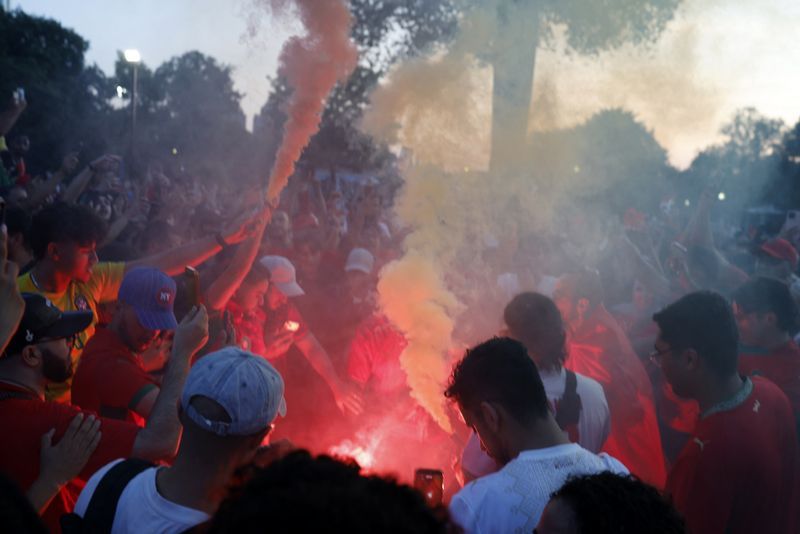
Gatherings in Boston Common ahead of Thursday's fixture demonstrated the peaceful nature of this cross-national engagement. Over one thousand supporters assembled to sing Dima l-Maghrib and brandish Moroccan flags in an atmosphere conspicuously free from the confrontational energy that sometimes accompanies international football. Youssef Bennani, a thirty-six-year-old software engineer who travelled from Finland to witness every stage of Morocco's tournament, described encountering both Moroccan supporters and French ones within the same spaces, with an anticipated celebratory mood transcending national boundaries. This harmonious coexistence would prove difficult to replicate in France itself, where security concerns and historical memory create psychological barriers to such easy fraternisation.
Morocco's trajectory through this tournament has fundamentally altered the nature of any fixture between these opponents. Four years earlier, they arrived in Qatar as compelling underdogs, a narrative that invited natural sympathy and created dramatic tension. Their subsequent progression to the semi-finals—a continental first for an African nation—recalibrated global perceptions of African football's competitive capacity. Now, returning to quarter-final competition just months later, they arrive not as romantic outsiders but as an organised, strategically developed force possessing genuine capacity to challenge established powers. Their federation's deliberate strategy of connecting domestic player development with diaspora talent cultivated across Europe has created a hybrid strength that traditional international football hierarchies have struggled to counteract effectively.
The federation's approach represents a distinctly modern interpretation of how nations can leverage migration and diaspora networks as sporting assets rather than viewing such displacement as a loss of talent. By systematically identifying players raised abroad yet eligible through heritage to represent Morocco, the federation transformed what might have been a weakness into a fundamental structural advantage. This methodology requires robust scouting infrastructure, clear selection communication, and player confidence that choosing Morocco represents a prestigious opportunity rather than a backward step from European football. Morocco has evidently succeeded in establishing all three prerequisites, enabling them to field teams whose technical quality and tactical sophistication rival any European opponent.
France, conversely, arrives as defending world champions from 2018 with deep tournament experience and an attack that has consistently demonstrated incisive potency throughout this competition. Their progression past Paraguay to reach the quarter-finals proceeded almost as expected, befitting a squad laden with established talent and proven match-winners. However, Morocco's clinical three-nil dismantling of Canada should inject caution into French planning, revealing pace, structural discipline, and unbounded ambition that can trouble even the most accomplished defences. The Canadian performance suggested Morocco have not merely qualified for this stage through fortune or generosity but through the sustained application of a coherent tactical system executed with focus and intensity.
The historical context informing this fixture creates layers of meaning extending well beyond contemporary sporting competition. For supporters in Boston, the match offers opportunity to celebrate shared heritage and footballing excellence without the weight of metropolitan tension that accompanies such fixtures in Europe. For the players themselves, particularly those with connections to both nations, the contest represents an occasion to demonstrate the sophisticated footballing identity that diaspora experience has granted them. France's task involves overcoming an opponent whose development strategy has deliberately eliminated any European technical or organisational advantage, while Morocco must execute their blueprint with sufficient precision to trouble opponents accustomed to winning major tournaments. The Boston setting permits this contest to unfold with a familial quality that the Boston setting permits, turning competitive intensity into something that feels more like family reunion played out on international sport's highest stage.

