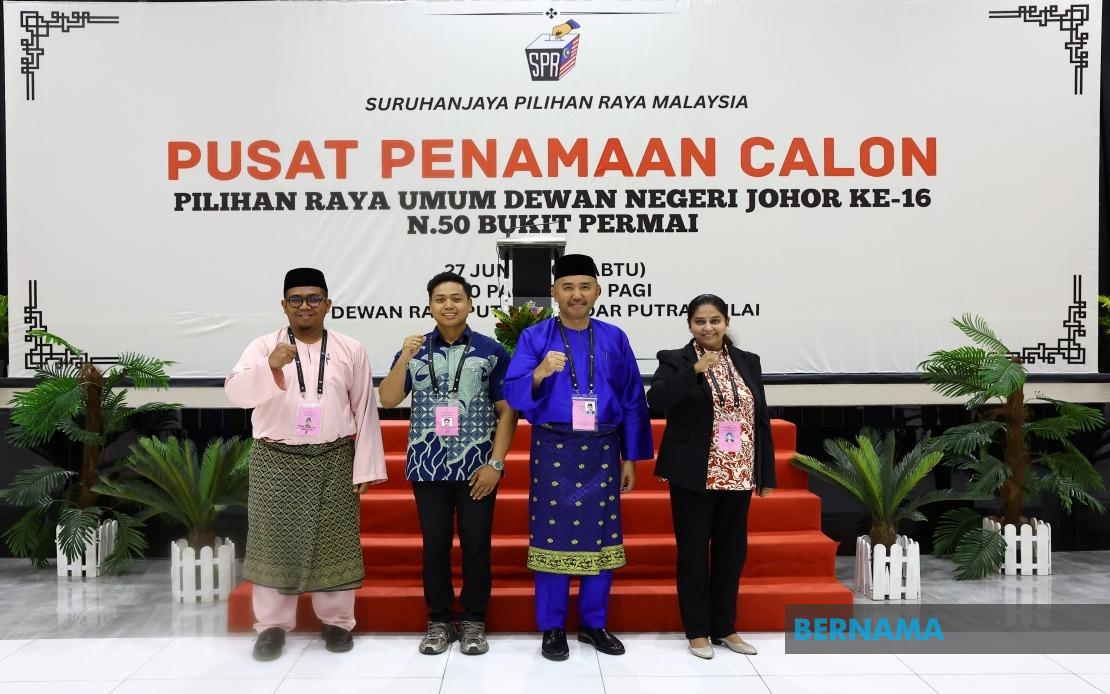
The battle for the Bukit Permai state assembly seat is intensifying as nominations closed for the 16th Johor state election, setting the stage for a competitive four-way contest in the Batu Pahat district. Incumbent Datuk Mohd Jafni Md Shukor, representing Barisan Nasional, will seek to retain his position against three challengers vying for the seat that has become a significant focal point in this electoral cycle.
The returning officer, Afzan Azhari, formally announced the four candidates at the nomination centre at Dewan Raya Putra in Bandar Putra after the nomination process concluded at 10 am. Facing the BN incumbent are Mohamad Shafwan Ani fielded by Pakatan Harapan, M. Lina Manoh representing Perikatan Nasional, and Muhammad Aidil Riduan Mohd Yusof standing for Parti Bersama Malaysia. The presence of four distinct candidates reflects the fragmented political landscape currently reshaping Johor's electoral terrain, with multiple coalitions and newer parties seeking to establish footholds in state constituencies.
Pakatan Harapan's candidate received backing from party heavyweights at the nomination centre, with Johor DAP chairman Teo Nie Ching arriving at 8.26 am to accompany Mohamad Shafwan. This show of support underscores the coalition's determination to challenge BN's traditional stronghold, though the opposition's efforts remain complicated by the presence of competing anti-establishment forces. The arrival of party leadership suggests PH views Bukit Permai as a winnable seat where focused campaigning could yield results in an election where every marginal gain matters.
Mohd Jafni enters the contest with demonstrated electoral strength, having secured the seat in the previous 2022 Johor state election with a comfortable majority of 4,755 votes, also in a four-cornered fight. However, that previous victory took place in a different political environment, and the intervening period has witnessed significant shifts in voter sentiment and party alignments across Malaysia. The emergence of Perikatan Nasional as a serious contender at the state level, combined with the new entry of Parti Bersama Malaysia, suggests that the incumbent cannot assume his previous success provides immunity against this revised array of opponents.
The Bukit Permai contest exemplifies broader dynamics affecting Johor politics, where BN's traditional dominance faces pressure from multiple flanks. Unlike earlier elections where contests were often binary affairs between government and opposition, contemporary Johor constituencies increasingly feature diverse lineups reflecting the complexity of contemporary Malaysian politics. The four-way nature of this battle means victory margins could narrow significantly, placing greater emphasis on voter turnout and the effectiveness of ground-level campaigning in determining outcomes.
Peikatan Nasional's participation in Bukit Permai represents its ongoing effort to establish presence across Johor's state assembly seats. The coalition, which has gained traction in certain regions, views state elections as crucial platforms for consolidating support before national contests. M. Lina Manoh's candidacy offers voters a third alternative that positions itself outside the traditional BN-opposition binary that has dominated Malaysian politics for decades. The appeal of such positioning varies considerably by constituency, depending on local political histories and demographic composition.
Parti Bersama Malaysia's entry into the Bukit Permai race reflects the continued fragmentation of Malaysia's political space, where newer entities seek to carve out niches by appealing to specific voter groups or positioning themselves as alternatives to established parties. While such newcomers typically face structural disadvantages in terms of organisational capacity and voter familiarity, they occasionally capitalise on broader dissatisfaction with traditional political offerings. Muhammad Aidil Riduan Mohd Yusof's candidacy will test whether such newer formations can gain meaningful traction in Johor constituencies.
The campaign period leading to polling day on July 11 will prove critical for all candidates. Early voting has been scheduled for July 7, allowing certain voter categories including those working in essential services and those away from their constituencies to participate in advance. This two-phase voting arrangement has become standard in Malaysian elections but requires campaigns to maintain momentum across both periods. The relatively compressed timeframe between the close of nominations and election day means candidates must immediately mobilise their organisations and messaging strategies to reach voters effectively.
For Datuk Mohd Jafni, the campaign presents both opportunities and risks. His incumbent status provides advantages in terms of visibility, established networks, and ability to point to constituency development work undertaken during his tenure. However, incumbency can also generate grievances among constituents regarding unfulfilled promises or inadequate service delivery. His challengers will likely emphasise such concerns while presenting their own visions for Bukit Permai's future development and governance.
The outcome in Bukit Permai will form part of the larger Johor state election narrative, where the collective results across all constituencies will determine the composition of the state government and the balance of power in Johor politics. Individual contests like this one increasingly influence broader patterns, as strong performances in previously safe seats can signal shifting voter preferences that reshape political calculations across multiple constituencies. Malaysian political observers will be monitoring whether this four-way contest produces results consistent with national trends or reflects distinctly local dynamics.
The significance of Bukit Permai extends beyond its immediate electoral importance to what it reveals about voter receptivity to different political offerings in Johor. The presence of four candidates representing distinct political traditions and approaches provides voters with genuine choice but also complicates predictions about electoral outcomes. Factors including turnout levels, campaign effectiveness, and the degree to which strategic voting occurs will all influence final results. As Johor voters prepare to cast their ballots on July 11, constituencies like Bukit Permai will demonstrate whether established patterns of political dominance remain intact or whether the state's electoral landscape is genuinely shifting.

