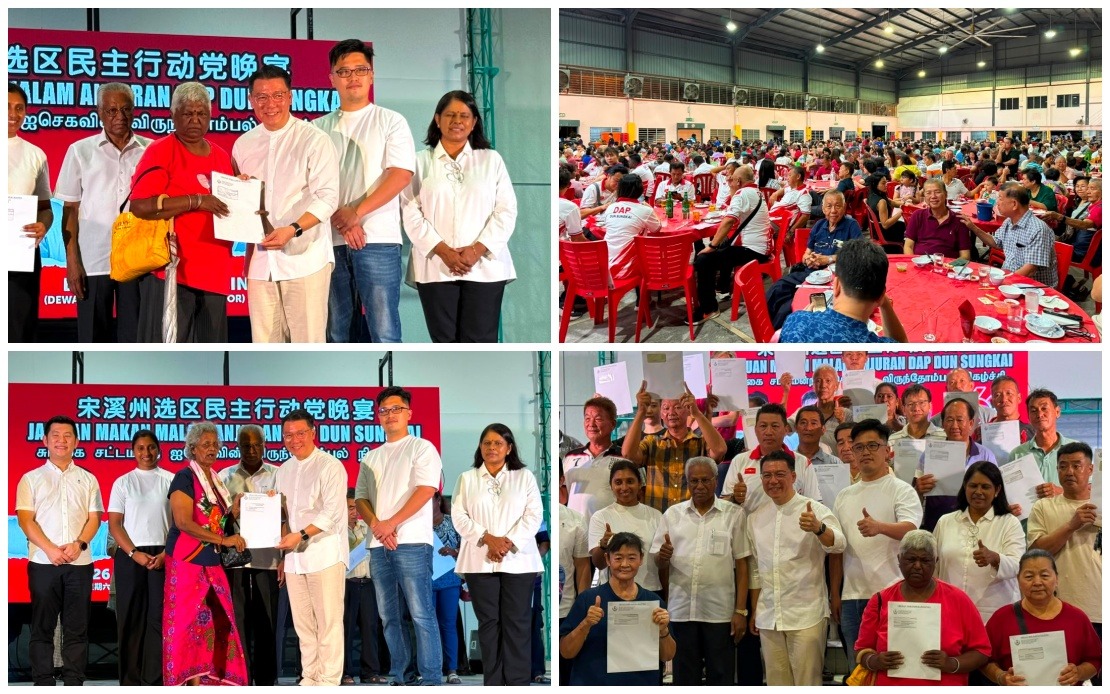
A major milestone in Malaysian land settlement policy was reached when 120 families residing in the Sungkai and Kuala Bikam areas of Perak finally received formal land grants, concluding a protracted dispute spanning over four decades. Housing and Local Government Minister Nga Kor Ming announced the resolution at a ceremony held during a DAP Sungkai state constituency anniversary dinner, presenting the documentation to recipients before more than 1,200 community members from diverse backgrounds.
The completion of this settlement case represents a significant policy victory for the current administration, which has framed housing security and land ownership as fundamental development priorities. For the families involved, the grants provide legal certainty and a foundation for long-term financial stability, transforming their status from informal occupants to legitimate landowners. The gesture carries particular weight in Malaysian politics, where land disputes have historically been flashpoints for community grievance and electoral mobilisation, especially in constituencies with mixed demographic compositions.
Nga Kor Ming contextualised the outcome within the broader MADANI Government framework, positioning the resolution as evidence of an administration committed to leaving no Malaysians behind regardless of ethnicity or socioeconomic standing. This framing carries strategic importance in Malaysian politics, where perceptions of equitable resource distribution directly influence community support and electoral fortunes. The minister's emphasis on inclusivity addresses longstanding concerns within Indian Malaysian communities about adequate policy attention and resource allocation for settlements and infrastructure.
The government has simultaneously amplified its financial commitments to Indian community development beyond land regularisation. Allocations include RM20 million dedicated to Indian settlements, RM50 million earmarked for Tamil vernacular schools (SJKKs), and an expanded RM150 million budget for the Malaysian Indian Transformation Unit (MITRA). These concurrent announcements suggest a coordinated approach to addressing infrastructure and institutional gaps within Indian Malaysian communities, particularly relevant in peninsular states where Tamil-speaking populations maintain significant political influence in certain constituencies.
Sungkai assemblyman Datuk A. Sivanesan, who chairs the state's Human Resources, Health, Indian Community Affairs and National Integration Committee, received ministerial recognition for his role in facilitating the resolution. Local officials including Ipoh Timur MP Howard Lee Chuan How and several state assemblypersons from surrounding constituencies attended the ceremony, indicating broader political investment in the outcome. This multi-level government representation underscores the significance attributed to settlement regularisation within the DAP's political strategy in Perak, where such programmes affect voter sentiment and community stability.
The resolution carries implications for land administration practices across Malaysia's peninsular states, where informal settlements remain widespread despite decades of urbanisation and infrastructure expansion. The successful conclusion of the Sungkai-Kuala Bikam case may establish procedural precedents for addressing similar disputes in other regions, potentially accelerating resolution timelines for other affected communities. However, the four-decade duration of this particular case also highlights systemic inefficiencies in land regularisation mechanisms, raising questions about the institutional capacity and prioritisation frameworks that determine how quickly such issues reach resolution.
Nga Kor Ming used the occasion to articulate a broader political philosophy emphasising performance-based governance over identity-driven politics. His appeal for voters to evaluate government achievements rather than succumb to communal sentiment reflects the current administration's strategic positioning in an increasingly fragmented electoral landscape. This messaging attempts to redirect political discourse toward measurable outcomes—land grants, school funding, infrastructure projects—while cautioning against what the minister characterised as outdated, divisive political approaches. The rhetorical strategy acknowledges the persistence of identity-based politics while attempting to subordinate it to technocratic considerations.
For Malaysian readers in other states and constituencies, the Sungkai-Kuala Bikam resolution illustrates both the potential and limitations of government intervention in resolving entrenched settlement disputes. The 40-year timeline suggests that even successful outcomes require extraordinary persistence and political capital, while the eventual resolution demonstrates that land regularisation remains achievable through sustained institutional effort. Communities facing similar situations may view this case as either encouraging evidence of eventual administrative action or cautionary evidence of protracted delays requiring decades of advocacy to overcome.
The event's timing and scale—held during a major anniversary celebration with extensive community attendance—indicates deliberate political strategy to maximise public awareness and frame the resolution as a significant governance achievement. In Malaysian political culture, where local infrastructure projects and development announcements regularly feature in electoral campaigns, the presentation of land grants to 120 families serves multiple simultaneous functions: delivering tangible benefits to beneficiary communities, generating positive media coverage for the MADANI Government, and demonstrating DAP capacity to deliver material improvements in constituencies it governs.
Looking forward, the Sungkai-Kuala Bikam resolution may influence implementation approaches in other pending settlement cases across Perak and neighbouring states. The successful outcome could justify additional budget allocations for land regularisation programmes and accelerate departmental processing of outstanding claims. However, the four-decade resolution timeline also underscores the resource intensity and administrative complexity of comprehensive settlement regularisation, suggesting that significantly expanding such programmes may require substantial institutional restructuring and heightened funding commitments across multiple government agencies and state governments.

