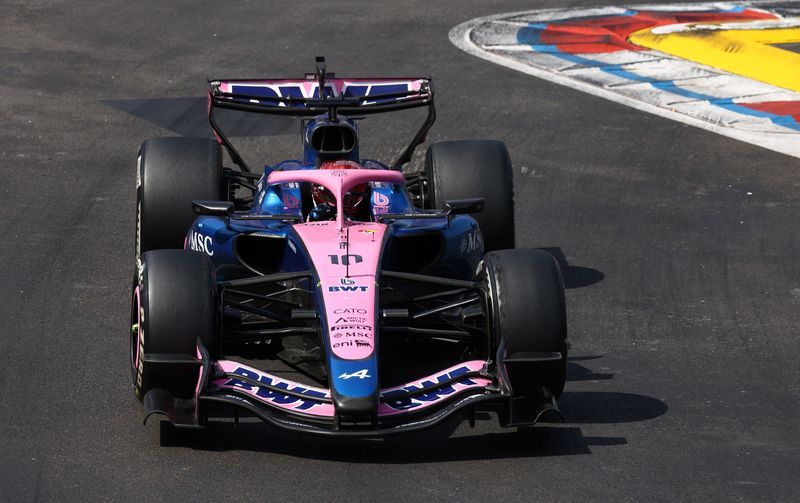
The saga surrounding the Monaco Grand Prix podium placement will finally reach its conclusion when Formula One's international court of appeal reconvenes in Paris on Tuesday, nearly three months after the actual race took place. What should have been a straightforward celebration on the streets of Monte Carlo has instead become a legal wrestling match that has threatened to undermine confidence in the sport's regulatory framework and set troubling precedents for how stewards' decisions are reviewed and reversed.
Alpine driver Pierre Gasly appeared to have secured a respectable third-place finish on June 7, a result that would have bolstered his team's championship aspirations. However, race stewards subsequently handed him two five-second penalties for exceeding the speed limit in the pit lane, a move that demoted him to seventh position. Red Bull's Isack Hadjar benefited from this decision and celebrated his promotion to the podium by spraying champagne on the rostrum, believing the matter had been settled according to the sporting regulations.
Five days later, the situation reversed dramatically when Alpine presented evidence demonstrating that a timekeeping error had occurred, providing technical documentation that stewards found sufficiently compelling to overturn their own decision. The penalties were rescinded, Gasly's third-place finish was restored, and Hadjar was obliged to return the trophy. This dramatic reversal immediately triggered concerns among teams and paddock observers that the ruling had created a problematic precedent, essentially allowing penalties to be nullified through post-race technical challenges in ways that fundamentally altered the competitive outcome.
Under normal circumstances, when a driver receives a time penalty during a race, they must serve it immediately in the pit lane, losing track position and momentum. Oscar Piastri, McLaren's rising star, had accepted his own pit-lane speeding penalties during the race itself, receiving the same five-second punishment twice. Believing there was no avenue for appeal and operating under the assumption that such infractions were unavoidable under certain track conditions, Piastri served his time and continued racing, though the penalties had significant consequences for his finishing position and championship points.
When Gasly's penalties were subsequently removed, the disparity between the two drivers' situations became glaringly apparent. Piastri had dropped from fourth to fifth place as a direct consequence of serving penalties that he believed were permanent and non-negotiable, while Gasly's reinstatement bumped the McLaren driver further down the order. The Australian driver thus suffered a double penalty: he lost positions during the race and then lost additional positions when a competitor's identical infraction was later cancelled through administrative review.
McLaren and Red Bull formally challenged the stewards' reversal through the international court on June 16, initiating the appeals process that now stretches toward resolution. McLaren's motivation extends beyond defending Piastri's individual result; team principal Andrea Stella articulated a broader concern about sporting integrity during a press conference at the subsequent Dutch Grand Prix, which Lando Norris won for McLaren. Stella emphasized that the situation raised fundamental questions about how penalties are applied, reviewed, and reversed, and whether the correction mechanism itself represented fair treatment of all competitors.
Stella outlined two distinct dimensions to McLaren's grievance. First, the team contends that the post-race process in Monaco requires thorough examination from the perspective of competitive fairness across the entire grid. The removal of Gasly's penalties established a troubling precedent that penalties applied and served during a race could potentially be overturned through technical evidence presented after the checkered flag, creating uncertainty about the finality of in-race stewards' decisions. Second, McLaren faces a material championship consequence: Piastri served penalties that could not be appealed while his competitor's identical penalties were subsequently erased, resulting in a swing of positions that directly affected both drivers' championship points.
Stella stressed that McLaren's appeal addresses both the systemic integrity of Formula One as a sport and the specific financial and championship implications for his team. The championship impact of losing points under circumstances perceived as procedurally unjust compounds the competitive frustration. For a team like McLaren, fighting for constructors' championship honors, such point swings can determine the difference between victory and defeat across an entire season, making this dispute far more consequential than a single race result might initially suggest.
The FIA has announced that the hearing will proceed at its Paris headquarters on Tuesday, conducted behind closed doors without public or media attendance. Officials cited confidentiality protocols as justification for the restricted access, a decision that ensures the proceedings will not be subject to public scrutiny, media analysis, or the watchful eyes of the broader Formula One community. The hearing's private nature means that the reasoning behind whatever decision the court reaches may not be fully transparent to teams, drivers, or fans seeking to understand how such situations should be handled in future.
The appeal represents a critical juncture for Formula One's regulatory credibility. How the international court resolves this matter will signal to the paddock whether race-day penalties can be confidently viewed as final verdicts or whether technical challenges presented weeks after the event can systematically unwind the competitive consequences embedded in those decisions. The broader implications extend to whether pit-lane speed violations and other objective infractions will be treated consistently across drivers and races, or whether the availability of technical resources and legal expertise will determine whose penalties survive post-race scrutiny.
For Malaysian and Southeast Asian Formula One enthusiasts, this extended dispute illustrates the sometimes byzantine nature of international motorsport governance, where technical precision and sporting fairness can clash in ways that challenge even the sport's most senior officials. The delay in reaching a final determination also underscores how disputes that occur on a specific weekend can resonate through the entire season, affecting championship calculations and team strategies weeks later. Whatever the court decides, the Monaco controversy will likely influence how stewards approach pit-lane violations and technical reviews throughout the remainder of the season and beyond.
The FIA has committed to publishing its decision as quickly as possible following Tuesday's hearing, promising to bring closure to a dispute that has festered throughout the summer racing calendar. Nonetheless, the resolution will arrive well over 80 days after Gasly crossed the finish line at Monte Carlo, a timeline that itself reflects the complexity of modern Formula One administration and the challenges of reconciling technical precision with sporting fairness in a sport where milliseconds and millimeters determine champions.

