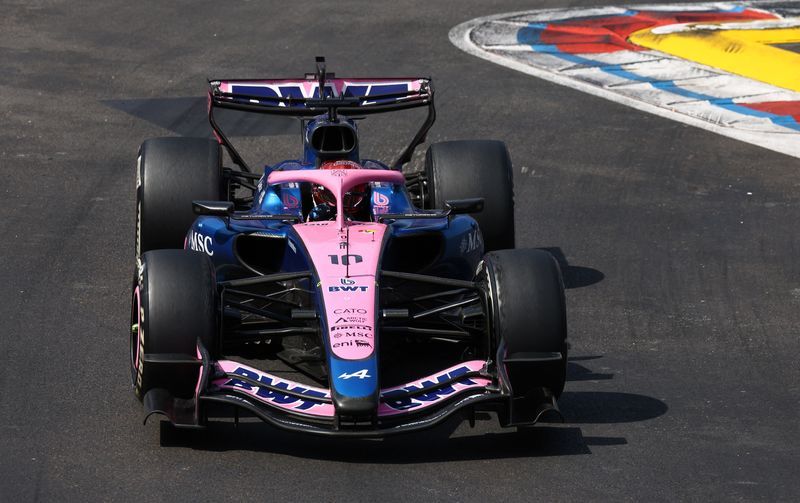
The FIA's international court of appeal has begun deliberations on one of the most contentious penalty decisions in recent Formula One history, with judges set to take between two and three weeks before announcing their ruling on the final standings of June's Monaco Grand Prix. The closed-door hearing took place in Paris on Tuesday, addressing a dispute that has fractured the paddock and raised fundamental questions about the consistency and fairness of stewards' decision-making in motorsport's premier category.
At the heart of the controversy lies Pierre Gasly's third-place finish, which has ping-ponged between him and Red Bull's Isack Hadjar as different judicial panels have examined the circumstances. Gasly crossed the finish line in third position on June 7, but stewards immediately applied two five-second pit-lane speeding penalties that demoted him to seventh place and elevated Hadjar onto the podium. The mechanics of the penalty system meant Hadjar could celebrate with champagne, his team believing the decision was final.
That certainty lasted less than a week. On June 12, stewards overturned their own decision after reviewing evidence presented by Renault-owned Alpine, accepting that a timekeeping error had undermined the original penalty's validity. Hadjar returned the trophy to Gasly in an awkward reversal that exposed the fragility of the stewards' initial judgment. However, this apparent resolution collapsed when Red Bull and McLaren jointly appealed on June 16, arguing that the reversal itself created a new injustice within the sport's regulatory framework.
The ripple effects of the dispute extend well beyond the two drivers in question, creating a domino effect through the lower placings. If the appeal court upholds the original penalties against Gasly, McLaren's Oscar Piastri would move from fifth position back up to fourth, improving his points haul in the championship fight. Liam Lawson would fall to seventh for Red Bull-owned Racing Bulls, with Arvid Lindblad dropping further. These seemingly modest positional changes carry substantial weight in a championship where every point matters, particularly for McLaren as it mounts an increasingly credible challenge against Mercedes.
What makes this dispute especially significant is the principle of selective application that it exposes. Piastri received identical pit-lane speeding penalties to Gasly but served them during the race itself, meaning he cannot benefit from any potential reversal due to how the penalty system operates. That asymmetry has become the crux of McLaren's complaint. The Australian driver lost positions and points because his penalties were served in real time, whereas Gasly's post-race penalties could theoretically be erased if a procedural error could be identified. Mercedes driver George Russell, another title contender, also served a pit-lane speeding penalty during the race and fell out of the points as a result, adding another voice to the chorus of complaint.
McLaren team principal Andrea Stella articulated the team's frustration at the Dutch Grand Prix, arguing that removing Gasly's penalties raised troubling questions about fairness across the entire field. Stella acknowledged that McLaren's appeal carried both a principled dimension and a practical self-interest, noting the direct championship impact of potential points adjustments. The tension between these motivations reflects the reality of high-level competition, where sporting integrity and competitive advantage are necessarily intertwined.
The stewards faced an unenviable position when deciding whether to overturn penalties that had already been handed down. While they accepted that a timekeeping error had occurred and warranted the reversal, they simultaneously noted the regulatory vacuum that such situations create. In their written decision, stewards remarked that no regulation actually grants them the authority to undo a penalty once it has been served or applied, and that attempting to reverse served penalties would be logically impossible within the existing framework. This admission highlighted how the Monaco situation fell into an uncomfortable grey area where established procedures failed to account for a particular set of circumstances.
The hearing itself yielded no public details, conducted entirely behind closed doors in the manner of appeal court proceedings. This confidentiality, while standard practice, adds to the frustration among teams and observers eager to understand the reasoning that will determine the final outcome. The judges must weigh competing interpretations of the regulations, assess the significance of the timekeeping error, and determine whether reversing penalties creates a worse precedent than allowing them to stand despite procedural failings.
For Malaysian and Southeast Asian Formula One enthusiasts, this dispute matters because it touches on fundamental principles that shape how the sport operates globally. The credibility of regulatory decisions affects fan confidence and the perceived legitimacy of championship outcomes. A high-profile bungle and subsequent reversal, followed by months of legal wrangling, sends a concerning signal about stewards' competence and the robustness of governing procedures. As the championship approaches critical phases, teams and drivers want certainty about how decisions will be made and enforced.
The broader context adds urgency to the resolution. With the Italian Grand Prix scheduled for Monza on September 6 and Madrid's inaugural circuit hosting its debut on September 13, Formula One moves forward regardless of the appeal court's timeline. The championship battle continues even as the Monaco result remains technically unresolved, creating an unusual situation where a potential change to prior points allocations could theoretically alter the mathematical trajectory of the title fight. Teams are essentially competing under two different potential scenarios simultaneously until the judges announce their decision.
This episode has crystallized concerns about consistency in stewards' decision-making that have simmered throughout the sport for years. The Monaco Grand Prix result has become emblematic of broader questions: How should procedural errors be remedied? What precedent does overturning penalties set for future decisions? And fundamentally, what constitutes fairness when established procedures produce outcomes that everyone acknowledges contain elements of injustice? The appeal court's eventual ruling will provide answers, but the damage to regulatory confidence may persist long after the champagne bottles are properly distributed.

