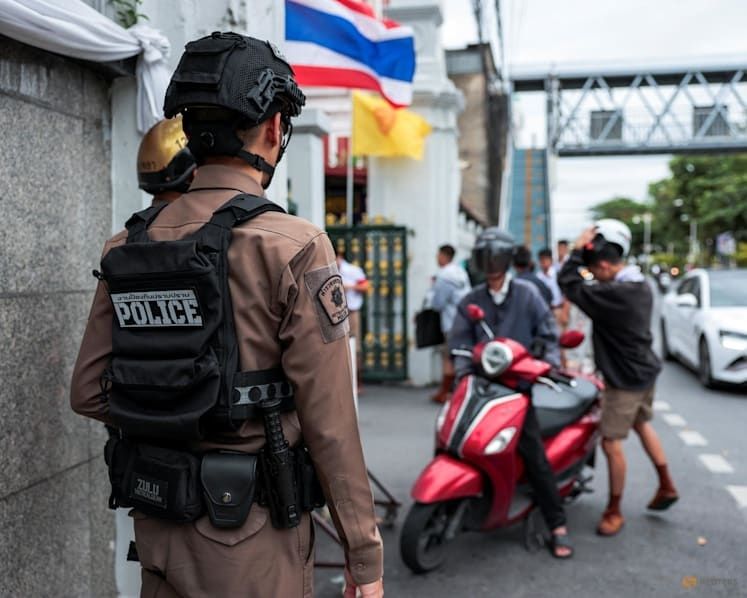
Thai police arrested a former parliamentarian on Monday on suspicion of shooting and injuring a local government official and his driver in Nonthaburi province, the latest security incident to shake the region just days after a school massacre that claimed eight lives. The shooting of the local administration chairman and his driver has intensified scrutiny over Thailand's gun ownership patterns and the effectiveness of existing firearms regulations.
Nonthaburi police chief Dejrapee Kongdee confirmed the arrest of former MP Chalong Riewrang and stated that investigators were examining potential motives behind the alleged attack. The two shooting victims were receiving medical treatment at a hospital following the incident, with the chairman of the Nonthaburi local government administration sustaining injuries described as serious. While police provided limited details about the driver's condition, both men remained hospitalised following the shooting.
Local news outlets have reported that the incident may stem from a personal or business dispute, though police have not publicly confirmed this line of investigation. Dejrapee declined to elaborate on the motive, indicating that inquiries were still in their early stages. The restraint in disclosing details is typical of Thai police procedure during active investigations, particularly when high-profile political figures are involved.
Charong's political connections add another dimension to the incident. He previously served as a member of parliament representing his constituency and held membership in the ruling coalition party led by Prime Minister Anutin Charnvirakul. The involvement of a former legislator in a violent crime raises questions about political tensions and underlying social fractures within Thailand's power structures. His formal arrest marks a significant development, as authorities move from investigation to formal charges.
This shooting occurs in a deeply troubling context. On Friday of the same week, a fourteen-year-old boy carried out a shooting rampage in Nonthaburi that left eight people dead, including his own grandparents who had raised him. After killing six additional people at his school, the teenager died by suicide. That incident sparked renewed national discussion about gun violence and whether Thailand's current safeguards are adequate to prevent such tragedies.
Thailand's relationship with firearms presents a complex policy challenge for Southeast Asia. Approximately ten million guns are estimated to be in private circulation throughout the country, translating to roughly one firearm for every seven inhabitants—a ratio that places Thailand among the highest gun ownership rates in the region. This prevalence reflects historical factors, cultural traditions around hunting and self-defence, and the accessibility of weapons through both legal and informal channels.
Government responses to the Friday school shooting have emphasised promises of stricter firearms legislation and enhanced controls. However, Thai policymakers face a pattern of recurring violence despite previous commitments to reform. Past pledges to tighten gun laws have failed to materialise into meaningful enforcement or have proved insufficient to stem incidents of shooting violence. This pattern suggests that legislative intent alone may not address deeper societal factors driving gun violence.
The dual incidents within days of each other have revived debate about the adequacy of Thailand's gun control framework and the enforcement mechanisms supporting existing regulations. Advocates for stricter measures point to the toll exacted by both random mass shootings and targeted violence involving private disputes. The involvement of a former MP in the latest incident complicates the narrative, suggesting that access to firearms cuts across social strata and that political status offers neither protection nor restraint.
For Malaysia and other Southeast Asian nations observing Thailand's security challenges, the incidents underscore the broader regional debate over balancing personal security and public safety. Malaysia maintains stricter firearms regulations than Thailand, with civilian gun ownership heavily restricted and subject to rigorous licensing. Thailand's looser approach creates a contrasting case study of how permissive weapons policies can intersect with social conflict to produce periodic cycles of violence.
The arrest of Chalong represents immediate law enforcement action, but broader questions persist about whether police investigations and prosecutions can adequately address systemic problems. The gap between policy pronouncements and implementation remains the critical challenge facing Thai authorities. Officials must demonstrate that promises of reform translate into tangible changes in gun registration, background checks, licensing oversight, and enforcement of existing restrictions.
Thailand's gun violence crisis extends beyond the two incidents this week, reflecting patterns established over years. Each major incident prompts official declarations of intent to strengthen controls, yet subsequent shootings suggest that those reforms either did not occur or proved inadequate. The international spotlight following Friday's school shooting has intensified pressure on Thai policymakers to move beyond rhetoric toward sustained, enforceable measures that address both the supply of weapons and the social conditions enabling their misuse.
As investigations into both incidents proceed, the scrutiny of Thailand's firearms regime will likely intensify. The involvement of a former politician in the Nonthaburi shooting may also prompt uncomfortable questions about access and privilege within Thailand's political system. Whether the Chalong case results in meaningful consequences or becomes another unresolved episode in Thailand's cycle of gun violence will signal the government's actual commitment to reducing firearms-related harm.

