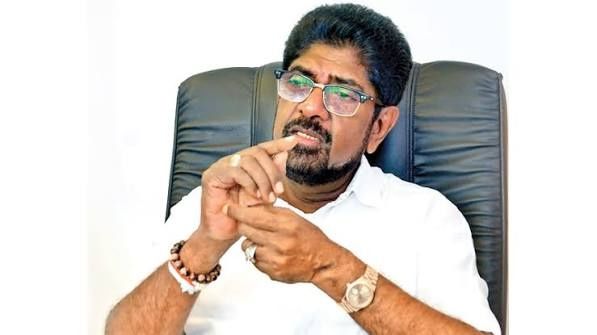
A former Sri Lankan government minister faced arrest this week after anti-corruption authorities accused him of orchestrating the removal of a priceless centuries-old carved stone from a royal palace. Keheliya Rambukwella's detention on Tuesday marked the latest development in what has become a sprawling corruption scandal ensnaring multiple high-ranking officials in the island nation.
The object at the centre of the inquiry is a distinctive circular granite rock known locally as a "moonstone," which forms part of the decorative threshold leading into the palace that once belonged to Veera Parakrama Narendrasinghe, Sri Lanka's last Sinhala monarch who ruled until 1739. The Commission to Investigate Allegations of Bribery or Corruption (CIABOC) alleges that Rambukwella not only facilitated the theft when it occurred in December 2022, but subsequently worked to impede the police investigation into the crime. Officials from CIABOC emphasised that the minister had "conspired, aided and abetted" in removing the historically significant artefact during his tenure in government.
Beyond the moonstone case, Rambukwella now faces a separate allegation that he misappropriated state resources to finance the employment of six individuals for his own business ventures. This charge underscores a pattern of alleged misconduct spanning multiple portfolios and time periods. The accumulating weight of accusations suggests systemic oversight failures within Sri Lanka's administrative apparatus, where senior officials appear to have exploited their positions for personal gain with relative impunity until recent accountability mechanisms began functioning.
Rambukwella's legal difficulties extend even further into an ongoing courtroom battle centred on his role as health minister. During that period, he allegedly authorised the procurement of counterfeit pharmaceutical supplies for national hospitals. Most alarmingly, police investigators have presented evidence to the court indicating that a life-saving cancer medication purchased under his watch proved upon inspection to be nothing more than water. The case exemplifies how corruption in critical sectors like healthcare can directly endanger public welfare, particularly in a nation already grappling with severe medical shortages.
The pharmaceutical fraud scandal has implicated several other senior officials within Sri Lanka's health ministry infrastructure, suggesting the problem was not confined to individual malfeasance but reflected institutional breakdown. During the period when Rambukwella held the health portfolio, the island nation was experiencing an acute scarcity of essential medicines that paralysed the healthcare system. This supply crisis itself emerged from Sri Lanka's catastrophic economic collapse, which forced the government to default on its US$46 billion foreign debt burden in April 2022 and trigger a formal declaration of national bankruptcy.
For Malaysian and Southeast Asian observers, the Rambukwella case illuminates how political instability and economic distress can rapidly corrode institutional integrity and enable brazen official misconduct. Sri Lanka's descent from relative regional stability to profound crisis occurred with shocking speed, and the cascading corruption cases now surfacing suggest that the crisis period created opportunities for officials to prioritise personal enrichment over public duty. The moonstone theft, the counterfeit medicine scheme, and the misuse of state employment resources all occurred during or immediately after the nation's economic unravelling, when government capacity to monitor and enforce standards had deteriorated markedly.
The moonstone matter carries symbolic weight beyond its material value. Removing a revered artefact from a palace associated with the island's pre-colonial past strikes at cultural heritage and national identity at a moment when Sri Lanka's institutional credibility was already severely compromised. The simultaneous emergence of multiple corruption investigations suggests that once-functional oversight mechanisms have finally begun operating more effectively, perhaps drawing momentum from international pressure and domestic social upheaval triggered by the economic crisis.
Rambukwella's arrest also reflects evolving dynamics within Sri Lanka's post-crisis political environment. As the nation gradually stabilises its macroeconomic position and rebuilds state capacity, newly empowered or re-energised anti-corruption bodies appear determined to hold officials accountable for misdeeds committed during the chaotic transition period. The CIABOC's willingness to pursue a former government minister on charges spanning multiple distinct offences signals that accountability mechanisms are no longer dormant or politically constrained.
The broader implications for regional governance deserve attention. Sri Lanka's experience demonstrates how thoroughly economic collapse can penetrate and poison administrative systems, transforming government institutions from service providers into vehicles for personal extraction. As other Southeast Asian nations navigate economic pressures and geopolitical tensions, the risks of similar institutional degradation remain pertinent. Furthermore, the international dimensions of Sri Lanka's debt default and IMF-supervised recovery programme mean that external creditors and multilateral institutions now exercise significant influence over the island's governance trajectory, including pressure to demonstrate anti-corruption commitment.
The multiplicity of charges against Rambukwella—ranging from theft conspiracy to pharmaceutical fraud to misuse of public funds—underscores how corruption frequently operates across several registers simultaneously. Officials who breach fiduciary duties in one domain typically do so across multiple portfolios and over extended periods. Only through comprehensive investigation and prosecution strategies can authorities effectively address such systemic misconduct. Sri Lanka's emerging accountability actions, while imperfect and sometimes appearing selective through international observer perspectives, represent a necessary corrective to the impunity that characterised the most acute phase of the economic crisis.

