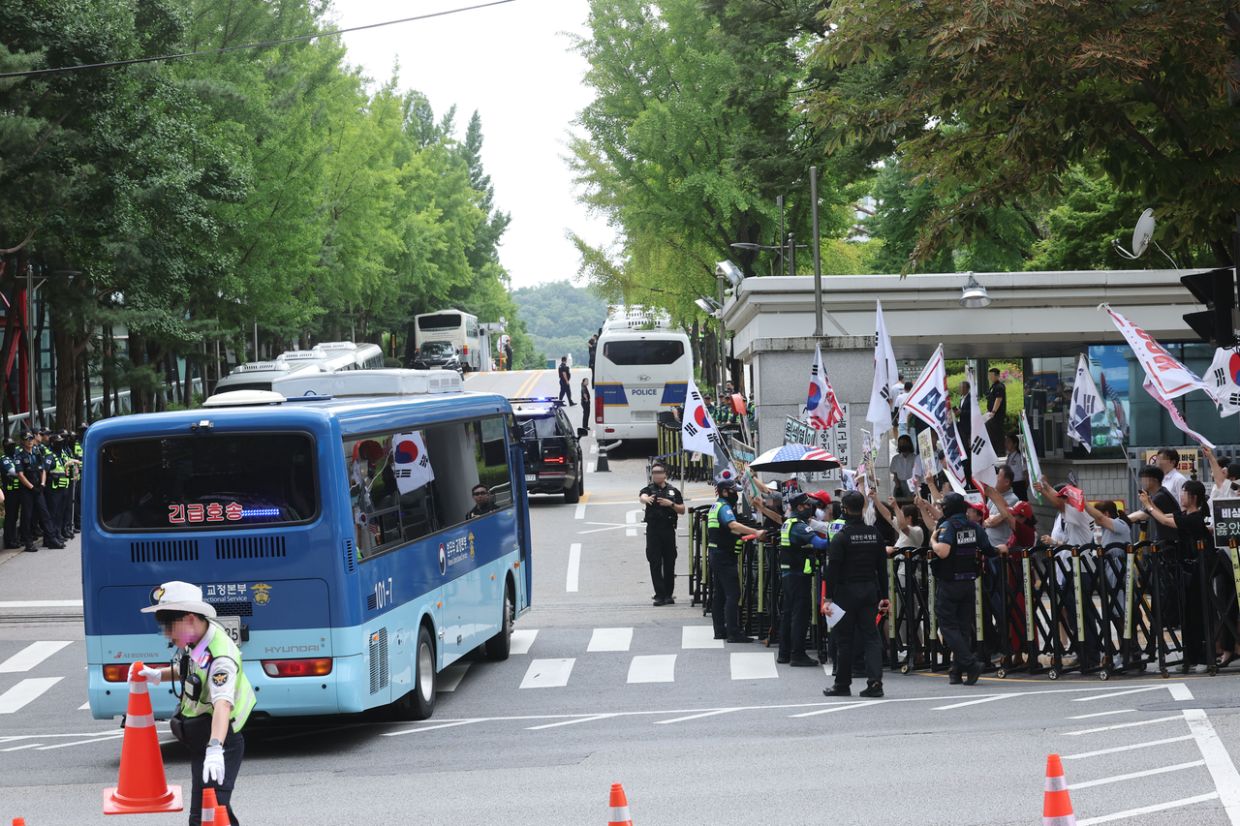
South Korea's judicial system has delivered a significant verdict in its ongoing reckoning with allegations of campaign finance misconduct, with former President Yoon Suk Yeol receiving a two-year prison sentence from the Seoul Central District Court for accepting unpaid political polling services during his successful 2021-2022 presidential campaign. The court's determination that Yoon violated the Political Funds Act marks a watershed moment in South Korean politics, establishing that even the nation's highest office does not exempt individuals from accountability in matters of electoral integrity.
The case centered on 14 separate surveys with a combined financial value of 27.92 million won (approximately $18,600) that were provided without charge by political broker Myung Tae-kyun. The court's investigation revealed a complex arrangement in which Yoon's wife, former first lady Kim Keon Hee, had authorized Myung to control the timing, content, methodological approach, and publication status of the polling operations. Evidence presented to the court demonstrated that Yoon himself was fully informed of this arrangement and tacitly consented to its continuation, establishing what the judiciary characterized as a successive and implicit agreement among all three parties involved.
Presiding Judge Lee Jin-gwan articulated a notably stern interpretation of the democratic principles at stake in the decision, emphasizing that opinion polls function as critical instruments that shape voter behaviour and form a fundamental pillar of democratic legitimacy. The judge's written reasoning underscored that when political figures receive contributions outside the legally prescribed framework, and polling firms respond by providing survey results as reciprocal consideration, the entire electoral process faces corrosive distortion. This framing reflects a judicial philosophy that prioritizes systemic integrity over individual circumstances, positioning the case as emblematic of broader concerns about the commercialization and privatization of political information in democratic societies.
Crucially, prosecutors had originally mounted a more expansive case, alleging that Yoon and his wife had conspired to receive as many as 58 separate surveys valued at over 270 million won across the period from June 2021 through March 2022. However, the court's final determination proved narrower than the prosecution's initial charges, with judges finding sufficient evidence to convict on 14 surveys while declining to establish culpability on the remaining counts. This more limited verdict nevertheless resulted in a substantial prison sentence, signalling that the judiciary viewed even the narrower set of violations as serious enough to warrant substantial punishment.
The evidence presented to the court also revealed an additional layer of alleged misconduct: that Yoon had promised Myung the political broker that former lawmaker Kim Young-sun would receive the ruling People Power Party's presidential nomination endorsement in return for the provision of polling services. The court documented that Yoon subsequently exerted demonstrable influence over the party's nomination process through Chang Je-won, then serving as chief of staff to the president-elect, to ensure that this promise was honoured. Nevertheless, the judges determined that establishing proof of this quid pro quo arrangement was not necessary to sustain a conviction under the Political Funds Act, a legal interpretation that represents a notably strict approach to campaign finance enforcement.
Myung Tae-kyun, the political intermediary at the centre of the arrangement, received his own substantial sentence of 18 months in prison and was immediately remanded into custody within the courtroom following the verdict. His conviction and immediate incarceration underscores the court's determination that responsibility for violating electoral finance regulations extends beyond those seeking political office to include the private actors who facilitate such arrangements. The parallel sentencing of both Yoon and Myung suggests a judicial intent to address not only high-level political misconduct but also the enabling infrastructure of political corruption that operates in the shadow of official campaign processes.
A striking asymmetry emerged in the court's treatment of Yoon's case compared to the parallel proceedings against his wife, former first lady Kim Keon Hee. Despite facing charges related to identical polling services provided by the same Myung Tae-kyun, Kim was acquitted at both trial and appellate court levels on charges of violating the Political Funds Act. Presiding Judge Lee explicitly acknowledged this divergence, noting that while the allegations shared a common source in Myung's polling services, the courts had determined that the cases themselves could not be regarded as legally identical. The lower courts in Kim's case had concluded that prosecutors had failed to establish that she had received a financial benefit equivalent to the cost of the surveys or that the services were provided as direct quid pro quo compensation for the Kim Young-sun nomination.
This legal distinction carries profound implications for understanding the court's approach to establishing guilt in campaign finance cases. The differential treatment of husband and wife in cases stemming from nearly identical factual circumstances suggests that South Korean judges are applying a nuanced analytical framework that distinguishes between different types of involvement in campaign finance violations. The greater legal culpability attributed to Yoon compared to Kim may reflect judicial findings regarding the directness of their respective involvement in authorizing or benefiting from the arrangement, the explicitness of any quid pro quo understanding, or the degree of personal knowledge and consent demonstrated by each party.
The case arrives at a particularly significant moment in South Korean political history, as the nation continues to grapple with the proper constraints on presidential power and the mechanisms through which accountability can be enforced against former chief executives. Previous administrations have witnessed dramatic political trials and reversals of fortune, yet the Yoon proceedings represent a new phase in which the judiciary is directly engaging questions about the permissible boundaries of campaign finance practices among the highest-ranking political figures. The court's willingness to impose a substantial prison sentence on a former president signals a strengthening of institutional constraints on executive power and a judicial determination that electoral laws apply with equal force to all political actors regardless of previous office.
The Supreme Court's scheduled delivery of its final ruling in Kim Keon Hee's case on Thursday will provide the ultimate judicial determination on the former first lady's status and may further clarify the legal reasoning by which Korean courts distinguish between different forms of participation in campaign finance violations. Should the Supreme Court affirm the acquittals delivered by lower courts, the divergent outcomes in the Yoon and Kim cases will establish a clear precedent that direct responsibility for unlawful campaign finance arrangements carries significantly graver consequences than indirect or secondary involvement. Conversely, if the Supreme Court reverses course and convicts Kim, the legal landscape would shift toward a more unified approach treating all beneficiaries of campaign finance violations with equal severity.
For regional observers in Southeast Asia, the Yoon case offers instructive lessons about the institutional capacity of judicial systems to constrain executive power even after individuals have departed office. Many regional democracies continue to wrestle with questions about post-presidential accountability and the mechanisms through which campaign finance violations can be effectively prosecuted. South Korea's experience demonstrates both the possibilities and limitations of judicial oversight, as courts work within existing legal frameworks to determine appropriate punishments while grappling with evidentiary challenges and questions of individual intent and knowledge that complicate the determination of guilt in complex financial arrangements.

