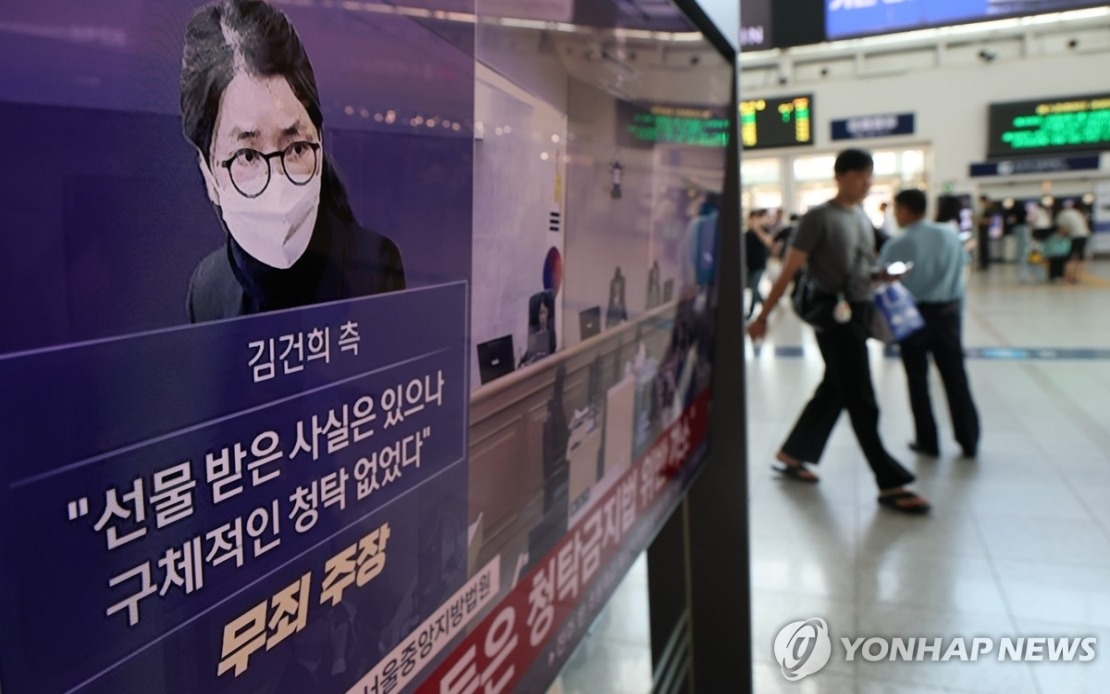
A Seoul court has handed down a seven-year prison sentence to Kim Keon Hee, wife of ousted former President Yoon Suk Yeol, in a landmark case exposing corruption within South Korea's highest political circles. The Seoul Central District Court found the former first lady guilty of systematically accepting expensive gifts as payment for leveraging her position to secure government appointments and advance business interests, marking a significant moment in South Korean anti-corruption efforts.
The charges against Kim encompassed a striking collection of luxury items allegedly received between 2022 and early 2025. Among the most significant was a Van Cleef & Arpels necklace and additional jewellery totalling over 100 million won gifted by a construction company chairman, who expected Kim to help secure a government position for his son-in-law. The court documented a pattern of acquisitions that revealed the scope of her alleged transgressions: a golden turtle ornament from the former head of the National Education Commission in April 2022; a Dior bag worth 5.4 million won from a pastor; and a Vacheron Constantin watch from a businessman in September 2022. Adding to this catalogue, investigators uncovered evidence that Kim had received a painting by the internationally acclaimed artist Lee Ufan from a former prosecutor in February 2023 in exchange for assisting his electoral nomination bid.
Presiding Judge Cho Sun-pyo delivered a scathing assessment of Kim's conduct during the televised hearing, emphasising that she had fundamentally betrayed the institutional dignity of her office. The judge stated that Kim had discarded the social responsibilities inherent in the position of first lady, instead treating it as a personal vehicle for accumulating wealth and influence. This characterisation underscores a broader concern in South Korean governance about the misuse of proximity to power and the erosion of public trust when high-ranking officials exploit their positions for private gain.
The prosecution's investigation revealed strategic behaviour suggesting deliberate wrongdoing rather than isolated lapses in judgment. When authorities began their inquiry, Kim attempted to return certain gifts and claimed that some items were personal purchases, defensive manoeuvres that the court interpreted as evidence of consciousness of guilt. Judge Cho noted that these attempts to evade accountability demonstrated that Kim fully understood the illegality of her actions and had actively tried to conceal them from scrutiny. Such calculated responses to investigation underscore the intentional nature of the corruption rather than inadvertent impropriety.
The temporal context of these transactions heightens their significance within South Korean politics. Most exchanges occurred between May 2022, when Yoon assumed office, and April 2025, when his presidency unravelled amid constitutional crisis and impeachment. This timeline places Kim's activities squarely within the period of her husband's executive power, suggesting that gift-givers operated with the understanding that the first lady possessed genuine influence over government decisions and could deliver tangible benefits. The concentration of alleged misconduct during this presidential term demonstrates systematic rather than sporadic corruption.
The court's decision aligns with the prosecution's demand for a 7½-year sentence, representing a firm stance against high-level corruption. Special counsel Min Joong-ki's team welcomed the verdict as affirming accountability even for individuals occupying the most elevated social positions. However, Kim's legal representatives have indicated their intention to appeal, suggesting the case will likely continue through South Korea's appellate system and potentially reach the Supreme Court, prolonging public scrutiny of the presidential family's conduct.
Beyond Kim's immediate sentencing, the court also addressed co-conspirators in the scheme. The construction company chairman received a one-year prison sentence suspended for two years, the businessman who gifted the watch received a ten-month suspended sentence, and the pastor was assessed an 8 million won fine. These differentiated penalties reflect the court's assessment that while other parties participated in the corrupt exchanges, Kim bore primary responsibility as the recipient wielding official influence.
This verdict represents the latest chapter in Kim's extraordinary legal troubles. She has already been convicted by an appeals court to four years in prison in a separate corruption case, with the current seven-year sentence adding substantially to her potential incarceration. The cumulative effect of these convictions, should they survive appellate review, could result in combined sentences exceeding a decade. For Malaysian observers, the scale and severity of these prosecutions illustrate South Korea's demonstrated commitment to holding even the most prominent citizens accountable to the rule of law.
Beyond the completed trial, Kim faces additional legal jeopardy arising from her alleged involvement in a controversial scheme targeting members of the Unification Church. Prosecutors contend that these individuals were coerced into joining the People Power Party, Yoon's now-opposition political party, before the 2022 presidential primary election. The investigation suggests this recruitment effort aimed to influence the primary's outcome in Yoon's favour, potentially constituting election interference. This case, still in preliminary stages, could introduce fresh corruption charges and compound Kim's legal exposure.
The case reflects broader patterns within South Korea's recent political history, where first ladies have periodically faced legal consequences for impropriety. The willingness of South Korean courts and prosecutors to pursue cases against high-ranking family members contrasts sharply with governance patterns in some neighbouring Asian democracies, where such investigations often remain politically contentious or stall entirely. This institutional robustness in pursuing corruption cases, regardless of the defendant's proximity to power, has become a defining characteristic of South Korean judicial process over recent decades.
For regional observers, particularly in Southeast Asia, the Kim case demonstrates how institutional mechanisms can function to constrain executive power even when circumstances appear politically fraught. South Korea's ability to investigate, prosecute, and convict a former first lady reflects a mature institutional capacity that remains imperfect but functional. As Malaysian and other regional governments grapple with accountability mechanisms and anti-corruption efforts, the South Korean experience offers both encouragement regarding institutional possibilities and cautionary lessons about the persistence required to maintain such systems against political pressure.

