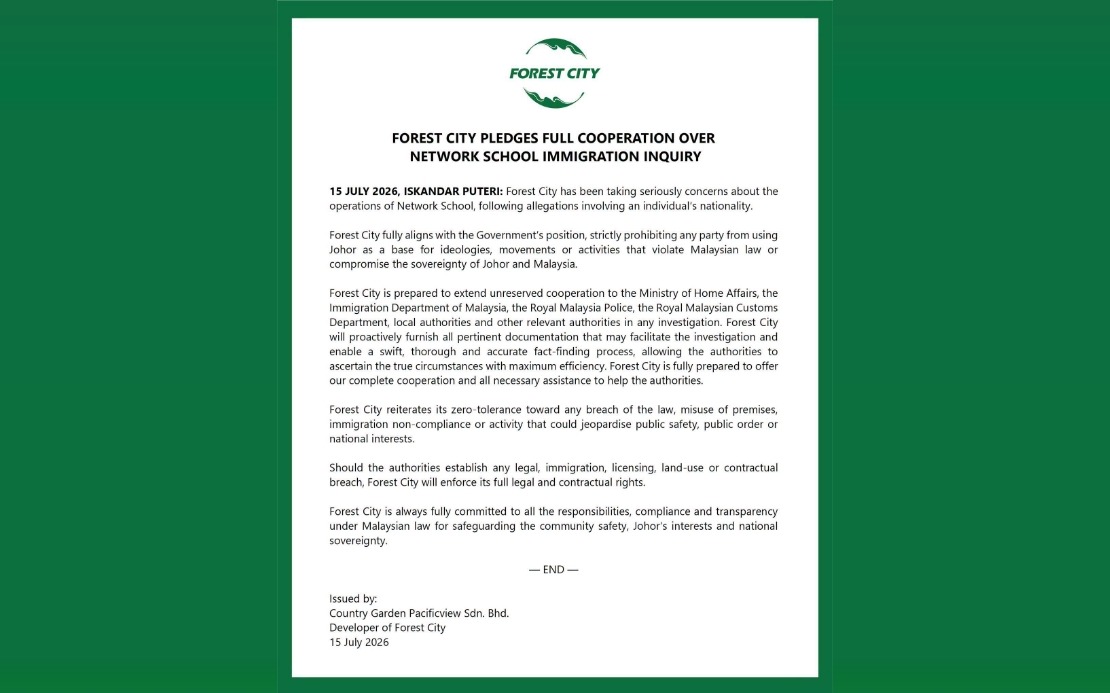
The developer of Forest City in Johor Bahru has committed to working closely with law enforcement agencies in an ongoing investigation into a private educational institution that authorities allege has enrolled Israeli nationals. Country Garden Pacificview Sdn Bhd, the company behind the sprawling mixed-use development, issued a formal statement signalling its readiness to assist multiple government bodies tasked with examining the Network School operation and the circumstances surrounding its students' presence in Malaysia.
In its response, the developer emphasised that it takes the matter with utmost seriousness and has aligned itself fully with Putrajaya's position that Johor and its commercial spaces cannot become platforms for activities that breach Malaysia's laws or compromise national sovereignty. This statement reflects the mounting scrutiny surrounding foreign nationals operating educational programmes within private developments, a concern that has gained traction among federal and state authorities concerned about potential security and regulatory vulnerabilities.
Country Garden Pacificview has signalled its intention to engage comprehensively with the Home Ministry, the Immigration Department, the Royal Malaysia Police, the Royal Malaysian Customs Department, and local administrative bodies. The breadth of agencies involved underscores the multifaceted nature of the investigation, which spans immigration compliance, national security considerations, and adherence to local regulations governing educational and institutional operations within the development.
The developer has further pledged to furnish all documentation deemed necessary by investigating authorities to support their fact-finding efforts. Such records could include student registrations, staff credentials, lease agreements, and operational permits relevant to the Network School's activities within Forest City's premises. By committing to transparency in document submission, Country Garden Pacificview aims to accelerate the investigative process and demonstrate its alignment with official procedures.
A critical aspect of the developer's position is its explicit rejection of any tolerance for legal infractions within its properties. The company has declared a zero-tolerance approach toward breaches of Malaysian law, misuse of its facilities, non-compliance with immigration statutes, and any conduct that could threaten public safety or social order. This declaration serves to establish clear boundaries regarding what activities are permissible within Forest City and signals the developer's intent to enforce its own compliance mechanisms.
The investigation was triggered by concerns raised by Johor's state leadership. Menteri Besar Datuk Onn Hafiz Ghazi had called for a formal inquiry into the Network School after reports emerged that individuals holding Israeli citizenship or passports had enrolled in the programme. According to state officials, some of these individuals allegedly entered Malaysia using alternative travel documents from other nations, a practice that raises questions about immigration oversight and the vetting procedures employed by educational institutions operating within private commercial developments.
Authorities moved swiftly following these concerns. The Immigration Department launched an inspection operation at Forest City targeting 266 foreign nationals representing 40 different countries. Preliminary findings from this exercise revealed that all individuals examined during the initial sweep possessed valid immigration documentation, a development that complicated the narrative around unauthorised entry. However, immigration officials have indicated that their investigation remains active, suggesting that deeper scrutiny is ongoing to determine whether documentation irregularities or other violations occurred that initial inspections might not have immediately revealed.
The Forest City situation reflects broader tensions in Malaysia regarding how private developments and foreign educational programmes operate within the country's regulatory framework. As mega-developments increasingly host international schools and specialised institutions catering to expatriate communities, questions have arisen about the adequacy of oversight mechanisms and whether existing protocols sufficiently protect national interests. The case has become emblematic of challenges balancing Malaysia's aspirations as an international business and education hub against security and sovereignty considerations.
For investors and operators within Forest City and similar large mixed-use developments, the incident serves as a reminder that regulatory compliance extends beyond commercial and real estate operations to encompass activities conducted by third parties occupying spaces within these complexes. Developers face potential reputational and legal exposure if institutional tenants violate immigration laws or engage in activities that authorities deem problematic, creating incentives for enhanced due diligence in tenant selection and ongoing operational monitoring.
The investigation also touches on the contentious issue of Israeli-Malaysian relations. Malaysia does not recognise Israel, and the presence of Israeli nationals within the country—even in educational capacities—tends to attract political attention. The use of alternative passports by individuals described as having Israeli connections suggests an attempt to circumvent Malaysia's implicit restrictions on Israeli entry, a factor that likely amplifies official concern regarding the Network School's operations and the adequacy of institutional vetting procedures.
Moving forward, the outcome of this investigation could establish important precedents for how Malaysian authorities treat foreign educational institutions within private developments and the standards required for verifying student and staff backgrounds. Regulatory agencies may implement enhanced protocols for licensing and monitoring schools and educational programmes operating within commercial complexes, particularly those catering to international clientele. These developments would apply pressure on developers and institutional operators to strengthen their compliance infrastructure and adopt more rigorous vetting standards for tenants and their activities.

