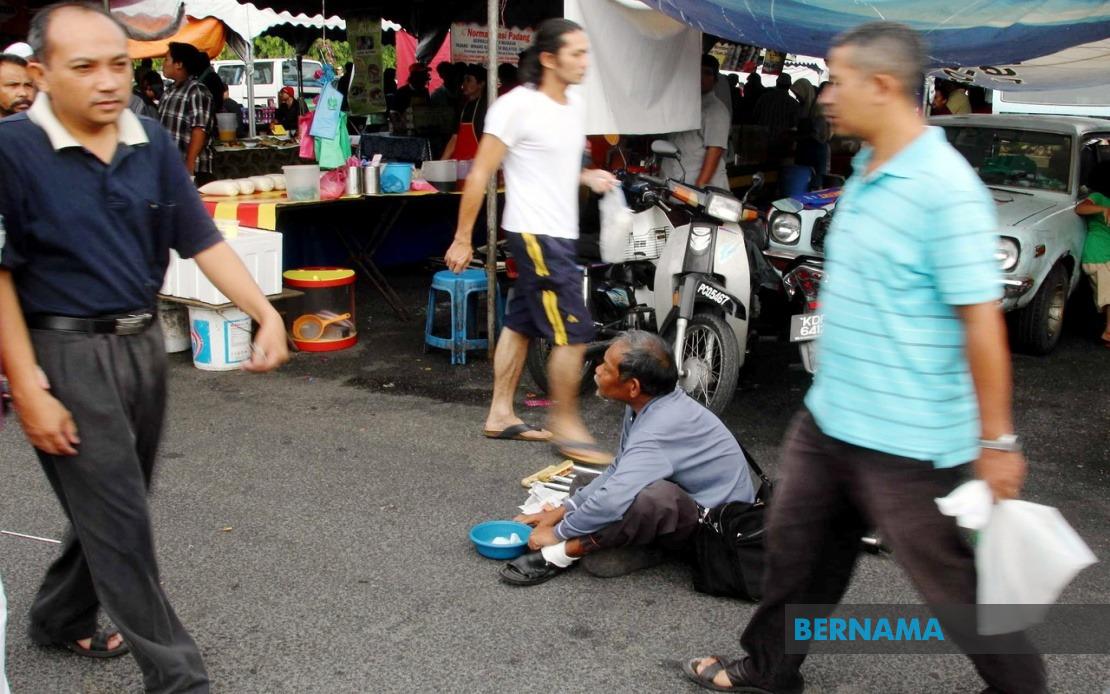
The Malaysian Home Ministry has raised fresh alarm over begging activities involving foreigners, signalling that such operations extend beyond street-level nuisance into the realm of organized crime. In parliamentary replies released this week, the ministry indicated that exploitation networks targeting vulnerable migrants—especially minors—are being treated with heightened urgency, with investigations now broadening to capture local facilitators profiting from the scheme.
Data from enforcement sweeps paints a picture of sustained activity in central Kuala Lumpur. Between early 2025 and the end of May, immigration officers executed 836 operations across the capital and its surrounding districts, resulting in checks on more than 10,600 individuals. Of these, approximately 5,400 foreigners faced detention on immigration-related grounds, with 42 individuals specifically caught up in begging-related activity. While the 42 begging cases represent a small fraction of total detentions, ministry officials underscored that each figure likely masks broader involvement by syndicates pulling strings behind the scenes.
The parliamentary inquiry, lodged by Fong Kui Lun of the Bukit Bintang constituency, focused on whether enforcement had proven effective in combating the phenomenon at notorious tourist zones including Bukit Bintang, Jalan Alor, and Changkat Bukit Bintang—areas where foreign nationals visibly solicit donations from shoppers and diners. The lawmaker pushed the ministry to detail how authorities were identifying and dismantling the syndicate architecture supposedly orchestrating these operations. The response signals that the Home Ministry has elevated its analytical capacity to map organizational structures, targeting protectors, organizers, and money handlers operating within Malaysian borders.
Crucially, investigations have pivoted toward local complicity. Ministry statements reveal ongoing probes into Malaysian citizens suspected of shepherding foreign beggars, organizing their placement on streets, or capturing earnings from the activity. This dimension reflects an understanding that sustainable begging operations require domestic infrastructure—safe houses, local guards, collection systems—that cannot function without Malaysian cooperation. The implication is that street-level foreigners are often subordinate actors in larger schemes directed by residents with knowledge of local enforcement patterns and vulnerable neighborhoods.
To fortify its response, the Immigration Department has formalized joint operations with the Royal Malaysia Police and Kuala Lumpur City Hall, establishing information-sharing protocols and analytical units dedicated to mapping syndicate networks and identifying operational patterns. This coordinated posture extends through the KL Strike Force, a multi-agency taskforce that brings together immigration, police, city authorities, social welfare, and other enforcement bodies. The Strike Force framework assigns participating agencies rotating responsibilities for monitoring known hotspots, conducting surprise raids, processing intelligence from public tip-offs, and tracking whether detained individuals resurface—an approach designed to disrupt cyclical offending.
The expansion of inter-agency cooperation reflects a broader strategic shift in how the ministry approaches migration enforcement. Rather than reactive detention, the framework emphasizes preventive surveillance, network mapping, and intelligence synthesis. Participation in the Federal Territory Security Working Committee ensures that begging operations are assessed within a wider security context, potentially linking street activities to human trafficking, false documentation, or other transnational crimes. For regional readers, this signals that Malaysia is adopting techniques increasingly common across Southeast Asia as countries grapple with organized migration exploitation.
The Home Ministry's public commitment to preserving national image and reputation carries implications for tourism and business confidence. Foreign begging, particularly involving children, generates negative impressions among visitors and expatriate communities, potentially dampening spending and foreign investment sentiment. By positioning the crackdown as a reputation-protection measure, the ministry acknowledges that street-level disorder carries soft power costs. This framing may also justify resource allocation to enforcement bodies and stricter immigration protocols, elements that could affect legitimate migrant populations and cross-border commerce.
The investigation's expansion to local beneficiaries opens complex questions about prosecution and punishment gradations. Malaysian citizens involved in exploitation face potential charges under human trafficking statutes, labor laws, and immigration-related offences, yet enforcement statistics rarely distinguish sentences by nationality or severity. How aggressively authorities pursue local protectors versus foreign frontline actors will signal whether the crackdown genuinely targets syndicate leadership or primarily sweeps vulnerable migrants from streets. Regional observers will watch for charging patterns and case outcomes over coming months.
Separately, the ministry disclosed that a special application window for foreign worker quotas, spanning January to March this year, produced 314 approved employer recommendations from nearly 1,900 applications. These quotas remain pending final approval by the Department of Labour Peninsular Malaysia, a procedural stage reflecting the multi-stage gatekeeping of Malaysia's foreign workforce. While nominally unrelated to begging enforcement, the quota system reveals tension within immigration policy: Malaysia maintains formal channels for authorized migrant workers while simultaneously combating unauthorized activity. Tighter enforcement against illegal presence may paradoxically increase pressure on legitimate pathways and labor costs for small enterprises unable to navigate quota bureaucracy.
The Home Ministry's statements underscore that begging syndicates represent a multifaceted challenge requiring sustained intelligence work, cross-border coordination, and consistent prosecution. For Malaysian policymakers, the persistence of such networks despite enforcement operations suggests either that economic desperation among foreign migrants remains sufficiently acute to replenish supply or that organizational profits motivate continuous reformation. Regional governments facing similar patterns may benchmark Malaysia's taskforce model while acknowledging that enforcement alone rarely eliminates exploitation absent complementary policies addressing root causes—wage gaps, document confiscation, and debt bondage—that drive participation in illegal street economies.

