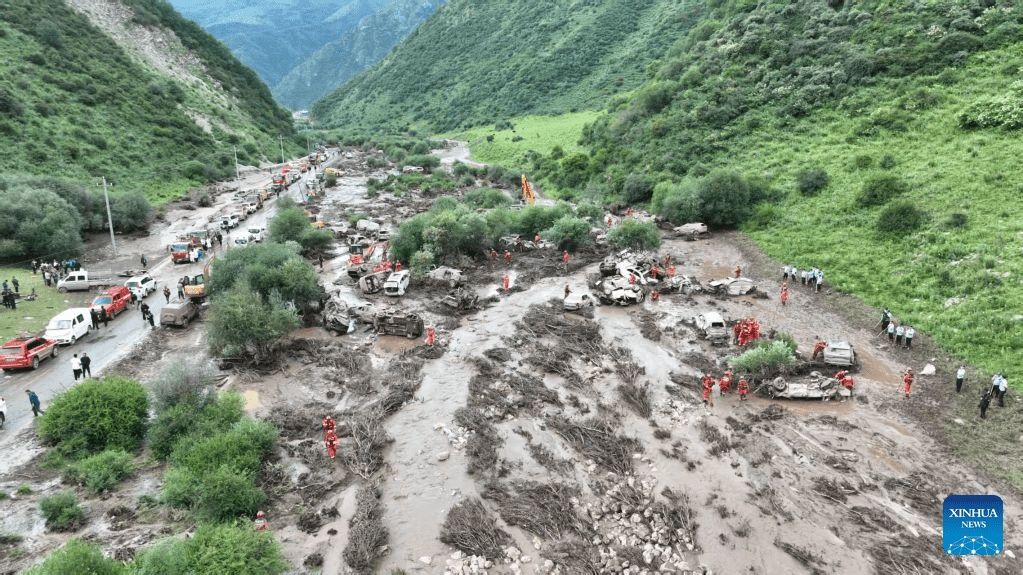
A catastrophic flash flood swept through a tourist destination in Gansu Province in northwestern China on Sunday, claiming at least 10 lives and leaving 23 others injured as rescue operations intensified throughout the afternoon. The disaster struck the scenic Weiyuan County area in Dingxi City when unexpected torrential downpours triggered the sudden surge of floodwater, trapping campers and other visitors who had been enjoying the countryside. By early evening, local emergency response teams including public security and fire-and-rescue units had mobilized to the site, with search efforts continuing as darkness fell.
The tragedy unfolding in Gansu reflects the broader meteorological crisis gripping much of China as Typhoon Noul, the nation's third typhoon this month and the twelfth tropical cyclone of the year, carved a destructive path across the country. The system made landfall in Huidong County in Guangdong Province during the early hours of Sunday morning, packing gale-force winds that ravaged coastal communities before moving inland. The Korean name Noul, referring to the ethereal glow of sunrise or sunset, belied the storm's ferocious nature as it advanced across the landscape.
Responses to the escalating disaster have reached the highest levels of Chinese government coordination. The Ministry of Water Resources and China Meteorological Administration jointly issued a red-level alert—China's most severe warning category—for flash floods across multiple provinces. The warning extended across Jiangxi, Hunan, Guangdong, Sichuan, Shaanxi, Gansu, and parts of Xinjiang in the southeast, with alerts remaining in force from Sunday evening through Monday evening. This unprecedented coordination underscores official concern about the cascading impacts of Typhoon Noul as it progresses inland over a 48-hour window.
The sheer scale of human displacement caused by the typhoon demonstrates the extraordinary power of the storm system. Authorities in Guangdong Province alone orchestrated the relocation of more than 700,000 residents ahead of and during the typhoon's passage, representing one of the largest civilian evacuations undertaken in response to a single weather event in recent years. This massive precautionary effort, while disruptive, prevented even greater loss of life as the typhoon's outer bands delivered sustained destructive winds and rainfall.
Hong Kong experienced significant disruption from Typhoon Noul's proximity, with the storm passing within 80 kilometres of the territory as it approached landfall. Despite the city's experience with tropical cyclones and its sophisticated early warning systems, the typhoon's intensity warranted the issuance of multiple warning signals. Airport authorities suspended flight operations for more than 12 hours as a safety precaution, with a gradual resumption of services beginning Sunday afternoon. The Observatory cancelled all typhoon warning signals by Sunday evening, though southwesterly gales continued to pound portions of the Asian financial hub, indicating the system's lingering influence even as it weakened.
Meteorological authorities expect Typhoon Noul to maintain its threat level as it penetrates deeper into central China over the coming days. While the system is gradually weakening as it moves away from oceanic heat sources, heavy to torrential rainfall is forecast to persist across much of southern China through at least Tuesday. Certain areas, particularly in Fujian Province, face the risk of extremely intense downpours that could trigger additional flooding and landslides in vulnerable terrain. State broadcaster CCTV emphasized that the rainfall pattern will remain protracted rather than concentrated, complicating drainage and increasing the cumulative water stress on river systems.
The disaster in Gansu Province illustrates the compound risks facing regions in the path of tropical cyclones. The scenic area where the flash flood occurred serves as a natural focal point for rainfall concentration, with surrounding topography channeling runoff into valleys and watercourses. The concentration of tourists in such areas during fair weather creates vulnerability when sudden meteorological shifts transform recreational spaces into hazardous zones within minutes. The entrapment of campers in the Weiyuan County area occurred precisely because the landscape that makes the location attractive for tourism—its dramatic terrain and river valleys—becomes perilous during flash flood events.
Emergency management authorities have issued pointed directives to local governments emphasizing the need for heightened surveillance of flood-prone zones. Particular attention has been directed toward mountain regions, river valleys, construction sites, and bridge approaches—locations where flash floods pose acute dangers to life and property. The specificity of these warnings reflects accumulated knowledge from previous disasters and recognition that flash floods, unlike slow-moving river floods, provide minimal warning time for evacuation.
The convergence of the Gansu flash flood disaster with Typhoon Noul's broader rampage across China underscores the country's ongoing vulnerability to extreme precipitation events, despite technological advances in forecasting and response capabilities. For Southeast Asian nations including Malaysia, which experience similar tropical cyclone seasons, the unfolding situation in China offers instructive lessons about disaster preparedness, evacuation coordination, and the need for robust early warning systems. The ability of Chinese authorities to mobilize resources on such a massive scale—relocating three-quarters of a million people—demonstrates both the seriousness with which the nation treats cyclone threats and the practical challenges of managing such large-scale displacement operations.
As search-and-rescue operations continued in Gansu and regional meteorological services tracked Typhoon Noul's inland progression, attention focused on preventing further loss of life through vigilant monitoring and swift action. The red-level flood alert covering multiple provinces represents a commitment to aggressive risk management across a vast area. However, the mounting death toll from flash floods and the ongoing dangers posed by heavy rainfall underscore the limits of human preparedness when confronting nature's most extreme manifestations.

