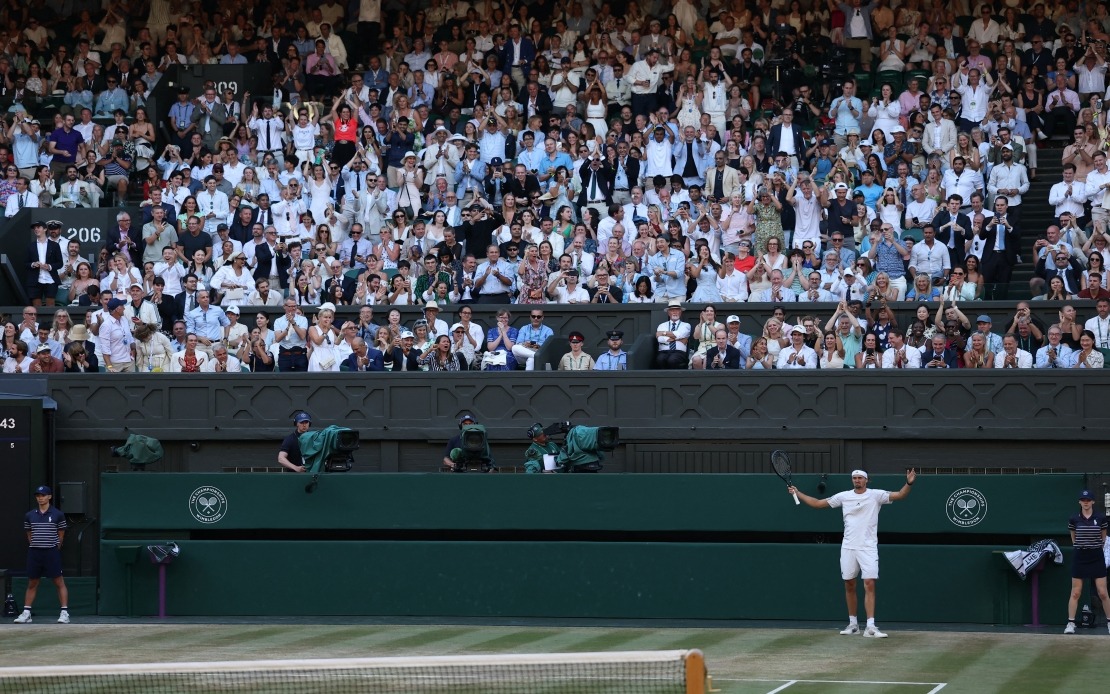
Wimbledon 2026 delivered a fortnight of captivating drama that will be remembered for years to come, culminating in Jannik Sinner's commanding four-set victory over Alexander Zverev in the men's singles final. The Italian champion's triumph provided a spectacular conclusion to a championship distinguished by remarkable individual achievements, surprising underdog stories, and moments that tugged at the heartstrings of tennis fans worldwide. Beyond the laurels claimed by the tournament's top seeded players, the All England Club witnessed several matches that transcended sport and became defining narratives of human resilience and sporting excellence.
The women's singles final presented one of the most emotionally charged contests of the tournament, as first-time grand slam finalist Marketa Noskova demonstrated extraordinary mental fortitude in her clash against a formidable opponent. Noskova's path to victory proved treacherous when she surrendered five championship points whilst leading 5-2 in the second set, a dramatic collapse that momentarily seemed to echo the ghosts of Wimbledon past. The match evoked memories of Jana Novotna, the late Czech champion whose 1993 final loss to Steffi Graf produced one of sport's most poignant images: the world number one weeping on the shoulder of the Duchess of Kent after squandering a commanding position. For Noskova, however, the narrative diverged sharply from Novotna's initial heartbreak. The 21-year-old demonstrated the psychological resilience required at the highest echelon of professional tennis, recovering from the brink of defeat to claim her maiden grand slam title. In a moment of youthful exuberance, Noskova paused during her walk back from a bathroom break to gaze upon the trophies lining the corridor before making a bold declaration of intent: she would claim the championship trophy before the fortnight concluded. Her prophecy proved prescient, as she went on to capture the crown in a thrilling decider, potentially marking the beginning of a distinguished career reminiscent of Novotna's resurgence to victory in 1998.
The men's draw showcased an improbable and inspiring narrative when British wild card James Fery transformed himself from relative obscurity into a household name across the United Kingdom. The 23-year-old from the Wimbledon area, languishing at 114th in the world rankings, orchestrated a shock run to the semi-finals that galvanized home supporters and provided a rare bright spot in what proved to be a disappointing championships for British tennis competitors. Fery's breakthrough moment crystallized during his fourth-round encounter with Zizou Bergs, a match that tested his physical endurance and psychological composure in equal measure. Competing on the notoriously sweltering Court 18 under blistering conditions, Fery endured three nosebleeds whilst simultaneously mounting a comeback from apparently insurmountable positions. He faced deficit of 4-1 in both the fourth and fifth sets, circumstances that would ordinarily consign most players to defeat. Yet Fery displayed the grit and determination that typifies British underdog stories, forcing a tie-break in the fourth set before executing a clinical performance in the fifth-set super tie-break. As Bergs, ranked 77 places higher than Fery in the world standings, succumbed to mounting pressure and lost his composure, the young Briton exhibited the mental acuity to capitalize on his opponent's frustration. Fery's achievement places him alongside an exclusive group of only four other British men to reach the second week of Wimbledon during the twenty-first century, a statistic that underscores both his personal accomplishment and the broader challenges facing British men's tennis in the contemporary era.
Novak Djokovic's participation in the championship demonstrated why the Serbian master remains a formidable force despite approaching his fortieth year, yet his quarter-final encounter revealed the immense toll that professional tennis exacts upon even the greatest champions. The 24-time grand slam titleholder engaged in a five-hour and fifteen-minute epic against Felix Auger-Aliassime, a contest that transcended typical sporting competition and represented the longest quarter-final in Wimbledon's storied history. The match concluded merely eight minutes before the 11pm curfew imposed by tournament organisers, leaving spectators exhausted and Djokovic visibly depleted. The physical demands manifested early when Djokovic required courtside medical attention for a calf injury at the conclusion of the opening set, an ominous sign for a player whose physical integrity has periodically compromised his championship ambitions. Beyond physiological challenges, Djokovic engaged in a heated altercation with tournament referee Denise Parnell regarding the closure of the Centre Court roof prior to the third set, an exchange that further diverted his mental resources from the contest at hand. Despite ultimately prevailing against the third-seeded Canadian, Djokovic emerged from the encounter visibly diminished, his reserves nearly exhausted by the marathon encounter. The costs of this Herculean effort became apparent when he subsequently encountered Jannik Sinner in the semi-finals, where the accumulated fatigue proved decisive in determining the championship's trajectory.
The women's semi-final between Coco Gauff and Karolina Muchova produced one of the tournament's most thrilling finales, a pulsating tie-break that stretched across eighteen tension-laden minutes during which both competitors held match point opportunities. The deciding set proceeded evenly until the tie-break, where fortune and misfortune alternated with bewildering rapidity. At a critical juncture when the score stood level at 8-8, Muchova received a time violation from the chair umpire before her serve drifted marginally long, inadvertently gifting Gauff her initial match point. Yet the American squandered this golden opportunity by miscalculating a straightforward drop-shot, dispatching what should have been a winning stroke directly into the net. The momentum appeared to shift decisively toward Muchova when she held her own match point, yet sporting fortune intervened in the most dramatic fashion. As Muchova prepared to execute a volley, her feet betrayed her as she slipped upon the grass surface, a momentary lapse of balance that allowed Gauff's cross-court forehand to traverse the net safely. Rather than wilting under the accumulated tension, Muchova recalibrated her approach and seized upon her subsequent opportunity, methodically repositioning Gauff around the court before the American's weary forehand found the net, granting the Czech ninth seed passage to the final and demonstrating the psychological resilience demanded by championship tennis.
Serena Williams' wildcard return to competition at the age of 44 and nearly four years after announcing her evolution away from professional tennis represented the tournament's most emotive narrative, transcending the boundaries of sporting competition to become a cultural phenomenon. The legendary American entered Centre Court to thunderous standing ovations as spectators paid homage to her transformative impact upon women's professional athletics. Facing Ajla Tomljanovic, an Australian player nearly a quarter-century her junior, Williams appeared positioned for triumph when she secured an early break in the deciding set, momentarily suggesting that she might depart the sport with a victory christening her return after her last competitive victory in the 2019 semi-finals. However, Williams' physical condition deteriorated markedly during the closing stages of the contest when she sustained a knee injury late in the opening set, an ailment that progressively sapped her mobility and effectiveness. Tomljanovic, demonstrating commendable composure under the extraordinary pressure of competing against a sporting icon, mounted an impressive comeback that ultimately proved decisive. Beyond the immediate result, the injury precluded Williams from participating in a doubles partnership reunion with her sister Venus, depriving supporters of another potential highlight from the championship. Nevertheless, Williams' appearance represented an inspiring testament to the enduring appeal of professional tennis and the capacity of athletic greatness to transcend time.
These five matches encapsulated what made Wimbledon 2026 exceptionally memorable for followers across Southeast Asia and beyond. For Malaysian readers and the broader regional tennis community, these narratives underscore the sport's capacity to generate compelling human drama whilst simultaneously pushing competitors to the extremes of physical and psychological endurance. Djokovic's marathon encounter and Williams' emotional return demonstrated that longevity in professional tennis demands extraordinary sacrifice, whilst Noskova's comeback victory and Fery's underdog triumph illustrated how younger players are challenging the established hierarchy. The championships reinforced tennis' status as a global sport capable of manufacturing unforgettable moments that resonate far beyond the manicured grass courts of SW19, inspiring aspiring athletes throughout Asia to pursue excellence in a sport increasingly dominated by players from the region.

