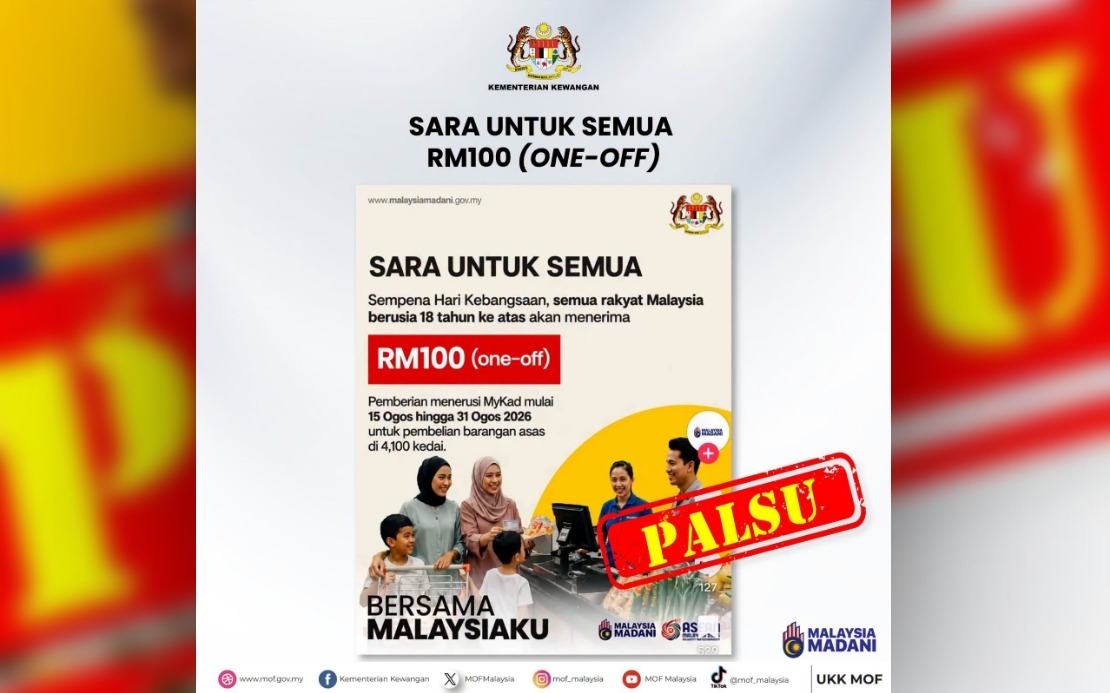
The Ministry of Finance moved swiftly to quash a viral social media claim circulating across Malaysian platforms, denying that a one-off RM100 Sumbangan Asas Rahmah (SARA) payment would be distributed to all citizens aged 18 and above around National Day. The ministry's direct refutation, posted through its official social media channels, explicitly labelled the poster making such claims as fabricated and cautioned Malaysians against believing or propagating the false information.
The timing of the viral claim proved particularly sensitive, arriving as the nation prepared for National Day celebrations and at a moment when public attention typically focuses on government policy announcements. Such false claims have become increasingly common across Malaysian social media platforms, particularly during periods of heightened patriotic sentiment or around public holidays when citizens are more receptive to news and announcements. The SARA scheme itself, established as part of government assistance programmes, has been the subject of previous misinformation campaigns, making this latest incident part of a recurring pattern of confusion regarding social safety net initiatives.
In its statement, the Ministry of Finance emphasised that no official announcement had been made regarding any additional SARA payment tied to National Day celebrations. This distinction proves crucial for understanding how government communications function in Malaysia—official government assistance schemes follow formal channels and are announced through verified ministry platforms, not through unconfirmed social media posters. The ministry's intervention underscores the importance of institutional credibility when countering misinformation, as citizens must distinguish between authentic government communications and unverified claims made by anonymous users.
The public advisory component of the ministry's response reflected growing concern about the rapid spread of false information through social media networks. By explicitly advising Malaysians to obtain verified information exclusively through the Ministry of Finance's official channels before sharing content, the government sought to interrupt the circulation chain that allows misinformation to spread exponentially. This approach acknowledges the challenge digital-age governance faces: combating false claims requires not only denial but also educating citizens about information verification practices and encouraging them to adopt critical evaluation habits before amplifying claims through their own networks.
For Malaysian citizens, the incident served as a timely reminder that government cash assistance programmes, while popular and occasionally expanded during special occasions, do not materialise through unverified social media announcements. The SARA scheme has genuinely provided assistance to eligible Malaysians in various phases, but each distribution involves official announcements through government ministry channels, coordination with banking systems, and verifiable eligibility criteria. Claims circulated through unverified posters lack these institutional hallmarks and should trigger immediate scepticism among informed citizens.
The broader context of this incident reflects ongoing challenges across Southeast Asia regarding digital literacy and information governance. Malaysia, like its regional neighbours, continues grappling with the proliferation of false claims related to government benefits and social assistance programmes. These fabrications often exploit citizens' genuine hopes for additional financial support, particularly among lower-income groups who depend heavily on government assistance. The psychological appeal of such claims—promising unconditional cash payments—makes them particularly susceptible to rapid viral spread, as hopeful citizens share them within family and community networks.
From a governance perspective, the Ministry of Finance's response illustrated the necessity for government institutions to maintain active social media presence and rapid-response capabilities when false claims emerge. Delayed responses allow misinformation to entrench itself within public consciousness, creating confusion that persists even after official denial. The ministry's prompt statement aimed to catch the narrative while the claim remained relatively fresh in the viral cycle, though the effectiveness of such interventions remains an ongoing question in the digital information environment.
The incident also highlighted the distinction between actual government welfare initiatives and false claims that exploit public awareness of these programmes. Malaysia operates several genuine assistance schemes including various tranches of the SARA payment itself, which has been distributed in phases based on specific government announcements and eligibility criteria. Citizens familiar with previous genuine SARA payments might understandably view new claims with less scepticism, particularly if the claims cite similar payment amounts or timing near public holidays when government historically makes additional announcements.
Moving forward, the Ministry of Finance's experience with this particular claim underscores the necessity for sustained public education campaigns about distinguishing authentic from false government announcements. Institutional credibility, while important, proves insufficient alone in combating misinformation that exploits citizens' legitimate expectations of government assistance. Public understanding of verification mechanisms, official announcement procedures, and the characteristic features of genuine government communications must be strengthened to build resilience against future false claims that inevitably will emerge as digital communication continues evolving.

