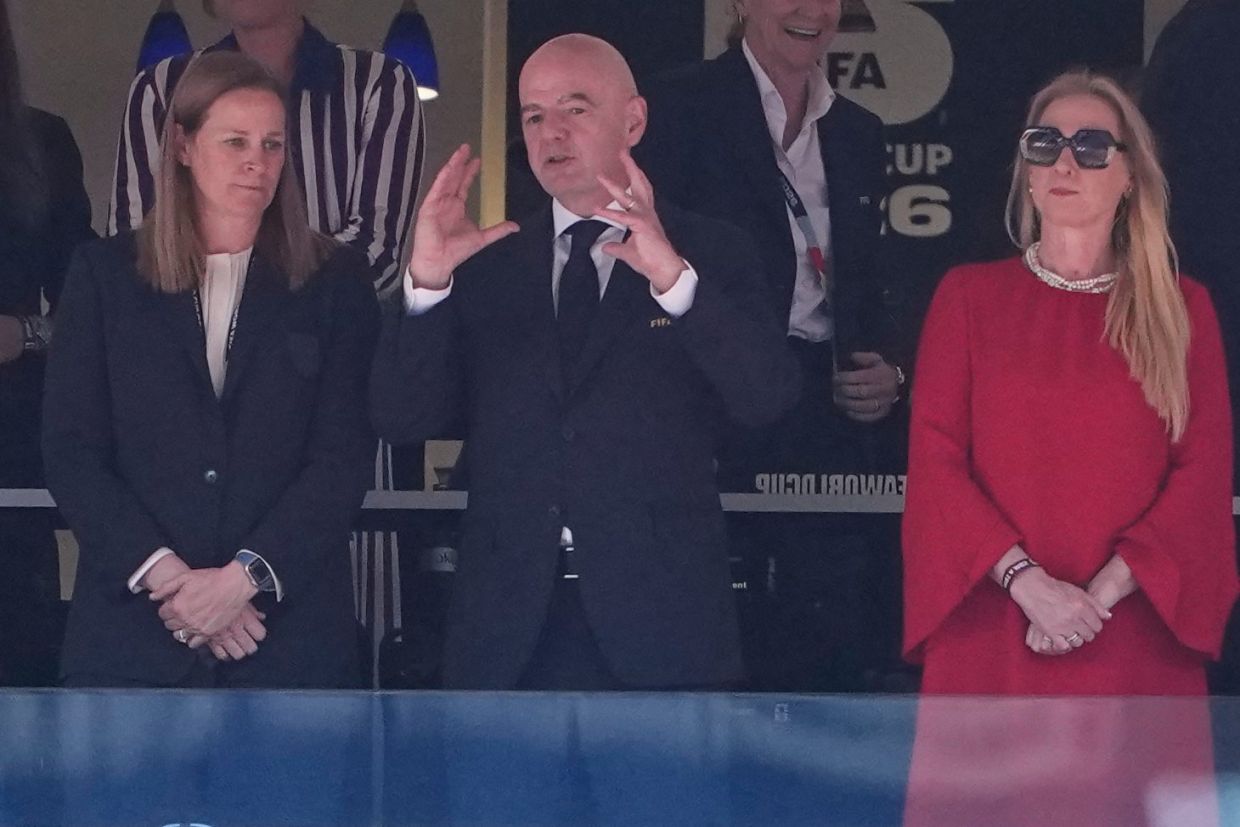
The controversy surrounding FIFA's handling of the 2026 World Cup has done little to dent the organisation's financial ambitions or weaken the grip of chief executive Gianni Infantino, who appears poised to consolidate his authority at a critical moment for global football governance. Despite mounting criticism spanning ticket pricing scandals, the ostracisation of Iran's national squad, the controversial barring of a Somali referee, and FIFA's controversial peace prize to United States President Donald Trump, the 56-year-old administrator has maintained his laser focus on revenue generation and political consolidation. The most damaging moment came when FIFA permitted a suspended American player to return to the field following direct pressure from Trump, an intervention that drew sharp condemnation from footballing figures worldwide and exposed fundamental questions about whether the governing body has compromised its regulatory authority in pursuit of commercial and political gain.
Yet the intensity of these criticisms has already begun to evaporate as the tournament progresses and the news cycle moves forward, a pattern FIFA appears to have anticipated and factored into its strategic calculations. Sports lawyer Nick De Marco captured the essence of the damage assessment, arguing that the core issue transcends the legitimacy of any individual disciplinary decision and cuts to the heart of FIFA's credibility as the sport's global regulator. The organisation's willingness to capitulate to political pressure from one of the world's most powerful nations signals a troubling precedent that undermines the principle of competitive integrity that theoretically anchors the entire tournament. Nonetheless, the organisation's financial machinery has proven remarkably insulated from such concerns, suggesting that public outrage, however legitimate, carries minimal weight against institutional interests and revenue imperatives.
Financially, the 2026 World Cup represents an unprecedented windfall for FIFA, with the organisation projected to extract approximately $9 billion in direct revenues—a substantial $2 billion increase compared to the 2022 Qatar edition. This exponential growth reflects Infantino's strategic expansion of the tournament structure, most notably the increase from 32 to 48 participating teams, which has dramatically enlarged the revenue pie while simultaneously spreading wealth among member federations. The restructuring has introduced a fundamental tension within FIFA's governance model, pitting its ostensible commitment to sporting fairness and regulatory integrity against its commercial imperative to maximise revenue and satisfy stakeholder expectations. The contradiction became visible precisely when political considerations threatened to override sporting principles, yet member federations have largely signalled their indifference to this philosophical tension, perhaps because the financial benefits now flowing their way have made them stakeholders in FIFA's current institutional model.
The economic benefits of tournament expansion permeate every level of the football ecosystem. Concession operators managing stadium food and beverage services have witnessed unprecedented spending levels, with some venues recording per-capita fan expenditures reaching $100 during matches—nearly double the equivalent figures from National Football League events. Advertisers have benefited from FIFA's introduction of mandatory hydration breaks, effectively transforming the traditional two-half structure into an American-style four-quarter format that generates additional commercial opportunities. Host cities, which voiced considerable cost anxieties before the tournament commenced, are now experiencing measurable economic gains, with Bank of America data documenting year-on-year credit and debit card spending increases of 6.3 percent in World Cup venues, while non-resident spending surged 16.7 percent. These metrics suggest that the tournament has successfully delivered on the economic development promises that justified the substantial infrastructure investments required.
The prize pool architecture has fundamentally shifted in ways that secure FIFA's institutional support from smaller football nations. The total prize distribution has doubled to a record $871 million, with every participating country guaranteed a minimum payment of $12.5 million simply for participation. This funding floor has transformed the economics of football governance in smaller nations, with Cape Verde earning over $21 million from its historic tournament run—equivalent to approximately 0.75 percent of the tiny nation's entire gross domestic product. For football associations across Africa, Asia, and Latin America, FIFA's redistributive largesse represents a critical revenue source that underwrites operational capacity and development programmes that would otherwise prove financially unsustainable. This structural dependency creates powerful incentives for member federations to maintain institutional loyalty to Infantino and the current governance model, regardless of concerns about regulatory independence or sporting integrity.
Infantino faces re-election in early 2027 at the 77th FIFA Congress scheduled for Rabat, Morocco—itself a host nation for the next World Cup cycle. With 211 member associations each casting a single vote, the electoral mathematics appear overwhelmingly favourable to the incumbent, who is running unopposed and has already secured backing from federations across Asia, South America, and Africa. This will constitute Infantino's third consecutive term, extending a tenure that began in 2015 following the departure of Sepp Blatter amid the corruption scandal that had nearly destroyed FIFA's institutional credibility. The contrast between FIFA's reputational nadir a decade ago and its current position of apparent strength underscores Infantino's successful recalibration of the organisation's priorities and stakeholder relationships. While reform efforts and transparency initiatives provided the rhetorical architecture for institutional rehabilitation, the dramatic expansion of tournament size and the redistributive wealth mechanisms have proven far more effective in cementing member federation support.
Despite the legitimate criticisms concerning regulatory independence and political interference, FIFA has positioned the World Cup as an undeniable sporting and commercial success. Stadium attendance has remained consistently strong despite elevated ticket pricing, the tournament's most prominent superstars have delivered compelling performances, and the expanded format has generated unprecedented global representation. Nine African teams reached the knockout stage, reflecting the tournament's expanded capacity to showcase football from emerging regions. The quality of hosting infrastructure and hospitality has exceeded standards established during the preceding two World Cups in Russia and Qatar, creating positive spectator experiences that translate into soft power benefits for participating nations. From a pure football perspective, divorced from governance considerations, the tournament has delivered compelling competition and expanded opportunity for traditionally marginalised confederations.
The calls for Infantino's resignation emanating from British and Belgian political figures, alongside critical commentary from respected football figures including former Liverpool manager Jurgen Klopp, have failed to gain institutional traction within FIFA's member federation structure. Klopp's observation that allowing political figures to influence disciplinary decisions transforms football into a tool of state power captures the philosophical stakes of the controversy, yet his concerns resonate primarily with observers in wealthy Western nations with independent football traditions. Asian Football Confederation president Sheikh Salman has characterised FIFA as operating from its strongest institutional position ever, while federations ranging from Kuwait to South Africa have publicly affirmed their support for Infantino's leadership. The Royal Moroccan Football Federation has specifically praised Infantino's stewardship in advancing both African and global football development, language that signals member federation alignment with the current institutional trajectory.
The fundamental asymmetry underlying FIFA's current position reflects the divergent interests of wealthy, established football nations and the broader global federation. Western observers concerned about regulatory independence and sporting integrity operate from a position of football saturation, where national confederations command substantial independent resources and exercise genuine autonomy within their domestic contexts. Conversely, smaller nations and emerging football confederations experience FIFA's redistributive mechanisms and tournament access as transformative opportunities that fundamentally enhance their institutional capacity and development prospects. This constituency—representing the numerical majority of FIFA's membership—has demonstrated consistent loyalty to Infantino precisely because his tenure has translated into tangible financial and competitive benefits. The political pressure from Trump regarding player eligibility decisions, while troubling from a governance perspective, carries minimal weight against the institutional preferences of member states who benefit from FIFA's expanded commercial model.
Infantino's consolidation of power represents a deliberate institutional choice to subordinate certain regulatory principles to commercial expansion and stakeholder satisfaction. The strategy acknowledges that FIFA's legitimacy increasingly derives not from abstract commitments to sporting integrity but from its capacity to distribute resources and expand opportunity across the global football ecosystem. By positioning himself as the architect of this expansion, Infantino has created constituencies with direct material interest in his continuation in office. The 2027 re-election will almost certainly formalise this reality, granting the FIFA chief a fresh mandate to pursue his vision of global football governance centred on revenue maximisation and coalition-building among member states. Whether this model ultimately proves sustainable depends on whether the regulatory compromises necessary to maintain coalition cohesion can be contained within manageable bounds, or whether they will eventually accumulate into a legitimacy crisis that even FIFA's financial resources cannot overcome.

