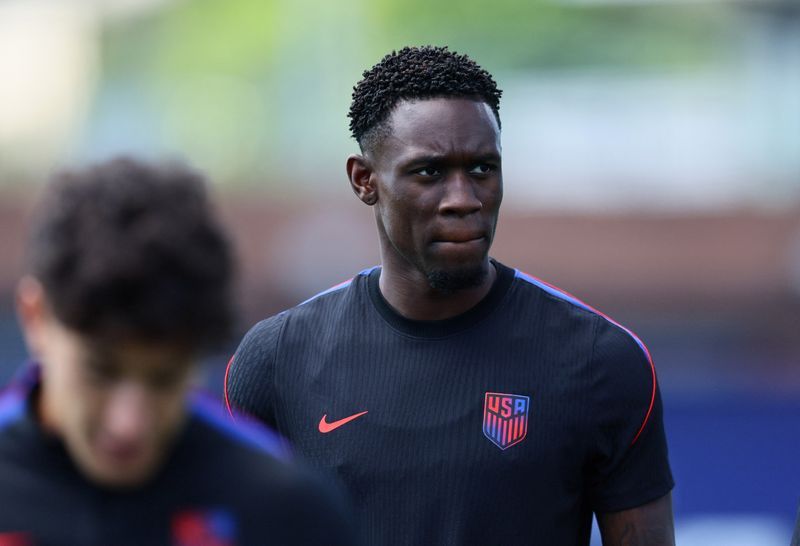
The international football community erupted in condemnation on Sunday following FIFA's extraordinary decision to suspend the automatic one-match ban triggered by Folarin Balogun's red card, a move that coincided with U.S. President Donald Trump's direct appeal to FIFA President Gianni Infantino to reconsider the punishment. The suspension allowed the American striker to play against Belgium in Monday's World Cup last-16 encounter, but the ruling immediately became the centre of a firestorm regarding the sanctity of competition and the troubling precedent of political interference in sport governance.
Belgium's football association was among the first to articulate the fundamental problem with FIFA's action. Officials pointed out that while the FIFA Disciplinary Code does technically grant the Disciplinary Committee discretion to suspend enforcement of sanctions under Article 27, Article 66.4 explicitly mandates that red cards automatically result in suspension for the next match. This categorical rule had been applied consistently throughout the tournament to other players who received dismissals, making its sudden suspension for Balogun appear arbitrary and capricious. The Belgian federation's position reflected a broader anxiety that FIFA had violated the principle of equal treatment that underpins fair competition.
Germany's football association, through President Bernd Neuendorf, escalated concerns by directly challenging FIFA to address the apparent political dimension of the decision. Neuendorf demanded that FIFA issue a clear statement categorically denying that Trump's telephone conversation with Infantino had influenced the disciplinary ruling, stressing that allowing such an impression to persist would fundamentally compromise both the tournament's integrity and FIFA's credibility as a governing body. His intervention represented a significant moment in which one of football's traditional powerhouses publicly questioned the legitimacy of a major tournament decision based on the methodology through which it was reached.
The stakes for Southeast Asian football audiences extend beyond mere sportsmanship concerns. Malaysia and neighbouring countries maintain intense interest in World Cup proceedings, and decisions that appear politically motivated rather than rule-based undermine the democratic principle that international sport should represent a level playing field. When wealthier nations or those with more political clout can effectively overturn disciplinary decisions through executive pressure, smaller football nations—including those in Southeast Asia—face implicit disadvantages should they ever find themselves in similar circumstances. The precedent established here potentially reshapes the very nature of tournament fairness.
The suspension created an immediate problem for FIFA's future rulings within the same competition. Once an exception is made to an automatic disciplinary sanction, consistency becomes nearly impossible to enforce. Players from other nations who received red cards earlier in the tournament had dutifully served their one-match suspensions without recourse, establishing a pattern of enforcement. The Belgian federation explicitly highlighted this logical trap: if the Committee can suspend Balogun's ban on grounds that remain unclear, what prevents other nations from demanding similar treatment? Should Belgium or another team face similar circumstances, FIFA would face compelling pressure to extend the same courtesy, potentially unravelling the entire disciplinary framework.
Football strategists and neutral analysts pointed to the broader competitive implications of allowing Balogun to play. If the United States were to defeat Belgium and advance further in the tournament, any subsequent achievement would carry an asterisk, a permanent cloud of suspicion that the result was tainted by an unjust disciplinary deviation. This is precisely what makes FIFA's decision damaging to the sport itself: rather than resolving a dispute cleanly, it created the conditions for permanent contestation over the legitimacy of the tournament's outcome. Neither the American team nor the wider sporting world benefits from a championship decided under such compromised circumstances.
The political angle here cannot be understated for Malaysian readers accustomed to watching World Cup competitions unfold according to supposedly neutral rules. The public revelation that a sitting U.S. President directly contacted FIFA's chief executive to overturn a sporting decision represents an extraordinary breach of the traditional separation between political authority and sports governance. While lobbying and backchannelling undoubtedly occur in international sport behind closed doors, the transparent nature of Trump's intervention and Infantino's apparent compliance suggest a casual disregard for the appearance of impartiality that might have previously been preserved through discretion.
Germany's officials further emphasised the absurdity of the timing and procedure. One administrator wryly noted that FIFA seemed to have declared July 5 an April Fool's Day, suggesting that the decision was so incongruous with established practice that it bordered on the farcical. The comment reflected genuine bewilderment that an institution responsible for global football governance could suddenly treat automatic disciplinary rules as discretionary suggestions when sufficient political pressure materialised. This bewilderment spread across football communities worldwide, with the decision becoming the subject of intense scrutiny from media, fans, and officials who recognised it as a dangerous turning point.
The integrity crisis extends to how this decision affects smaller nations' confidence in FIFA's impartiality. If wealthy, politically powerful nations can effectively overturn disciplinary sanctions through executive channels, the playing field is no longer level. Malaysia, Vietnam, Thailand, and other Southeast Asian football nations must now consider whether FIFA will apply rules consistently to them or whether the organisation has effectively established a two-tier system where some nations enjoy greater flexibility. This erosion of confidence in institutional fairness has long-term consequences for international football's credibility across regions that have invested substantially in developing their sporting infrastructure.
Tournament dynamics were fundamentally altered by the decision. Belgium, facing an American side without the guaranteed absence of a key player, suddenly confronted different tactical challenges than anticipated. The playing field that both teams prepared for was redrawn at the last moment through administrative fiat rather than athletic competition. This retroactive alteration of competitive conditions represents a category of harm distinct from simply favouring one team; it undermines the entire concept that teams enter matches with equivalent information and constraints.
FIFA's apparent reliance on Article 27 to justify the suspension represented a technical sleight of hand that satisfied no one. While the article theoretically grants discretion to suspend enforcement, explicitly doing so for automatic red card bans contradicted Article 66.4's categorical language. This internal contradiction within FIFA's own rulebook became a symbol of an organisation willing to interpret regulations creatively when political convenience demanded it. For observers across Southeast Asia and worldwide, the episode demonstrated that sporting institutions cannot be relied upon to maintain standards with consistency when subjected to sufficient pressure from powerful actors.
The scandal also raised uncomfortable questions about FIFA President Infantino's leadership and judgment. His decision to accede to what appeared to be direct presidential pressure—rather than defending the institutional integrity of the disciplinary process—suggested either inadequate backbone or a fundamentally compromised approach to governance. Either interpretation was troubling for an organisation that billions of people worldwide expect to manage the world's most popular sport according to fair and transparent principles. The damage to Infantino's credibility extended beyond this single decision to cast doubt on his fitness for a role demanding institutional independence.
Looking forward, this episode will likely haunt the remainder of the tournament. Should the United States advance and eventually win the World Cup, every victory becomes disputed territory, permanently associated with the disciplinary anomaly that allowed Balogun to participate when rules suggested otherwise. Conversely, if Belgium prevails, the narrative shifts to one of justice overcome despite FIFA's unjust intervention. Either way, the tournament's legitimacy emerges compromised, a cautionary tale about allowing political pressure to corrode sporting institutions' foundational principles of fairness and consistency.

