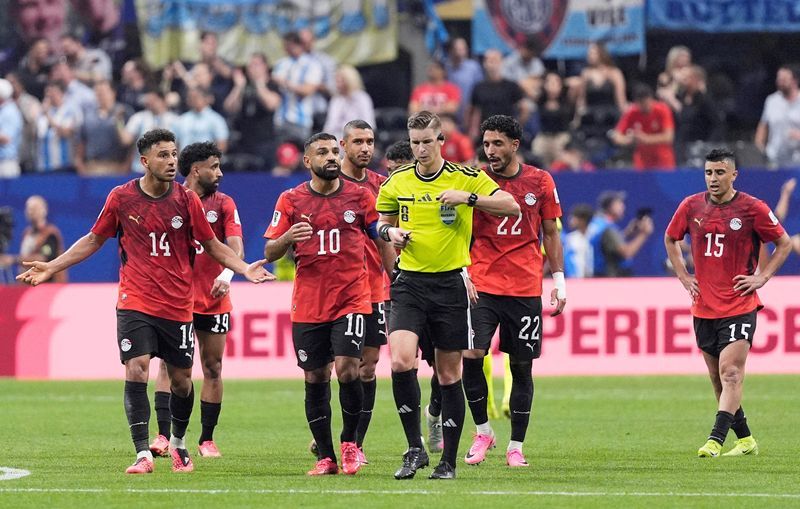
The international football body's top refereeing official has moved to quell mounting criticism over the decision-making in Argentina's contentious 3-2 World Cup round-of-16 triumph against Egypt. Pierluigi Collina, FIFA's chief of refereeing, issued a forceful defence of the match officials in an interview released on the federation's official website, characterising allegations of prejudicial conduct as unfounded and damaging to the sport's credibility. The statement represents an escalation in the dispute that erupted immediately after the final whistle, when Egypt's coaching staff and national federation protested what they viewed as systemic inconsistencies in how the referee had enforced the rules.
Collina's intervention underscores the gravity of accusations levelled by the Egyptian Football Association, which formally questioned whether the officiating favoured Argentina's progression in the tournament. The Egyptian federation cited multiple controversial moments during the match, including the disallowance of Mostafa Zico's second-half goal and the failure to award a penalty for contact involving Mohamed Salah moments before Argentina scored their decisive late goal through substitute Enzo Fernandez. Egypt's coach Hossam Hassan had suggested that external pressure may have influenced how the referee managed the fixture, a particularly serious insinuation in global football that threatens to undermine public confidence in tournament integrity.
In his statement, Collina articulated FIFA's position that referees operate with complete institutional autonomy, insulating them from external interference regardless of a nation's football prominence or political influence. He stressed that no individual—including FIFA president Gianni Infantino—could sway match officials' decision-making, and he cautioned that unfounded integrity allegations create dangerous situations by potentially inciting threats against referees and their families. This framing positions Egypt's complaints as not merely disputable interpretations of technical rules, but as baseless attacks on professional ethics that cross an ethical line within the sport.
The flashpoint over Zico's disallowed goal reveals how VAR application generates persistent disagreement among football's stakeholders. Collina confirmed that VAR had recommended the referee overturn the goal after identifying a foul by Marwan Attia against Argentina defender Lisandro Martinez during the build-up to the strike. Rather than viewing this as debatable judgement, Collina invoked a straightforward principle: a foul is a foul, and VAR's function includes intervening to correct obvious errors even when the on-field referee initially missed them. This interpretation prioritises technical correctness over the subjective reality that referees' decisions, once made and not obviously erroneous, traditionally stand unless video review reveals clear-cut misconduct.
The second contentious incident—the non-award of a penalty for the Salah challenge—presented Collina with an opportunity to illustrate the distinction FIFA applies between genuine fouls and normal contact within play. He explained that both the referee and VAR determined the contact between Salah and Argentina defender Julian Alvarez constituted ordinary physical engagement rather than a punishable infringement. Collina articulated FIFA's framework by noting that while stepping on an opponent's foot constitutes a foul, a defender who makes contact with the ball first and subsequently engages in standard football contact commits no offense. This technical distinction, however, depends on granular assessment of sequence and intent—precisely the kind of marginal call that generates legitimate disagreement among observers.
For Malaysian and Southeast Asian readers, these controversies carry relevance beyond football aesthetics or Argentine advancement. They illuminate how major international sporting bodies manage the intersection of technical rule-making, technology deployment, and political sensitivity when nations perceive unfair treatment. VAR's introduction was meant to enhance consistency and eliminate obvious mistakes, yet the Argentina-Egypt dispute demonstrates that video technology can amplify disputes when different officials assess the same images and reach divergent conclusions about subjective criteria such as whether contact qualifies as "normal football contact." The disagreement raises questions about whether FIFA's protocols provide sufficient clarity to prevent divergent interpretations.
Collina acknowledged that subjectivity inevitably characterises certain refereeing decisions, a candid admission that complicates his broader assertion that all decisions were correctly made. This concession creates tension with FIFA's confident assertion that VAR principles were properly applied throughout the tournament. If subjective judgment is genuinely unavoidable in football, then Egypt's complaints—while perhaps overstated in suggesting deliberate bias—retain substance when focused on whether marginal calls happened to consistently favour one team. The distinction between bias and unfortunate consistency matters, yet remains difficult to establish conclusively through post-match analysis.
The confrontation between Egypt and FIFA also reflects the tournament's broader geography of power. Argentina, as a football superpower with two-time World Cup winner Diego Maradona in its recent history and continental championship pedigree, commands disproportionate global attention and narrative sympathy. Egypt, historically influential in African football but not a recent continental champion, carries less institutional weight within FIFA's hierarchy. Whether this dynamic consciously influenced referees remains unknowable; what is clear is that the perception of unequal treatment damaged tournament credibility among Egyptian observers and potentially wider audiences across North Africa and the Middle East.
Collina's defence, while comprehensive in technical detail, does not address the broader institutional question of whether FIFA's VAR protocols provide sufficient transparency and consistency to prevent reasonable observers from suspecting bias when marginal decisions accumulate in one nation's favour. His statement emphasises that officials operated independently, but independence from external pressure differs from decisions that demonstrably reflect equal application of rules. The Egyptian Football Association's formal protest suggests that technical explanations alone may not satisfy nations that feel disadvantaged by the interaction of complex rules, subjective judgment, and technology-assisted decision-making.
The resolution of this dispute matters for football's legitimacy in regions where tournament participation carries significant national pride. FIFA's insistence on official integrity, while legally necessary and procedurally sound, does not eliminate the legitimate debate about whether specific interpretations of the rules were the only reasonable conclusions. For Southeast Asian football communities observing from outside but deeply invested in global sport's fairness principles, the Argentina-Egypt controversy illustrates how even the world's most prestigious tournaments remain vulnerable to disputes that pit technical rule-making against perception of equal treatment. Collina's intervention closes FIFA's official position on the matter, but it does not resolve the underlying tension between objective application of complex, subjective rules and public confidence in impartial enforcement.

