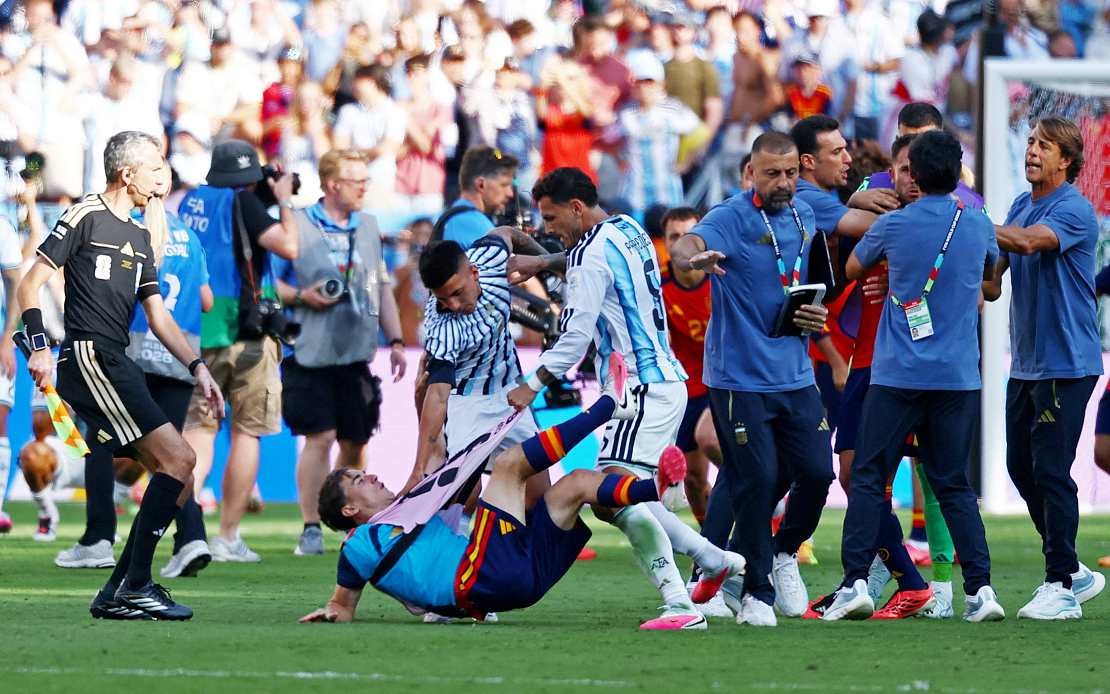
FIFA has formally opened a disciplinary investigation into Argentina's conduct during their World Cup final loss to Spain, marking another chapter in the tournament's ongoing scrutiny of player behaviour and sportsmanship standards. The global football governing body appointed a Disciplinary and Ethics Prosecutor to examine potential violations of FIFA's disciplinary code following incidents that occurred after the final whistle in New Jersey. The decision underscores FIFA's renewed commitment to policing player conduct beyond the traditional scope of on-field infractions, expanding its oversight to include post-match interactions and celebrations.
The most prominent allegation centres on Argentine midfielder Leandro Paredes, who appeared to exchange punches with Spanish players as they celebrated their victory on the pitch. This incident, captured during the immediate aftermath of the match, drew widespread attention from commentators and officials monitoring the game. The alleged altercation represents the type of confrontational behaviour that FIFA has increasingly sought to address through its disciplinary framework, particularly in high-profile tournaments where such moments receive global media coverage and scrutiny.
Argentina's conduct throughout the tournament had already drawn criticism from tournament observers and opposing teams. During their semi-final victory over England, the South American side faced particular scrutiny for their physical approach to the match. The team's aggressive playing style culminated in midfielder Enzo Fernandez receiving a red card for accumulating two bookable offences, further highlighting the intensity and, in some quarters, the lack of restraint that characterised Argentina's campaign.
The formal investigation process outlined by FIFA follows a structured protocol established under Article 36 of the FIFA Disciplinary Code. Officials reviewed comprehensive match reports prepared by the designated match commissioner, who observed the final comprehensively. This assessment triggered the decision to escalate the matter beyond preliminary review and into a full investigative process. The appointment of a dedicated prosecutor signals that FIFA takes the allegations seriously enough to warrant detailed examination rather than summary dismissal or immediate sanctioning.
Further controversy may yet emerge regarding Argentina's actions following their victory over England. Media reports suggest the team displayed a banner proclaiming Argentine sovereignty over the Falkland Islands after winning their semi-final encounter. Such political messaging potentially violates Article 34.3 of the tournament's regulatory framework, which establishes parameters around what symbols and statements are permitted during official competition events. It remains unclear whether FIFA's current investigation will extend to include this incident or whether it will be treated as a separate matter requiring its own assessment.
Argentina has previous experience with FIFA sanctions over similar political gestures. The Argentine Football Association faced financial penalties following a 2014 friendly match against Slovenia for comparable conduct. However, enforcement of such regulations has proven inconsistent across different competitions and administrative bodies. UEFA, the European football confederation, has demonstrated a more stringent approach to political expression, imposing one-match bans on Spanish players Rodri and Alvaro Morata after they engaged in chanting about Spain's territorial claims to Gibraltar following their Euro 2024 victory. This disparity in enforcement creates uncertainty about what Argentina might ultimately face.
FIFA's historical record on political gestures reveals a clear pattern of attempting to depoliticise international football, though application of these principles has often been selective and sometimes contradictory. During the 2022 World Cup in Qatar, FIFA warned the English Football Association that captain Harry Kane would face immediate sporting sanctions, including a yellow card, should he wear a 'OneLove' rainbow-coloured armband in protest against the host nation's criminalisation of homosexuality. The decision to threaten sanctions for displaying an anti-discrimination symbol while investigating post-match political statements about territorial disputes reveals the complex and sometimes contentious nature of FIFA's disciplinary approach.
The investigation's conclusions remain pending completion of the prosecutor's formal report. FIFA indicated that further details regarding the findings and any potential sanctions would be communicated once this examination concludes. The timeline for such investigations typically extends over several weeks, reflecting the need to gather evidence, conduct interviews, and prepare a comprehensive assessment. This delayed resolution means Argentina and Spanish football will operate under a cloud of uncertainty regarding potential future consequences.
For Malaysian and Southeast Asian football observers, this investigation carries broader implications about tournament conduct standards and disciplinary consistency at the global level. The case illustrates how FIFA continues wrestling with balancing player discipline, political expression, and the realities of high-intensity competitive football. The outcome will likely establish precedents affecting how similar future incidents are handled, potentially influencing the conduct of Asian national teams competing in FIFA tournaments and continental competitions where comparable situations might arise.
The investigation also reflects growing international football's complexity in managing not just on-field play but the entire ecosystem surrounding matches. Post-match celebrations, political messaging, and players' conduct in victory represent increasingly scrutinised elements of modern football governance. For tournament organisers and continental confederations across Asia and beyond, the Argentina case demonstrates FIFA's willingness to extend its regulatory reach, suggesting that clubs and national associations must prepare their players for heightened scrutiny of behaviour extending well beyond the ninety-minute match itself.

