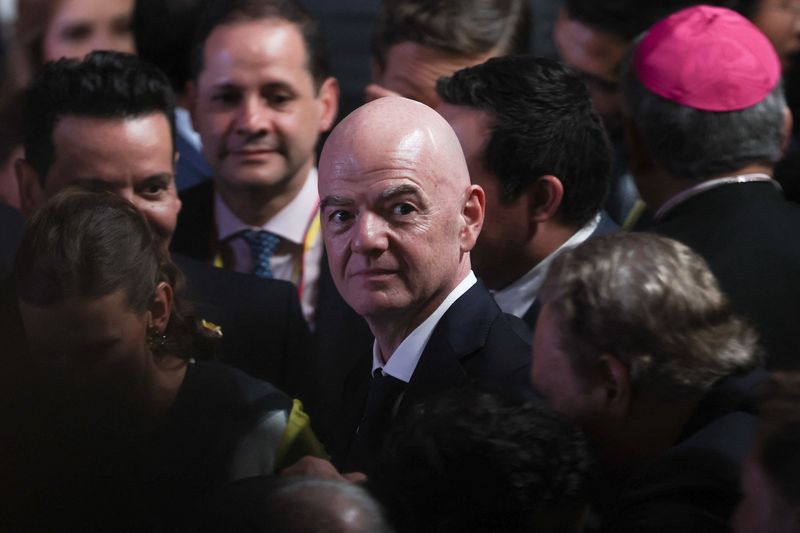
African Football Confederation president Patrice Motsepe has weighed into the mounting controversy surrounding FIFA president Gianni Infantino's leadership by advocating for the organization's democratic processes to determine his fate. Rather than capitulating to pressure from rival confederations demanding his exit, Motsepe has argued that the 211 FIFA member associations should be given the opportunity to pass judgment on Infantino's tenure at the 77th Congress scheduled for Rabat, Morocco on March 18, 2027. His measured intervention underscores deepening fault lines within international football's governance structure and suggests that support for the embattled FIFA chief remains fragmented along regional lines.
Infantino's position has deteriorated sharply following his failed attempt to secure private investment in FIFA competitions, including the World Cup itself. The proposal triggered an extraordinary backlash from three of FIFA's six continental confederations: UEFA representing Europe, the AFC covering Asia, and CONCACAF encompassing North America, Central America and the Caribbean. These three organizations collectively represent a substantial portion of FIFA's membership and revenue-generating capacity, amplifying the significance of their public denunciations. Their calls for Infantino's resignation represent an unprecedented level of open institutional rebellion against a sitting FIFA president, signalling that fundamental disputes over the organization's commercial direction and governance philosophy have reached a critical juncture.
Motsepe's stance reflects the African confederation's distinct interests and voting power within FIFA's organizational structure. By framing the issue as a matter of procedural propriety rather than substantive policy disagreement, the CAF president has positioned Africa as a defender of institutional legitimacy and democratic norms. This rhetorical approach carries particular weight given Africa's numerical representation within FIFA and the continent's historical relationship with the global football body. Motsepe explicitly confirmed that CAF intends to continue supporting Infantino, citing the FIFA chief's loyalty to African football initiatives and what he describes as strong continental backing for the embattled executive.
The CAF leader's comments reveal a fundamental tension in FIFA's governance architecture. On one hand, Motsepe acknowledges that organizational leaders must remain subject to scrutiny and accountability mechanisms. On the other hand, he insists that proper channels exist within FIFA to address governance concerns, implying that the public pressure campaign mounted by UEFA, AFC, and CONCACAF represents an end-run around established processes. This distinction between legitimate oversight and inappropriate external pressure has become a central point of contention as the March 2027 Congress approaches. For Malaysian football administrators and regional observers, the debate illustrates how competing visions of football governance—centralized authority versus confederal democracy—play out within FIFA's institutional framework.
Motsepe's emphasis on unity and cooperation, rather than confrontation, suggests an effort to prevent FIFA from fracturing along continental lines. The CAF president framed the upcoming election as an opportunity for the membership to demonstrate confidence or lack thereof in the incumbent, positioning democratic choice as the appropriate remedy for leadership disputes. This framing implicitly criticizes UEFA, AFC, and CONCACAF for attempting to force Infantino's departure through public pressure rather than allowing the electoral process to operate. However, the very intensity of opposition from three major confederations indicates that routine procedural remedies may prove inadequate to address the scale of institutional discontent now evident within FIFA.
The commercial proposal that triggered this crisis carries significant implications for football governance throughout Southeast Asia and the broader developing world. Infantino's initiative to introduce private capital into World Cup operations represented a fundamental shift in FIFA's business model, potentially concentrating wealth and decision-making authority among a small group of investors. The confederation reactions suggest that even organizations with deep financial interests in FIFA's current structure view this transformation as excessively disruptive. For Malaysian stakeholders in regional football administration, the controversy raises important questions about how decisions affecting the sport's governance and financial structure get made and who participates in that process.
Motsepe's invocation of due process and legality as non-negotiable principles reflects broader concerns about FIFA's institutional integrity. The organization has endured multiple corruption scandals and governance crises over recent decades, creating pressure for demonstrated commitment to transparent procedures and equitable treatment. By insisting that grievances be channeled through established FIFA mechanisms rather than resolved through coordinated confederational pressure, Motsepe positioned himself as defending institutional stability and predictability. Yet this same emphasis on procedure could be interpreted as implicitly defending the status quo and resisting the kind of fundamental leadership change that UEFA and its allies consider essential.
The regional alignments evident in this dispute carry particular relevance for Southeast Asian football administrators. The AFC's explicit opposition to Infantino positions the confederation against the incumbent FIFA president at precisely the moment when Asian football is experiencing unprecedented commercial investment and competitive growth. How this conflict resolves could significantly shape AFC's influence within FIFA and its capacity to shape international football governance in directions beneficial to Asian interests. Malaysia, as an AFC member, will find its voting power within FIFA influenced by how the confederation navigates these institutional tensions and whether it maintains unified positions on governance matters.
Motsepe's reference to allowing candidates to stand against Infantino adds another layer of complexity to the unfolding drama. The mere fact that rival candidacies could emerge suggests dissatisfaction with the status quo extends beyond the three rebellious confederations. However, successfully recruiting a credible challenger to Infantino will require coordination across AFC, UEFA, CONCACAF, and potentially other confederations, creating a formidable organizational challenge. The CAF president's framing of competitive elections as the appropriate forum for resolving leadership disputes, while procedurally sound, may underestimate the advantages of incumbent advantage in international sports governance contests.
Looking toward March 2027, the trajectory of Infantino's tenure remains uncertain despite Motsepe's endorsement of the electoral process. The unprecedented opposition from three major confederations indicates that institutional consensus around the FIFA president's vision has fractured irreparably. Even if Infantino retains sufficient votes to secure re-election, his presidency would likely continue operating under conditions of significant internal resistance and limited capacity to advance transformative initiatives. Conversely, if opposition confederations successfully mobilize sufficient votes to unseat him, the outcome would represent a dramatic repudiation of the commercialization agenda that has defined his tenure.
For Malaysian observers and regional football administrators, this institutional struggle within FIFA carries implications that extend well beyond the organization's leadership. The methods by which FIFA resolves internal disputes, the degree to which procedural propriety or substantive policy concerns dominate the process, and the relative influence of different continental confederations all bear on how the sport's global governance will evolve. Whether regional confederations like the AFC can effectively challenge FIFA's incumbent leadership structures, how voting coalitions form across geographic and economic dividing lines, and whether commercial interests or traditional governance principles prevail in the final outcome will shape international football's character for years to come.

