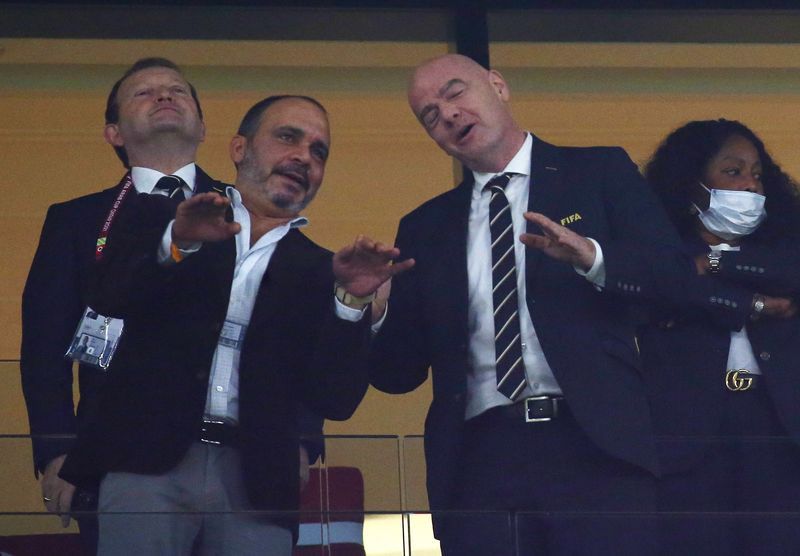
Jordan's Football Association has finally received prize money owed to its national team and coaching staff for reaching the final of the 2025 Arab Cup in Qatar last December, according to an announcement from JFA President Prince Ali bin Hussein on Thursday. The payment arrived precisely two days after Prince Ali made public accusations that FIFA had engaged in what he termed "blackmail" by conditioning financial support on his endorsement of FIFA President Gianni Infantino.
The delay in settling these payments represents a significant administrative failure within FIFA's operations. The Jordanian association had been awaiting the funds for approximately eight months, a timeframe that Prince Ali highlighted as emblematic of broader governance issues within world football's governing body. In his statement via social media, Prince Ali expressed gratitude to FIFA's administrative team for delivering the money, yet his measured thanks carried unmistakable undertones of frustration about the circumstances surrounding the delayed payment.
Prince Ali's allegations strike at the heart of FIFA's institutional credibility and raise uncomfortable questions about how the organization manages relationships with national associations. According to his account, FIFA officials communicated verbally during the World Cup period that backing Infantino's continued presidency "would go a long way to helping our FA out." This alleged quid pro quo arrangement directly contradicts FIFA's public commitments to transparent and equitable treatment of all member associations, regardless of their stance on internal leadership matters.
The timing of the payment release cannot be overlooked as coincidental. Prince Ali's willingness to publicize FIFA's apparent conditioning of financial assistance demonstrates a significant departure from the typical diplomatic silence maintained by national federation leaders when dealing with FIFA. His public critique appears to have generated sufficient pressure that FIFA responded with immediate action, releasing funds that should have been transferred months earlier according to standard tournament protocols.
For Malaysian and Southeast Asian football stakeholders, this episode illuminates persistent concerns about FIFA's financial governance and the potential vulnerabilities facing smaller confederations. If a prominent Arab federation faced an eight-month delay in receiving legitimately earned tournament prize money, questions naturally arise about whether similar delays might affect other regions. The incident underscores how dependent national associations remain on FIFA's financial architecture while simultaneously having limited recourse when administrative failures occur.
Prince Ali's explicit rejection of Infantino despite receiving the delayed payments represents a calculated political statement. By making clear that the money's arrival would not alter his position against Infantino's re-election, Prince Ali signals that the payment should not be interpreted as resolving the underlying governance concerns he has raised. This distinction matters significantly in the context of FIFA's presidential politics, where every bloc of votes carries strategic importance.
The episode reflects broader turbulence within FIFA's leadership structure, triggered in part by Infantino's now-abandoned proposal to sell commercial rights to the World Cup. That initiative generated substantial backlash from confederations and national associations across multiple regions, ultimately forcing FIFA to retreat from the plan. The subsequent crisis meeting in Morocco saw FIFA's leadership reaffirm support for Infantino while simultaneously apologizing for the mistakes surrounding the World Cup commercialization proposal, a mixed message that failed to resolve underlying skepticism about the organization's direction.
Prince Ali's willingness to speak critically about FIFA's conditional approach to financial assistance may embolden other federation leaders to voice similar grievances. Historically, national association presidents have exercised considerable caution when criticizing FIFA publicly, recognizing the organization's power over tournament allocation, funding mechanisms, and development resources. His more confrontational stance potentially signals a shifting dynamic where larger and more established federations feel emboldened to challenge FIFA's institutional practices.
The broader implications for Southeast Asian football merit consideration. Associations within this region typically lack the political influence and international visibility that Jordan commands within Arab football structures. Should FIFA's financial management practices prove unreliable even for prominent Arab federations, smaller associations might face even greater vulnerabilities in accessing timely payments or securing transparent administrative processes. This incident serves as a cautionary reminder that stronger governance frameworks and accountability mechanisms remain necessary throughout FIFA's operations.
Prince Ali's stance regarding Infantino's re-election carries weight beyond Jordan's individual position, particularly if other federation leaders adopt similar public positions. The accumulation of such opposition could significantly impact upcoming FIFA leadership elections, making this financial dispute and its public airing strategically consequential for football's institutional future. Meanwhile, FIFA's apparent responsiveness only after public pressure became untenable suggests that the organization continues to operate according to political calculation rather than established administrative protocols, a pattern that undermines confidence in its institutional integrity.

