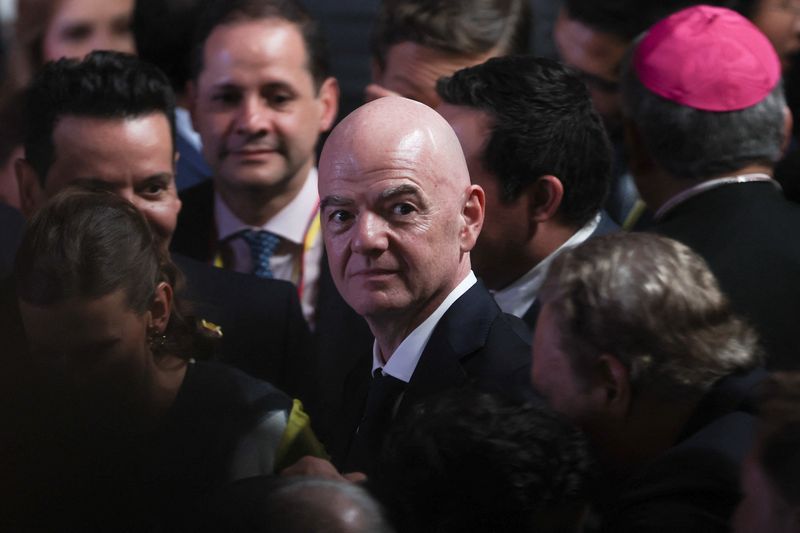
FIFA has issued a forceful statement defending President Gianni Infantino against what it characterizes as a deliberate and sustained campaign to weaken his position, marking an escalation in the institutional tensions engulfing world football's governing body. The announcement on Saturday came as the organisation grapples with the fallout from Infantino's collapsed proposal to raise approximately $4.2 billion through the sale of commercial rights to the World Cup and other major tournaments, a scheme that triggered immediate backlash from multiple quarters within football's establishment.
The proposed commercial deal represented Infantino's most ambitious financial initiative since assuming the presidency, and its failure has exposed significant fractures within FIFA's leadership structure. The initiative drew sharp criticism from UEFA, the European confederation that oversees the continent's football operations, along with numerous national associations and prominent officials within FIFA itself. The intensity of the pushback forced FIFA to convene an emergency leadership meeting in Morocco this week, where the governing body's senior figures publicly reaffirmed their confidence in the president, though the need for such a gathering underscored the severity of the institutional crisis.
While FIFA's statement avoided naming specific critics or detailing which allegations it considered illegitimate, the timing suggests reference to reporting by The Daily Telegraph concerning payments UEFA made to a former employee during Infantino's tenure as the European confederation's general secretary. Infantino has categorically denied these allegations, and FIFA has dismissed them as without foundation. The emergence of such peripheral controversies during a moment of core institutional weakness demonstrates how leadership crises can become vectors for scrutiny of historical decisions and conduct that might otherwise have remained dormant.
The FIFA statement employed particularly strong language, accusing critics of attempting to achieve through "allegation, insinuation or misinformation" what they could not accomplish through the organisation's formal democratic mechanisms. This framing represents FIFA's effort to delegitimize opposition to Infantino by characterizing it as procedurally illegitimate rather than substantively addressing the concerns that motivate it. The statement further declared that FIFA would vigorously contest any reporting it considered inaccurate or misleading, signalling an increasingly confrontational posture toward media scrutiny.
For Malaysian and Southeast Asian observers, this institutional turmoil at FIFA carries significant implications. The association's stability directly affects the governance structures through which regional football federations operate and the resources allocated to continental development programmes. Prolonged instability at FIFA creates uncertainty for strategic planning within regional confederations like the ASEAN Football Federation and individual national associations that depend on FIFA's institutional frameworks for competition scheduling and technical support.
Infantino's bid for a fourth consecutive term at the FIFA Congress scheduled for Morocco in March remains substantially complicated by this crisis, though no clear alternative candidate has yet emerged to challenge him. The absence of a viable challenger paradoxically strengthens his position despite the rhetorical assault his leadership faces, suggesting that discontentment with his direction has not yet crystallized into organized institutional opposition. This dynamic mirrors earlier succession struggles within FIFA, where the absence of coordinated alternatives allowed embattled leaders to survive periods of acute institutional stress.
Support for Infantino remains geographically fragmented but numerically substantial among FIFA's 211 member associations. The Confederation of African Football threw its unanimous backing behind the president on Thursday, reflecting the substantial influence African federations exercise within FIFA's voting structures. South America's CONMEBOL confederation similarly rejected any challenge to Infantino that circumvented formal voting procedures, prioritizing procedural regularity over substantive governance concerns. These regional blocs represent enormous football constituencies and their continued support provides Infantino with a formidable institutional base.
European opposition, however, carries particular symbolic weight given the continent's historical dominance within FIFA and its sophisticated institutional capacity to organize collective action. UEFA's public declaration that it no longer maintains confidence in Infantino represents an unprecedented institutional rupture, signalling that European football's establishment views the current impasse as fundamental rather than procedural. Norwegian Football Federation President Lise Klaveness added to this pressure by explicitly calling for Infantino's resignation, arguing that his capacity to command the institutional trust necessary for FIFA governance has become irreparably compromised.
Yet even within Europe's sphere, fractures appear. Mexico's football federation, despite operating within CONCACAF which had previously called for a "comprehensive reckoning" with Infantino's presidency, announced it would neither recognise nor endorse any challenge to the president conducted outside FIFA's formal institutional framework. This position, emphasizing procedural legitimacy over substantive critique, demonstrates how governance arguments can obscure deeper institutional interests and reveal that regional confederations calculate their strategic positions distinctly from their continental organisations.
The commercial proposal's failure itself warrants closer examination for regional audiences. The $4.2 billion monetization scheme represented an attempt to tap new financial sources precisely at a moment when FIFA faced pressure to distribute greater resources to developing football nations and strengthen investments in emerging markets. The plan's collapse therefore carries implications for the distribution of football development resources, potentially affecting funding flows to Southeast Asian federations that depend on FIFA technical and financial support programmes.
As this institutional struggle unfolds, FIFA's insistence on adhering to formal democratic procedures reflects the organisation's awareness that legitimacy ultimately rests on procedural regularity. However, the contrast between the statement's procedural emphasis and the substantive governance concerns driving Infantino's critics suggests that the current crisis cannot be resolved merely through procedural compliance. The question confronting FIFA's membership remains whether formal democratic processes can adequately address substantive concerns about leadership competence and institutional direction.
The coming months will prove decisive in determining whether Infantino's substantial institutional support bases can translate into sufficient voting strength to secure his renomination at March's Congress, or whether accumulating pressure forces the FIFA leadership to negotiate a graceful transition. For regional stakeholders in Southeast Asia, the outcome carries practical consequences for development funding, competition scheduling, and the stability of the governance frameworks through which national football programmes operate.

