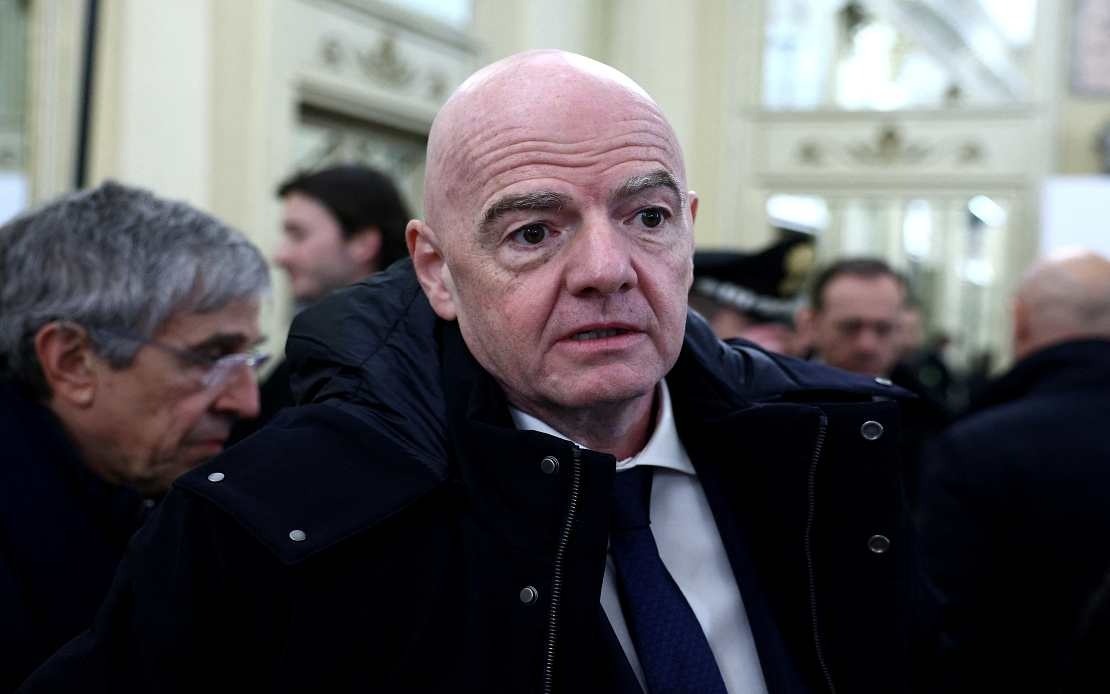
The International Olympic Committee has received a formal complaint against FIFA President Gianni Infantino from human rights advocacy group FairSquare, which contends that the football leader has systematically breached Olympic Charter provisions requiring political impartiality. The complaint, submitted in early July, represents an escalation in efforts to hold the FIFA chief accountable for what critics view as compromised decision-making at the world's governing body for football.
FairSquare's allegations centre on Infantino's conduct towards United States President Donald Trump, with the group asserting that these interactions demonstrate a pattern of political partiality incompatible with Infantino's status as an IOC member—a position he has held since 2020. The complaint identifies five explicit violations of IOC neutrality standards and presents what it characterises as preliminary evidence of two further grave breaches, creating a comprehensive case that extends beyond isolated incidents.
At the heart of the controversy lies the suspension of a one-match ban against a United States footballer by FIFA's disciplinary committee, a decision that enabled the player to participate in a crucial World Cup knockout fixture against Belgium. This intervention occurred following a direct telephone conversation between Trump and Infantino, an interaction that raised immediate questions about the independence of FIFA's supposedly autonomous regulatory machinery. Infantino has publicly maintained that FIFA's disciplinary processes operate with complete autonomy, yet the timing and circumstances surrounding the ban's suspension cast doubt on these assurances.
The procedural pathway of this complaint reveals mounting international pressure on FIFA's governance structure. FairSquare initially filed a parallel grievance with FIFA's own ethics committee in December, seeking investigation through the organisation's internal mechanisms. That step proved insufficient, prompting the escalation to Olympic authorities. Simultaneously, Norway's football federation formally wrote to FIFA's ethics committee, requesting that body examine FairSquare's allegations with appropriate rigour and transparency.
European parliamentary scrutiny has added another dimension to the accountability effort. Fifty members of the European Parliament jointly addressed correspondence to FIFA's ethics committee on June 29, explicitly urging the committee to take FairSquare's complaint seriously and implement thorough investigation protocols. This intervention signals that concerns about FIFA's governance and the apparent politicisation of its decision-making have transcended sporting circles to reach the highest political institutions of the European Union.
The Infantino situation illustrates broader anxieties about institutional independence within global sports governance. When a football federation president maintains regular contact with sitting heads of state, and when disciplinary decisions appear to coincide conveniently with such interactions, the appearance of impropriety becomes difficult to dispel through mere assertion of procedural independence. For regional sporting bodies and national associations across Southeast Asia and beyond, the implications are significant—if the FIFA president can operate without meaningful accountability, questions naturally arise about whether other international sports leaders face genuine oversight.
Infantino's position as IOC member theoretically subjects him to Olympic Charter obligations regarding political neutrality. However, the enforcement mechanisms for such standards have historically proven weak. The IOC's ability to investigate and discipline even its own members faces structural limitations, and the political sensitivity of sanctioning a major sports administrator adds further complexity. Previous instances of IOC disciplinary action reveal an institution often reluctant to take aggressive stances against powerful figures, particularly those heading major sporting confederations.
The case also exposes fundamental questions about how global sports organisations should manage relationships with political authority. In an era when sports increasingly intersect with geopolitical considerations, maintaining genuine neutrality has become extraordinarily difficult. Yet abandoning the principle entirely would undermine the legitimacy that international sports bodies depend upon. The challenge for FIFA and the IOC is calibrating appropriate engagement with political institutions while ensuring that sporting decisions remain genuinely independent from political influence.
For Malaysian and Southeast Asian football observers, this accountability effort carries particular resonance. The region's football federations operate within a global system where decisions made in FIFA headquarters directly affect their competitions, player eligibility, and tournament participation. If that system's highest officials operate without genuine accountability for political interference, smaller nations' interests may suffer disproportionately in disputes where political considerations might factor into resolution.
The investigation now rests with IOC mechanisms, which must determine whether Infantino's conduct genuinely violates Olympic Charter provisions or whether his actions, while appearing improper, fall within permissible parameters. The IOC faces a test of its own institutional credibility. Should it find insufficient grounds for action, critics will argue that even the world's Olympic body lacks teeth when confronting powerful sports leaders. Should it pursue disciplinary measures, FIFA may face an unprecedented institutional crisis.
FairSquare's persistence in pursuing this complaint through multiple channels demonstrates that external pressure can sustain accountability efforts despite organisational resistance. The human rights group's decision to escalate from FIFA's internal ethics process to Olympic authorities reflects recognition that FIFA alone may prove unwilling to police its president rigorously. Whether the IOC proves a more effective forum for accountability remains to be determined, but the complaint's international backing suggests that standards for sports governance transparency and political independence are increasingly becoming non-negotiable expectations.

