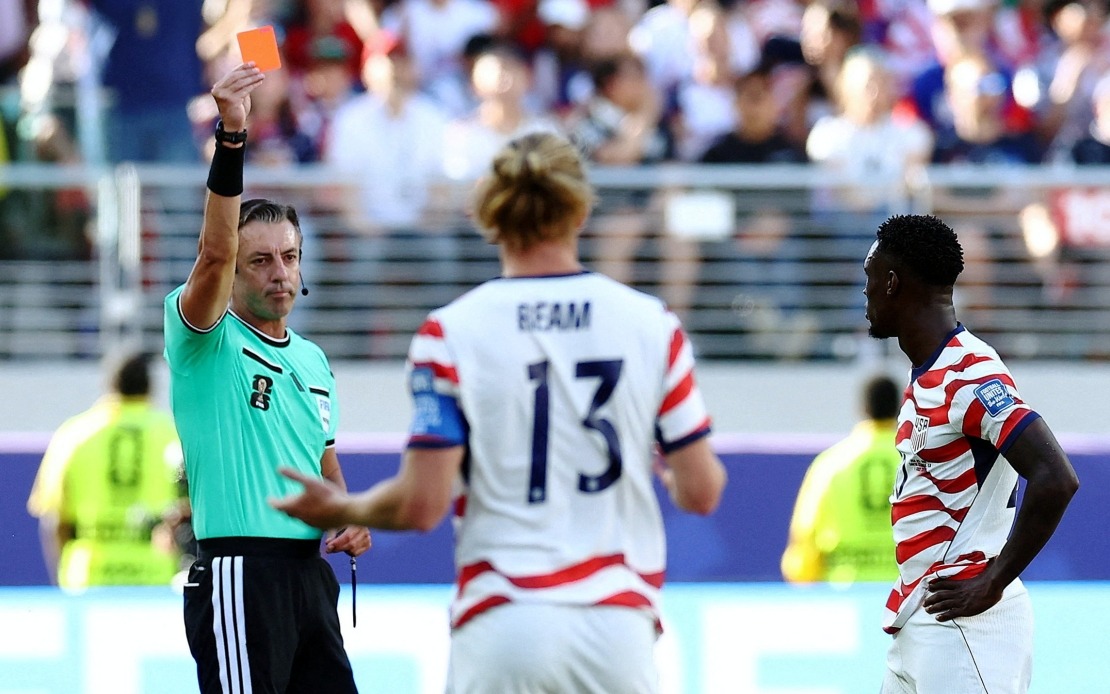
The international football governing body has thrown its full backing behind Brazilian referee Raphael Claus, positioning him as one of the tournament's most capable match officials despite incoming pressure from US President Donald Trump, who questioned the integrity of a significant disciplinary decision. Claus found himself at the center of diplomatic tensions after sending off US striker Folarin Balogun during the round-of-32 encounter against Bosnia and Herzegovina, a call that prompted the American leader to personally intervene and request a review of the incident.
The sequence of events that triggered Trump's complaint unfolded across consecutive days of competition. Balogun initially received a red card following a VAR review in the Bosnia and Herzegovina clash, yet the sanction was controversially overturned on Sunday, permitting the player to feature in the subsequent knockout round against Belgium on Monday in Seattle. The Americans fell to a decisive 4-1 defeat in that subsequent fixture, raising questions about whether tactical adjustments resulting from the suspension's reversal might have influenced the outcome.
FIFA's formal response positioned Claus squarely within its elite cadre of match officials, describing him as "one of the world's leading professional referees and a valued member of Team One" at the current tournament. The organisation's statement emphasised the Brazilian's consistent demonstration of professional standards and integrity throughout his career, framing his selection as deliberate rather than routine assignment. This characterisation reflects FIFA's broader messaging that its refereeing selections undergo rigorous evaluation against criteria including technical competency, consistency, and sustained performance benchmarks.
Pierluigi Collina, who oversees FIFA's referees program, offered personalised reassurance regarding Claus's standing. Collina noted that Claus was appearing at his second FIFA World Cup, having previously been deployed at the Qatar tournament in 2022, thereby positioning him as an established presence within international football's highest-profile stage. The referees chief explicitly stated that FIFA maintains "full confidence" in Claus and emphasised his reputation as "highly respected" within professional football circles, language designed to reinforce institutional backing for an official facing political scrutiny.
The unprecedented nature of Trump's direct involvement adds layers of complexity to refereeing decisions that would ordinarily remain within sport's administrative apparatus. By requesting a personal review of the Balogun incident, the American president elevated what might otherwise have been routine disciplinary discussion into high-level diplomatic territory, signalling that decisions affecting national sporting interests now warrant executive-level attention. FIFA president Gianni Infantino, who fielded Trump's concerns directly, subsequently issued Instagram messaging that avoided direct reference to Claus or the specific controversy, instead offering sweeping tributes to the referee corps.
Infantino's public statement emphasised that match officials were "selected through a rigorous process which considered their skills, consistency, and quality over a sustained period," effectively defending the appointment protocols without acknowledging the specific criticism. The FIFA president also reinforced that referees deserve respect and that their role remains fundamental to football's governance. This measured response appears calibrated to acknowledge Trump's intervention while simultaneously resisting pressure that might compromise institutional independence.
Claus's potential trajectory within the tournament remains elevated despite the controversy. Speculation suggests the Brazilian official could feature prominently in future knockout rounds, potentially even adjudicating the final match. This positioning carries significance given that Brazil itself has already exited the competition at the round-of-16 stage, meaning Claus faces no conflict-of-interest complications that might arise had his national team remained in contention. His continued deployment would signal FIFA's confidence and its unwillingness to allow external political pressure to dictate referee selection decisions.
The incident illuminates broader tensions between political leadership and sporting autonomy. Trump's intervention represents a notable instance of national political figures directly challenging referees' decisions at the sport's most prominent quadrennial tournament. While players and coaches frequently contest officiating through established appeals procedures, presidential-level involvement crosses thresholds that challenge international sports governance structures. FIFA's defensive posture regarding Claus suggests the organization intends to maintain institutional independence, yet the very fact that such public positioning became necessary demonstrates the pressure these situations create.
For Malaysian and regional observers, this episode carries implications for how international sporting governance handles political pressure. As Southeast Asian nations increasingly participate in global sporting competitions and international football tournaments attract attention from political leadership, the interplay between governance independence and political expectations becomes relevant. The Claus situation demonstrates both FIFA's capacity to defend its officials and the vulnerabilities that arise when prominent political figures openly question disciplinary decisions.
The controversy also reflects broader debates about VAR implementation and consistency in applying red card offences across different matches and tournaments. Balogun's initial dismissal followed by its reversal prompted questions about decision-making protocols themselves, beyond merely Claus's judgment. FIFA's response conflated support for the referee with confidence in the systems within which he operates, suggesting that the organization interprets political criticism as potentially challenging not just individual officials but the broader infrastructure supporting modern refereeing.
Moving forward, the referee assignment decisions made by FIFA regarding Claus's future deployment will carry symbolic weight extending beyond technical football considerations. Retaining him for high-profile matches would reinforce organizational independence, while reducing his assignments might suggest political pressure influenced sporting decisions. The balance FIFA strikes in addressing this situation will likely establish precedent for how international sports bodies respond to similar interventions from political actors.

