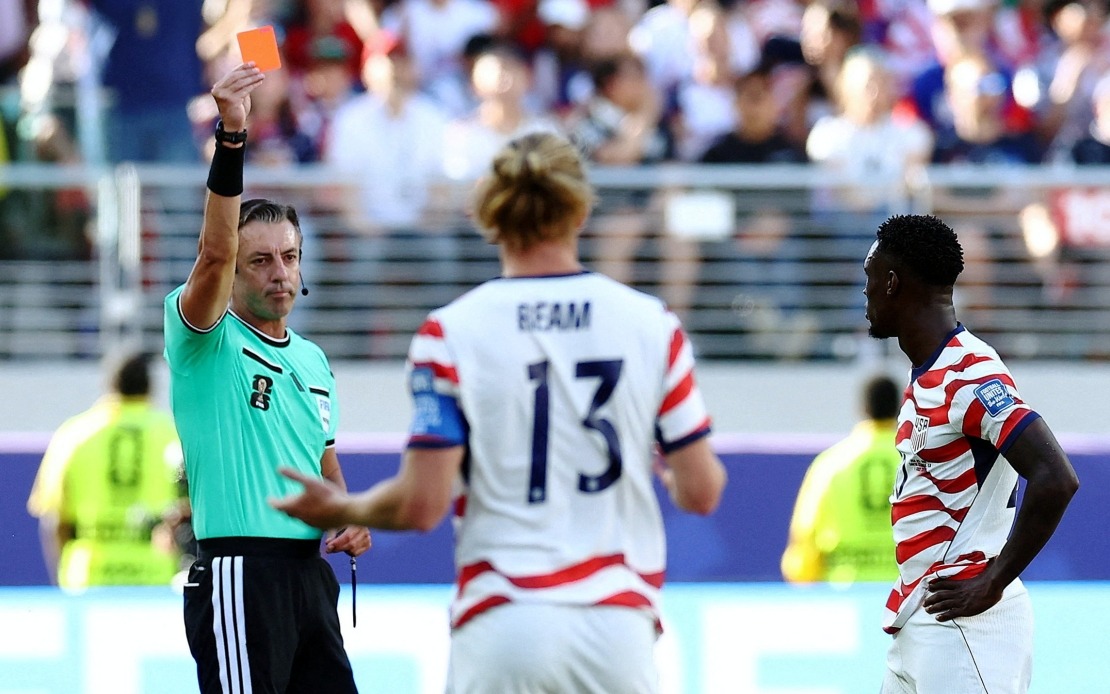
FIFA's decision to permit American striker Folarin Balogun to play in Monday's World Cup round-of-16 encounter against Belgium has triggered significant controversy, with the Belgian Football Association vehemently protesting what it views as an inconsistent application of tournament disciplinary rules. The world football governing body announced on Sunday that it would suspend enforcement of a one-match ban Balogun received for his red card against Bosnia and Herzegovina, effectively clearing him to participate in the high-stakes Seattle clash where a quarterfinal berth awaits the victor.
Balogun's dismissal came during the United States' 2-0 Group stage victory on July 1, when the American forward stamped on Bosnian defender Tarik Muharemovic. The FIFA Disciplinary Committee determined that this infringement violated Articles 14 and 66 of the FIFA Disciplinary Code, warranting a mandatory one-match suspension. However, the committee invoked Article 27 of the same code, which grants discretionary authority to suspend the enforcement of a sanction, thereby nullifying the suspension's immediate effect and making Balogun available for the knockout phase.
The timing of this decision carries considerable weight given Balogun's importance to the American campaign. The striker has emerged as the tournament's leading scorer for the United States with three goals, making his participation a substantial competitive advantage heading into the must-win fixture against Belgium. His availability transforms the tactical landscape for American manager Gregg Berhalter, who can rely on his primary attacking threat against a formidable Belgian defensive unit.
Belgium's official response, issued through the Royal Belgian Football Association (RBFA), conveyed unmistakable frustration with FIFA's ruling. The federation expressed astonishment at the decision and signalled its intention to exhaust all available avenues to contest what it characterises as an unjust deviation from established precedent. This strong-worded protest reflects genuine concern about competitive integrity and the apparent selective enforcement of disciplinary protocols that should govern tournament play uniformly across all participants and situations.
The Belgian argument rests on compelling technical grounds rooted in the tournament regulations themselves. The RBFA points to Article 66.4 of the FIFA Disciplinary Code, which contains explicit language establishing automatic suspension for any player receiving a direct red card. This automatic suspension mechanism has functioned consistently throughout the tournament for every other red card incident, creating a clear precedent that Balogun's situation should follow. The Belgian federation argues that FIFA's invocation of Article 27 essentially overrides this automatic provision, establishing a two-tiered disciplinary system based on undefined discretionary criteria.
Further bolstering Belgium's protest, the RBFA cites Article 10.5 of the FIFA World Cup 2026 Competition Regulations, which explicitly mandates automatic suspension for players receiving either direct red cards or second cautions. The federation emphasises that this provision uses unambiguous language requiring suspension from the subsequent match, with additional sanctions imposed at FIFA's discretion. This regulatory language appears designed to prevent exactly the scenario that has now unfolded, leaving the Belgian football authorities questioning how FIFA's application of Article 27 can supersede these mandatory suspension requirements.
The RBFA further strengthens its position by noting that FIFA itself reiterated the automatic suspension rule before the tournament commenced. Circular No. 16, distributed to all participating member associations in May, explicitly addressed automatic suspensions, and tournament officials reaffirmed this guidance during match coordination meetings and official workshops conducted in the days preceding each fixture. This institutional communication created a reasonable expectation among all federations that suspension rules would be consistently applied, making FIFA's departure from its own established messaging particularly problematic.
The disciplinary framework FIFA invoked permits Balogun to escape immediate sanction under a probationary arrangement lasting one year. Should the American striker commit another infringement of comparable severity during this twelve-month period, the original suspension would automatically activate without additional process. This conditional suspension approach, while allowing continued play, essentially places the pending sanction in abeyance rather than eliminating it entirely. However, Belgium's objection focuses not on the existence of suspended sanctions but rather on FIFA's apparent abandonment of automatic enforcement mechanisms that should function independent of discretionary suspension provisions.
For Southeast Asian football observers and Malaysian readers particularly interested in World Cup governance, this controversy illuminates broader questions about how international sporting bodies balance consistency with flexibility in applying disciplinary codes. The incident demonstrates that even FIFA's rulebook contains competing interpretations, and that significant matches can hinge on how officials reconcile overlapping regulatory provisions. The decision sets a potential precedent affecting future tournament administration and may influence how Malaysia, as a participating nation in Asian qualifying, views FIFA's commitment to uniform application of disciplinary standards.
The strategic implications extend beyond this single match. If the United States prevails against Belgium, Balogun would advance to the quarterfinals with his suspension still technically pending activation, potentially affecting subsequent matches depending on his conduct. Conversely, if Balogun's participation proves decisive in an American victory, the Belgian Federation's protest will carry additional weight, having accurately predicted that his availability would substantially influence the outcome. This controversial decision may ultimately shape how FIFA approaches discretionary suspensions in future tournaments, particularly regarding high-profile knockout matches where perceived bias becomes magnified by the stakes involved.
The United States' pursuit of its first quarterfinal appearance since 2002 now benefits from Balogun's availability, but the path forward remains clouded by the legitimacy questions Belgium has raised. FIFA's decision prioritised competitive equilibrium in allowing its star forward to participate, yet in doing so created the impression of preferential treatment that undermines the regulatory predictability essential to fair tournament competition. The Belgian protest signals that this matter may extend beyond Monday's match, potentially reaching FIFA's appeal procedures and influencing future discussions about automatic versus discretionary suspension mechanisms in world football governance.

