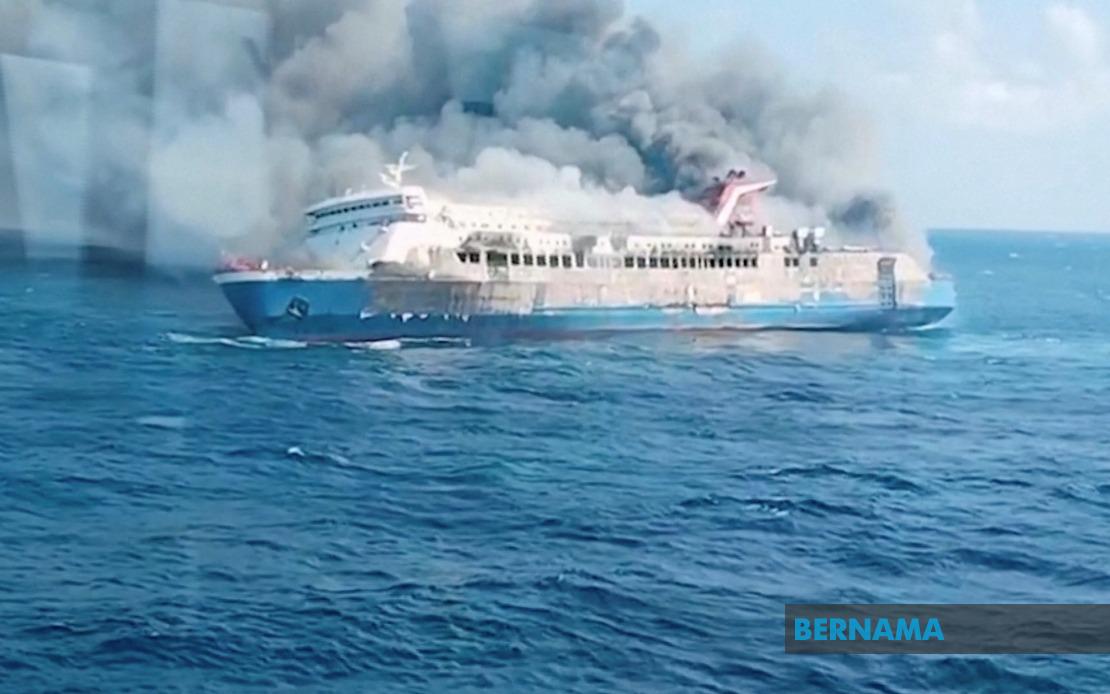
A devastating fire engulfed a passenger ferry in Indonesian waters on Thursday morning, claiming at least five lives and leaving 41 others unaccounted for in what authorities describe as an ongoing search and rescue operation. The KMP Mutiara Santosa 2, carrying 232 passengers and 39 crew members, erupted in flames while transiting between Surabaya and Makassar, triggering a major coordinated response involving multiple government agencies and maritime assets across the region.
The Surabaya Search and Rescue Office received the distress call at 8:24 am local time, immediately dispatching rescue vessels and personnel to the waters off northern Sumenep, Madura. According to Nanang Sigit, chief of the Surabaya Search and Rescue Office, the vessel's superstructure sustained catastrophic fire damage, with most of the ferry consumed by flames within hours of ignition. Passengers initially congregated on the bridge and forward sections of the ship, positioning themselves to await rescue assistance as the fire spread through the vessel's compartments.
By 4 pm local time Thursday, rescue teams had successfully evacuated 225 people from the stricken ferry, representing the majority of those aboard. However, the gap between the vessel's total complement of 271 personnel and those accounted for has created an urgent search priority, with authorities maintaining that 41 individuals remain missing and unlocated. The discrepancy suggests that some passengers may have entered the water during evacuation, whilst others could still be unaccounted for in unconfisced areas of the partially submerged hull.
Several survivors reached safety by jumping or being forced into the sea as flames advanced through the vessel's interior spaces. Nearby fishing boats and commercial vessels operating in the waters off Madura responded to the emergency and pulled numerous individuals from the water, providing critical assistance before official rescue coordination could be fully established. These private maritime actors likely prevented additional fatalities through their swift intervention, though comprehensive casualty figures remain uncertain pending completion of the full rescue operation.
The fire's origin remains under active investigation by Indonesian maritime authorities, who have not yet determined whether the incident resulted from mechanical failure, electrical malfunction, fuel system rupture, or other causes. Initial assessments suggest the rapid spread and intensity of the blaze across the vessel indicate either accelerated combustion conditions or structural vulnerabilities that allowed flame propagation. The KMP Mutiara Santosa 2 had been operating on the Surabaya-Makassar route, one of the busier inter-island ferry corridors connecting major eastern Indonesian cities, suggesting the vessel had accumulated significant operational history prior to Thursday's incident.
The disaster carries implications for maritime safety across Southeast Asia, where inter-island ferry services remain critical transportation infrastructure for millions of passengers annually. Indonesia operates one of the world's busiest and most geographically dispersed ferry networks, with vessels navigating challenging waters across the archipelago. Incidents of this magnitude prompt immediate review of fire suppression systems, crew training protocols, passenger evacuation procedures, and vessel maintenance standards across fleets operating regional routes.
For Malaysian readers and businesses with maritime interests in the region, the incident underscores the vulnerability of aging or inadequately maintained vessels still operating on high-capacity commercial routes. The Surabaya-Makassar corridor accommodates substantial passenger volumes and cargo traffic, suggesting that any temporary suspension of ferry services pending investigation could disrupt supply chains and travel patterns affecting broader Southeast Asian logistics. Malaysian shipping companies and trading enterprises with dependencies on eastern Indonesian maritime links may require contingency planning for route alterations or service delays.
The rescue operation's coordination reflects established protocols within Indonesia's maritime safety framework, though the ongoing search for 41 missing persons indicates that challenges remain in achieving complete casualty accounting. Rescue teams continue deploying assets across the incident zone, working against diminishing windows for locating survivors in open water. Weather conditions in the Madura region during August, typically characterized by choppy seas and limited visibility, complicate search operations and reduce prospects for locating survivors beyond the immediate rescue window.
Indonesian maritime authorities have indicated that comprehensive investigation into the KMP Mutiara Santosa 2 incident will examine vessel maintenance records, crew competency certifications, fire system functionality, and adherence to safety protocols during evacuation. The findings will likely inform regulatory adjustments across Indonesia's ferry fleet, potentially affecting operational standards, inspection frequencies, and crew training requirements. Such regulatory evolution typically ripples across the broader Southeast Asian maritime sector, as many nations adopt harmonized standards and information-sharing mechanisms.
For families of the missing and deceased, the disaster represents a profound tragedy compounded by the uncertainties inherent in large-scale maritime incidents. Survivors requiring medical attention for smoke inhalation, burns, and trauma-related injuries have been receiving care through Indonesian health facilities, though no detailed casualty or injury breakdown has been released. The incident serves as a stark reminder of the persistent risks associated with inter-island maritime transport in developing maritime jurisdictions where enforcement of safety standards and vessel maintenance occasionally lags regulatory requirements.

