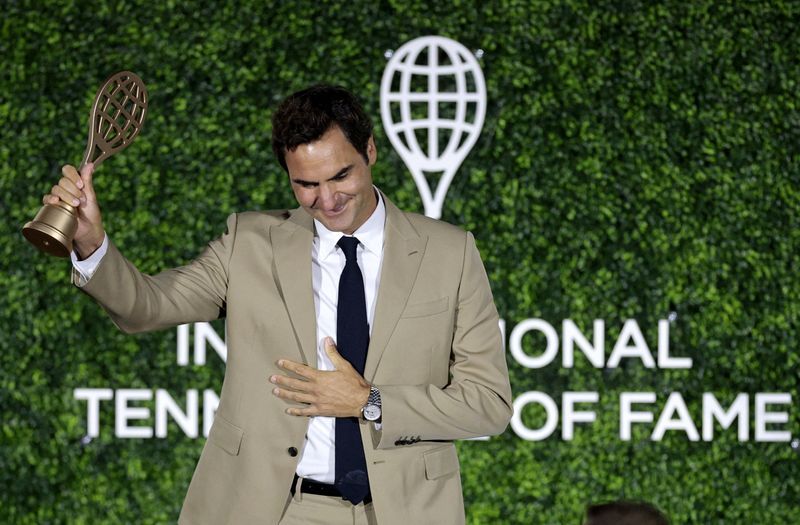
Roger Federer, the Swiss tennis virtuoso who redefined the sport with his grace and innovation, was formally inducted into the International Tennis Hall of Fame in Newport, Rhode Island, on Saturday in a ceremony marked by deep emotion and profound gratitude. The 20-time Grand Slam champion, now 45, took to the stage alongside broadcaster and journalist Mary Carillo, his voice wavering at times as he recounted a career that transcended mere sporting achievement to become a cultural phenomenon that touched millions across the globe.
In his acceptance speech, Federer articulated a philosophy that separated him from the competitive hunger that typically drives elite athletes. He emphasized that his pursuit was never driven by the allure of fame or record-breaking achievements, but rather by a fundamental desire to spend his professional existence engaged in something he genuinely loved, surrounded by people who shared that same passion. This distinction proved crucial to understanding Federer's legacy—his approach to the game reflected a maturity and perspective that would influence how subsequent generations of players viewed their own careers and responsibilities to the sport.
The statistical dimensions of Federer's career remain staggering even in retrospective analysis. His haul of eight Wimbledon titles stands as a men's record that underscores his particular mastery of grass court tennis, a surface that became synonymous with his name throughout his playing days. Beyond the All England Club, he claimed six Australian Open championships, five U.S. Open titles, and a single French Open victory, accumulating 103 ATP Tour titles overall while spending an extraordinary 310 weeks atop the world rankings. These numbers represent not merely success but a level of sustained excellence across different conditions, opponents, and eras that few athletes in any sport have achieved.
What distinguished Federer's approach to professional tennis was his commitment to playing with distinctive style and personality. His trademark headband became iconic—he playfully referenced wearing more than 5,000 throughout his career—and he maintained idiosyncratic habits such as wearing two pairs of socks that became part of his public persona. More significantly, however, Federer was celebrated for his innovative shot-making and tactical creativity. His serve-and-volley skills, his transition game, his willingness to play at the baseline or beyond it according to strategic necessity, and his famous SABR (Sneak Attack by Roger) return demonstrated an athlete who viewed professional tennis not as a sport to be dominated through power alone but as an art form to be continuously reimagined and refined.
Yet Federer's reflection during his induction speech revealed an understanding that his greatest contributions extended far beyond the court itself. He spoke movingly of his family, particularly his wife Mirka, whose support and companionship throughout his career proved foundational to his success. His coaches, medical team, and broader support network received particular mention as Federer grew visibly emotional acknowledging their sacrifices and dedication. This dimension of his remarks resonated powerfully because it reflected a recognition that professional sporting achievement represents a collective endeavour, not the product of individual genius alone—a perspective that carries implications for how young athletes across Southeast Asia and beyond should approach their own aspirations.
Federer's commentary on his journey carried particular poignancy as he recalled his connection to his Swiss homeland, specifically Basel, where he first fell in love with tennis as a 13-year-old ball boy. This origin story—modest, grounded, and rooted in genuine fascination rather than precocious talent development—provided a human counterpoint to his later dominance. His statement that Switzerland would accompany him into the Hall of Fame reflected a nationalist pride that remained central to his identity despite becoming a global sporting icon, a tension that many athletes from smaller nations experience as their influence expands internationally.
During his address, Federer emphasized that his induction did not represent a conclusion but rather a transition. His declaration that he was "still writing my love letter to tennis" conveyed the idea that retirement from professional competition need not entail a departure from the sport itself. For Malaysian and Southeast Asian audiences, this message carries particular relevance, as many countries in the region continue developing their tennis infrastructure and cultivating new generations of players. Federer's post-playing involvement in tennis—whether through commentary, mentorship, or sporting initiatives—demonstrates how legendary athletes can maintain meaningful engagement with their discipline beyond their competitive years.
Federer's observations about the future trajectory of professional tennis reflected an elder statesman's perspective on how the sport must evolve. He expressed hope that as the game becomes increasingly fast-paced and global in scope, it would retain what he termed its "amateur spirit" and the camaraderie among competitors. This appeal to preserve certain values even as the sport modernizes addresses a genuine tension in contemporary professional athletics, where commercialization and professionalization sometimes threaten the community and mutual respect that initially attracted players to competition. For tennis development in the region, where grassroots participation remains essential to producing world-class talent, Federer's vision of preserving genuine love for the game alongside competitive excellence offers important guidance.
The Swiss legend's exhortation to current and future players emphasized innovation and authenticity as essential qualities for tennis's continued growth. He encouraged players to remain young at heart, to stay true to themselves, and crucially, to continue pushing the sport's boundaries through novel approaches and creative risk-taking. This philosophy directly challenged the tendency toward homogenization in modern professional tennis, where coaching methodologies and training regimens have become increasingly standardized globally. Federer's advocacy for individualism and experimentation provides intellectual support for players who might otherwise feel pressured to conform to established templates of how elite tennis should be played.
Federer also reflected on his privilege in competing across multiple generations of exceptional players, from Andre Agassi and Lleyton Hewitt through his great rivals Rafael Nadal and Novak Djokovic. These rivalries and competitive encounters shaped not only his legacy but also the competitive landscape that inspired younger players worldwide to pursue tennis excellence. For regional players aspiring to international prominence, Federer's example of competing respectfully against rivals while maintaining personal integrity provides a model of how greatness can be achieved without sacrificing character or sportsmanship.
The inductee's emotional state throughout the ceremony underscored the genuine significance he attached to this honour. Unlike some athletes who treat Hall of Fame inductions as ceremonial formalities, Federer's evident gratitude and reflection indicated his understanding of the symbolic importance of such recognition—not for personal validation but as recognition of tennis's central role in his life and identity. His tears were not those of someone bidding farewell to a sport but rather of someone acknowledging the profound ways tennis had shaped his existence, his relationships, and his values.
As Federer concluded his remarks by insisting this was "not a goodbye," he articulated a vision of post-playing life that many athletes struggle to navigate. Rather than viewing retirement as a terminus, he framed it as a transformation in how his relationship with tennis would manifest. This perspective offers valuable guidance for Southeast Asian athletes contemplating their own eventual transitions from competitive play, suggesting that meaningful engagement with sports can continue in different forms throughout one's lifetime. His induction thus represented not merely the recognition of a legendary player but the celebration of a man whose commitment to his sport transcends the narrow confines of competitive ranking and tournament victory.

